For millions of Australians, Holden was never just a car company.
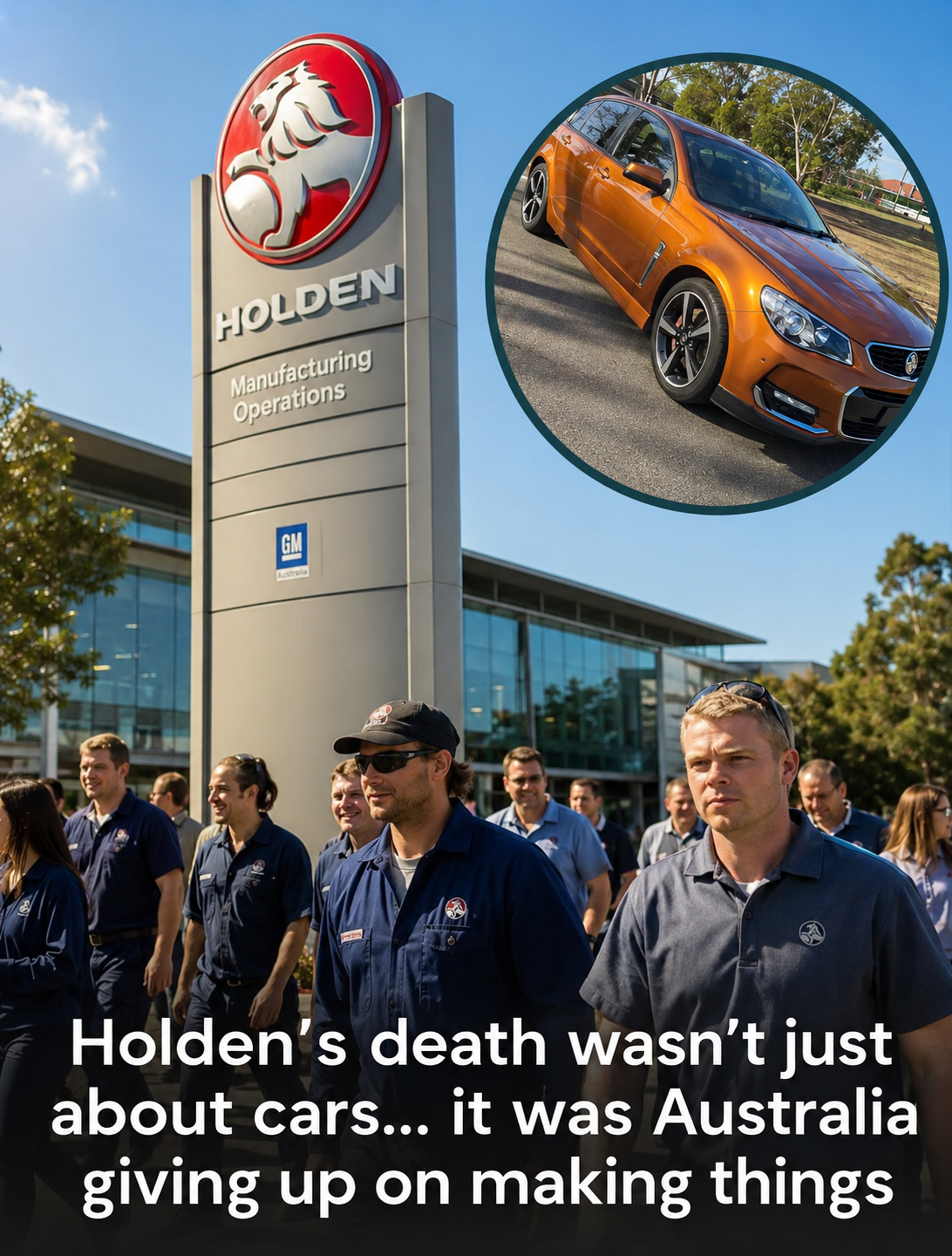
It was the Commodore parked in the driveway.
It was the Kingswood that seemed to appear in every Australian family story.
It was the ute on construction sites, the Monaro sitting in garages across the country and the badge that became part of Australia’s identity for generations.
That is why the closure of Holden still hits a nerve years after the final Australian-made vehicle rolled off the production line.
For many people, the sadness was never really about a car brand.
It was about what the end of Holden appeared to represent.
The final Holden rolled out of the Elizabeth plant in South Australia in October 2017, bringing Australian vehicle manufacturing to an end after decades of local production. The shutdown followed earlier announcements that Holden would cease local manufacturing operations, with thousands of direct jobs affected and many more connected jobs placed at risk across the supply chain.
For workers, the closure was not an abstract economic debate.
It was a pay cheque disappearing.
It was a career ending.
It was uncertainty arriving at the front door.
Entire communities had been built around automotive manufacturing.
Families worked in the factories.
Friends worked in component plants.
Local businesses relied on the spending power generated by those jobs.
When the industry disappeared, the shockwaves spread far beyond the factory gates.
The automotive shutdown ultimately became part of a broader collapse in local vehicle production as Holden, Ford and Toyota all exited Australian manufacturing over a four-year period. Researchers examining the closures found significant employment and community impacts in regions that had depended heavily on automotive jobs.
For many Australians, that period marked a turning point.
The country had once designed, engineered and built complex products that competed on the global stage.
Then, seemingly within a few years, an entire industry vanished.
The question people still ask is simple.
What replaced it?
That question has become even more relevant as cost-of-living pressures continue to dominate household budgets.
Australians are paying more for housing.
More for groceries.
More for electricity.
More for insurance.
Against that backdrop, many people have started wondering whether the country became too dependent on digging resources out of the ground while allowing manufacturing capacity to shrink.
Supporters of local manufacturing argue that strong industrial sectors create stable middle-class jobs.
They provide career pathways that do not require university degrees.
They support apprenticeships.
And they create economic activity that flows into surrounding communities.
Those arguments have gained renewed attention as Australia confronts productivity challenges and growing concerns about long-term economic resilience.
Recent industry data has highlighted broader struggles across Australian manufacturing, with thousands of manufacturers closing in recent years amid rising costs, skills shortages and increasing international competition.
That has led some Australians to view Holden not simply as a memory but as a warning.
If a country can lose car manufacturing, what other industries might follow?
Others take a different view.
They argue that global competition made local car production increasingly difficult.
Australia’s relatively small market, high labour costs and changing consumer preferences created enormous challenges for domestic manufacturers.
From this perspective, Holden’s closure reflected economic realities rather than political failure.
Yet even many people who accept those arguments still feel a sense of loss.
Because economics and identity are not always the same thing.
Something can make financial sense on paper while still leaving a cultural void behind.
That is why Holden remains such an emotional subject.
It represents an era when Australians believed they could build almost anything themselves.
Cars.
Engines.
Components.
Entire supply chains.
The closure forced a national conversation about what kind of economy Australia wanted to become.
That conversation continues today.
Governments regularly speak about advanced manufacturing, sovereign capability and rebuilding industrial strength.
Business groups call for policies that encourage investment and innovation.
Workers want secure jobs that provide long-term stability.
Young Australians want opportunities that allow them to build successful careers without leaving their communities.
All of those goals connect back to the same fundamental issue.
What should Australia make?
The answer may not involve building another Commodore.
The automotive world has changed dramatically since Holden’s peak.
Electric vehicles, batteries, advanced technology and specialised manufacturing are shaping the future.
But the underlying question remains remarkably similar.
Does Australia still believe it should manufacture things at all?
That is why Holden’s story continues to resonate.
For some, it is a story about nostalgia.
For others, it is a story about missed opportunities.
For many, it is a reminder of communities transformed by industrial decline.
And for a growing number of Australians, it has become a symbol of a much larger debate about jobs, self-reliance and the nation’s economic future.
Years after the last Holden left the production line, the cars are gone.
The factories are silent.
But the questions raised by their disappearance are still very much alive.






