Australia’s political debate over immigration, multiculturalism and social cohesion intensified on Saturday after Home Affairs Minister Tony Burke delivered a forceful rebuke of One Nation leader Pauline Hanson for comments she made during a podcast appearance with British far-right activist Tommy Robinson.
The controversy erupted as the Albanese Government announced its formal response to a landmark report into Islamophobia, placing renewed attention on Australia’s commitment to multiculturalism at a time of heightened community tensions.
Speaking at a Canberra press conference, Mr Burke criticised Senator Hanson after she appeared to suggest that Australia’s contemporary immigration challenges began when the White Australia policy was dismantled more than five decades ago.
“I never thought when I entered parliament that in my political lifetime anyone who had been elected would be calling for White Australia,” Mr Burke said.
“I thought we were in a country where everybody just accepted we had moved on and we were better because we had moved on.”
He continued by arguing that patriotism should embrace the nation Australia has become rather than an exclusionary vision based on race.
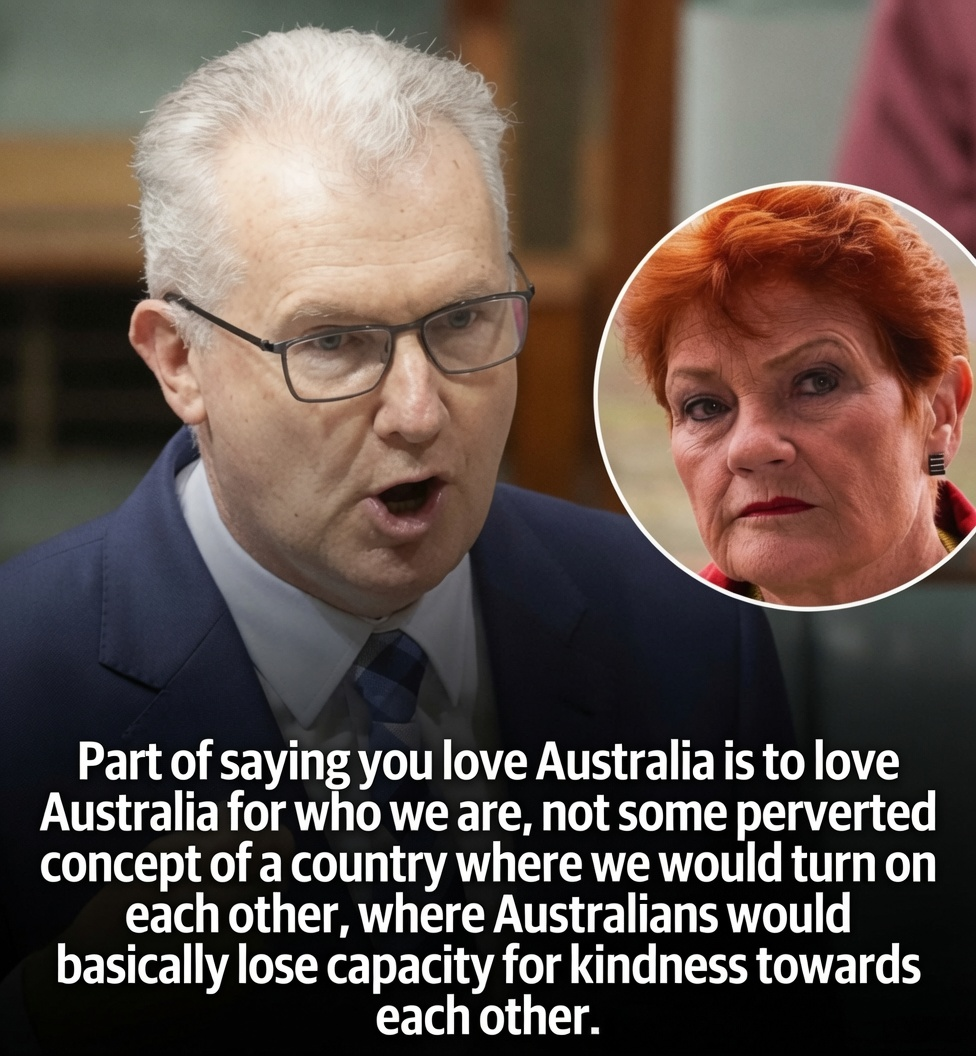
“Part of saying you love Australia is to love Australia for who we are, not some perverted concept of a country where we would turn on each other, where Australians would basically lose capacity for kindness towards each other.”
Mr Burke finished his remarks with a musical analogy, saying Australia’s diversity was one of its defining strengths.
“You will never find an orchestra where every instrument is the same.”
The minister’s comments followed Senator Hanson’s appearance on a podcast hosted by Tommy Robinson, whose real name is Stephen Yaxley-Lennon. Robinson is a British far-right activist whose criminal convictions and political activities have made him one of the United Kingdom’s most controversial public figures.
During the interview, Robinson questioned Senator Hanson about immigration in Australia and referred to what he described as “Pakistanis, Somalis” and “violent Africans”, asking how the country had developed what he characterised as migration-related problems.
In response, Senator Hanson said Australia’s migration issues began after governments abandoned the White Australia policy.
“They opened up and got rid of the White Australia policy then they started bringing in the different migrants,” she said.
She contrasted post-Second World War European migration with more recent migration, arguing that earlier arrivals from countries including Italy, Germany and Poland had integrated successfully despite language barriers.
“A lot of them couldn’t speak English, but they learnt to speak English. They had to work. These people who came in and really assimilated.”
Senator Hanson also claimed that some migrants were coming to Australia “purely for the welfare system” and suggested Muslim families were encouraged to have larger numbers of children because “Allah will provide”, before adding: “Well, the Allah that is providing is the taxpayer.”
The comments immediately attracted criticism from across the political spectrum and came as the Albanese Government released its long-awaited response to recommendations prepared by Australia’s Special Envoy to Combat Islamophobia, Aftab Malik.
The report examined the experiences of Muslim Australians and documented concerns about increasing levels of anti-Muslim prejudice, discrimination and abuse.
At the same press conference, Prime Minister Anthony Albanese said Islamophobia had no place in modern Australia.
“Hate directed at one community hurts us all,” the Prime Minister said.
“Diversity is one of Australia’s great strengths and we won’t as a nation let hate divide us.”
He added that every Australian should be able to feel safe regardless of their background.
“Every Australian has the right to feel safe, valued and respected for the contributions they make to our great nation.”
Mr Albanese did not directly debate Senator Hanson’s policy positions but argued that rhetoric capable of dividing Australians undermined social cohesion at a time when governments were attempting to strengthen community harmony.
The White Australia policy remains one of the most significant chapters in Australia’s immigration history.
Rather than a single law, the term refers to a series of legislative and administrative measures introduced after Federation in 1901 that restricted non-European migration while favouring migrants of predominantly British and European backgrounds.
The policy shaped Australian immigration for decades before successive governments gradually dismantled its provisions. By 1973, the Whitlam Government had formally ended race-based immigration selection, marking a major turning point in Australia’s transition towards a multicultural immigration system.
Since then, Australian governments led by both Labor and Coalition parties have broadly supported multiculturalism as a central element of national identity, even while often debating migration numbers, border security and integration policies.
Australia today welcomes migrants through skilled, family, humanitarian and temporary visa programs, with governments regularly adjusting intake levels in response to economic conditions, labour shortages and housing pressures.
Those broader debates have intensified in recent years amid concerns about housing affordability, infrastructure demand and cost-of-living pressures.
However, mainstream political leaders have generally distinguished between debates over migration levels and race-based immigration policies.
Mr Burke’s criticism reflected that distinction, arguing that Australians could discuss immigration policy without revisiting concepts associated with racial exclusion.
The government’s response to the Islamophobia report also outlined measures intended to strengthen community cohesion and improve protections for Muslim Australians.
The response accepted many of the recommendations advanced by Special Envoy Aftab Malik, including initiatives designed to improve reporting of anti-Muslim incidents, strengthen cooperation with affected communities and reinforce public education against religious hatred.
Mr Malik said many Muslim Australians had waited a long time for a coordinated national response.
“This is just the start of the journey,” he said.
“To tackle Islamophobia at its roots we must address the challenging questions.”
The release of the government’s response came against a backdrop of heightened concern over religious intolerance following international conflicts and several high-profile incidents targeting both Muslim and Jewish communities in Australia over the past two years.
Federal ministers have repeatedly argued that efforts to combat antisemitism and Islamophobia should proceed simultaneously, rather than treating either form of hatred as competing priorities.
Senator Hanson’s latest comments have also renewed scrutiny of her decision to appear alongside Tommy Robinson.
Robinson has previously been denied entry to Australia and has an extensive criminal record in the United Kingdom, while successive Australian governments have criticised his role in promoting anti-Muslim activism. Earlier this year, Mr Burke indicated Robinson would not receive a visa under the current government because officials were seeking to reduce inflammatory rhetoric rather than amplify it.
One Nation has long campaigned for significantly lower migration levels and stricter integration requirements for new arrivals. Senator Hanson has consistently argued that Australia should reduce permanent migration, tighten border controls and require stronger commitments to Australian values and English language proficiency.
Her critics, however, contend that many of her public statements blur the distinction between immigration policy debates and commentary directed at particular ethnic or religious communities.
The latest exchange is therefore likely to reinforce an already polarised political debate as Parliament prepares to resume.
While immigration remains one of Australia’s most contested public policy issues, the dispute between the Albanese Government and One Nation highlights the broader question of how political leaders discuss cultural diversity, national identity and social cohesion without inflaming community tensions.
For the government, the release of its Islamophobia response was intended to demonstrate a commitment to protecting religious communities while preserving Australia’s multicultural model.
For One Nation, Senator Hanson’s comments reflected her long-held criticism of Australia’s immigration settings and her belief that multiculturalism has failed in some areas.
Whether the latest controversy changes public opinion remains to be seen, but it has again placed questions of migration, national identity and political rhetoric at the centre of Australia’s national conversation.






