Nationalist activist Thomas Sewell has accused the Albanese government of making an “open admission of treason” in its defence of laws used to effectively shut down White Australia, as a landmark High Court battle over political communication and executive power moves towards a September hearing.
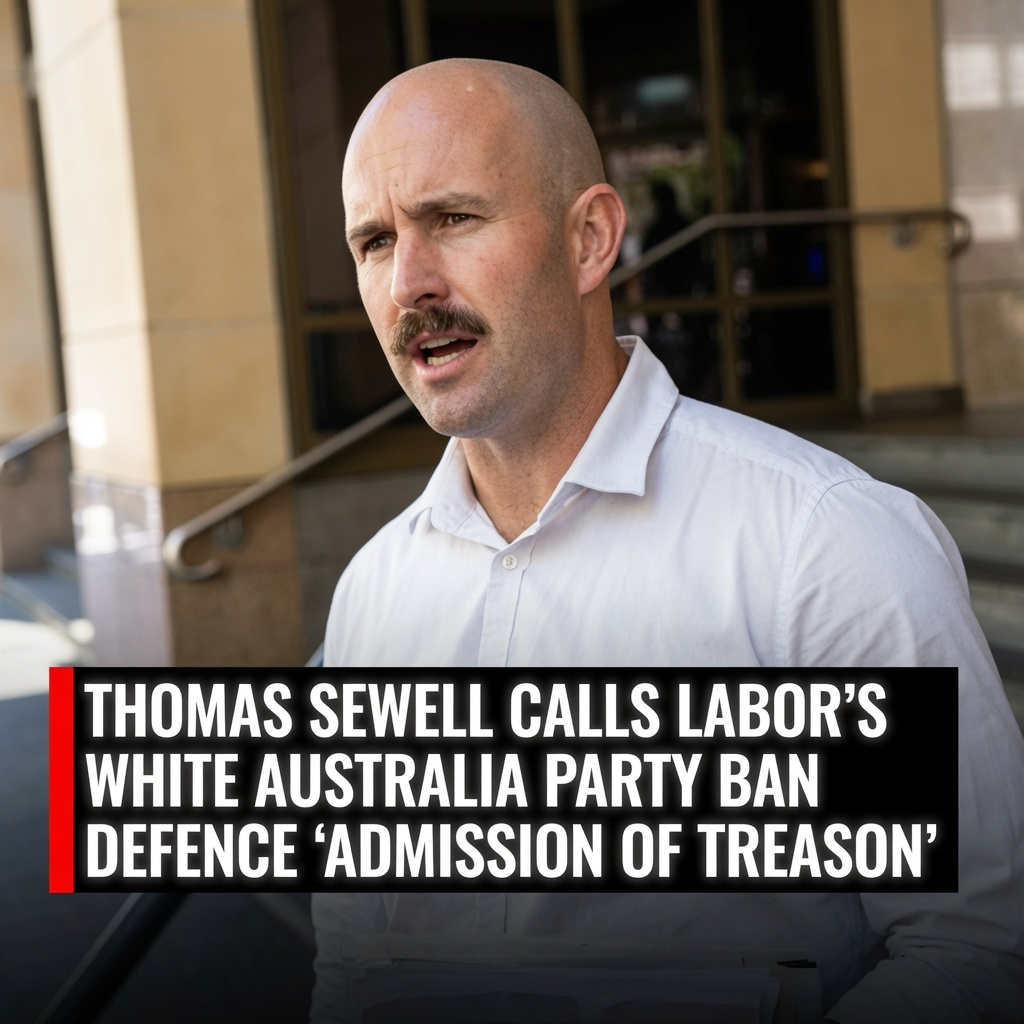
Sewell, the president of White Australia and a leading figure in the organisation previously known as the National Socialist Network, made the inflammatory accusation after the Commonwealth began advancing its legal position in proceedings challenging the new federal prohibited hate group regime.
His characterisation of the government’s case is fiercely disputed and is not a finding of the High Court. The Commonwealth has not admitted to treason, nor has it accepted Sewell’s description of its submissions.
But behind the rhetoric is a constitutional case with consequences extending far beyond Sewell or his organisation.
The central question is whether federal Parliament has gone too far by creating a system that allows the executive government to list an organisation as a prohibited hate group and criminalise major forms of participation in it.
White Australia Party Inc and Sewell are challenging the validity of the laws in the High Court in case M50/2026.
The organisation argues the legislation burdens the constitutionally implied freedom of governmental and political communication. It has also drawn comparisons with one of Australia’s most famous constitutional cases: the High Court’s 1951 decision striking down the Communist Party Dissolution Act.
The Commonwealth, meanwhile, is defending a legislative regime created after the Bondi terrorist attack and designed to confront organised groups accused of advocating, supporting or engaging in hate crimes.
The result could define how far an Australian government may go in suppressing an organisation it identifies as a threat without violating the constitutional structure of representative government.
White Australia was formally listed as a prohibited hate group in May.
On May 15, the Governor-General in Council made the Criminal Code (Prohibited Hate Group – White Australia) Regulations 2026.
The regulations specified White Australia as a prohibited hate group for the purposes of Part 5.3B of the Commonwealth Criminal Code.
The practical consequences are severe.
Under the new regime, criminal offences can apply to people who knowingly engage in particular forms of involvement with a listed organisation. These include intentionally directing its activities, intentionally remaining a member subject to statutory qualifications, recruiting others, providing certain forms of support, participating in training and dealing with funds connected to the group.
Maximum penalties for some offences reach 15 years’ imprisonment.
In an earlier judgment dealing with White Australia’s unsuccessful request for interim protection from the laws, High Court Chief Justice Stephen Gageler noted that the explanatory statement for the regulations described the effect of the listing as preventing the party “from legitimately operating in Australia through the criminalising of particular forms of engagement with” it.
That language is now central to the broader constitutional dispute.
White Australia argues the law does not merely punish individual crimes committed by individual members.
Its case is that the statutory regime can destroy the capacity of an organisation to function, communicate and participate in political affairs by criminalising the activities necessary for an organised political movement to exist.
The Commonwealth’s position is that the burden is constitutionally justified by the purpose and structure of laws aimed at protecting the Australian community from serious harm associated with organised hate.
Sewell has responded to that argument with claims of betrayal and foreign influence.
In comments published on Telegram on Monday, he alleged the Commonwealth’s defence could be summarised as an argument that white Australians did not deserve political rights where those rights conflicted with Jewish interests, multiculturalism or international treaties.
He further claimed the government’s legal position imposed restrictions on criticism of “Jewish power”, non-white immigration and international institutions.
Those statements are Sewell’s interpretation of the Commonwealth’s position. They should not be confused with direct admissions by the government or findings by the court.
Sewell concluded by accusing the Labor government of committing “treason” through the legal defence of its legislation.
There is no indication in the High Court material that the Commonwealth has admitted to treason. The word is Sewell’s political characterisation of the case.
His argument draws heavily on provisions in the explanatory statement accompanying the White Australia regulations.
The statement addressed Australia’s obligations under the International Covenant on Civil and Political Rights and the International Convention on the Elimination of All Forms of Racial Discrimination.
Australia has ratified both treaties.
The government acknowledged that the prohibited hate group regime limits rights including freedom of expression and association.
Its justification was that those limitations were necessary, reasonable and proportionate to a legitimate objective.
In relation to White Australia, the explanatory material argued the organisation’s conduct targeted people or groups distinguished by race or national or ethnic origin with hateful and violent rhetoric.
It also referred to protecting members of the Australian community from physical, psychological and social harm.
For Sewell, those statements amount to evidence that the Commonwealth accepts the laws burden political activity and is attempting to justify that burden through multicultural policy, community harm and international human rights obligations.
For the government, acknowledging that legislation limits a right is not the same as conceding constitutional invalidity.
That distinction is likely to be critical when the High Court considers the implied freedom of political communication.
Australia does not have a United States-style constitutional right to free speech.
The implied freedom of political communication is also not a personal right held by every Australian in the same way as a right contained in a bill of rights.
Instead, the High Court has described the implied freedom as a restriction on legislative and executive power derived from the system of representative and responsible government established by the Constitution.
In simple terms, the Constitution requires a functioning system in which Australians choose their representatives. Political communication is necessary to that system. Parliament therefore cannot validly burden such communication in a way the Constitution does not permit.
But the freedom is not absolute.
Australian governments routinely make laws that affect speech, protest, association and political activity. The constitutional question is whether a particular law burdens political communication and, if it does, whether the law’s purpose and means can be constitutionally justified.
This is why White Australia’s case cannot be resolved simply by pointing to the group’s ideology or the offensive nature of statements attributed to its members.
The High Court’s task is not to decide whether it likes White Australia’s politics.
It must determine whether the Commonwealth possessed the constitutional authority to enact and apply the legal mechanism being challenged.
Equally, the existence of political content does not automatically immunise an organisation from generally applicable criminal laws or give its members an unlimited constitutional entitlement to organise in any manner they choose.
The boundaries between those principles are what the court is being asked to examine.
The case has already produced one significant defeat for White Australia.
Before the full constitutional challenge could be heard, the organisation sought an interlocutory injunction that would have prevented its listing from taking practical effect against it.
Chief Justice Gageler dismissed that application on June 4.
The decision did not resolve the ultimate constitutional validity of the laws.
However, the Chief Justice examined the balance of convenience and the consequences of temporarily restraining the Commonwealth’s regime.
White Australia had argued the listing would effectively render the organisation “extinct” before the court could decide whether the law itself was valid.
The Commonwealth opposed interim relief.
Gageler concluded the organisation had not established the basis required for the injunction it sought.
The listing therefore remained in effect while the substantive constitutional proceedings continued.
Importantly, the High Court has not yet ruled that the prohibited hate group regime is constitutionally valid.
Nor has it accepted White Australia’s claim that the legislation is invalid.
Those questions remain live.
One of the most striking elements of the challenge is its reliance on the Communist Party Case.
In 1950, the Menzies government enacted the Communist Party Dissolution Act amid intense Cold War fears.
The legislation declared the Australian Communist Party unlawful and created mechanisms affecting associated organisations and individuals.
The High Court struck the law down in 1951.
The case became a defining statement about constitutional limits on executive and legislative power.
White Australia argues the new hate group provisions are, in relevant respects, indistinguishable from the invalid legislation considered in the Communist Party Case.
The Commonwealth contests that comparison.
The modern prohibited hate group framework operates through different statutory criteria and in a radically different legal environment. It is directed towards organisations linked by the legislation to hate crimes and the advocacy or support of specified offending.
Nevertheless, the historical comparison creates an uncomfortable constitutional question for any government.
Can Parliament establish the criteria for a prohibited organisation and then empower the executive to apply those criteria in a way that effectively prevents a politically active group from operating?
Or does such a system allow the executive to determine, in practical terms, which organised political movements may continue to exist?
The answer will depend on the precise legislation, the constitutional powers supporting it and the legal tests applied by the High Court.
It will not depend on whether the plaintiffs are popular.
That is why civil liberties concerns about the legislation cannot simply be dismissed as support for White Australia’s ideology.
The prohibited hate group framework was introduced as part of the Commonwealth’s response to the Bondi attack and passed with support from both major political parties.
Parliamentary debate described organised hate groups as dangerous because they can recruit, fundraise, train and distribute propaganda.
The legislation was designed to create a listing framework similar in some practical respects to Australia’s long-established system for proscribed terrorist organisations.
Yet hate group legislation enters politically sensitive territory because the activities of an organisation may involve a mixture of speech, advocacy, political campaigning and alleged criminal conduct.
A law capable of reaching membership, recruitment, support and funding can impose consequences far beyond prosecuting a person for an individual violent offence.
The constitutional issue is therefore not only whether the government has a legitimate objective.
Few would dispute that protecting Australians from violence and serious hate-motivated offending is legitimate.
The harder issue is the legal mechanism chosen to achieve it.
If the High Court upholds the regime, the Commonwealth will retain a powerful instrument for dismantling organisations that satisfy the statutory criteria for prohibited hate groups.
If the court invalidates the laws, Parliament may be forced to redesign one of the central elements of its post-Bondi response to hate and extremism.
A decision could also reshape how future governments approach organisations operating at the boundary between extremist activism and organised political participation.
Sewell is attempting to frame the case as proof that Labor has banned its political opposition.
That description requires context.
White Australia has sought political party status and presents its activities as political organisation. But the Commonwealth’s listing does not arise merely because the organisation opposes Labor or supports restrictive immigration policies.
The government’s explanatory material relies on a much broader body of alleged conduct and rhetoric associated with the organisation and its previous identity.
The group has been widely described by Australian authorities and mainstream reporting as neo-Nazi.
The High Court proceedings themselves identify White Australia as also known as the National Socialist Network.
None of that, however, removes the need for constitutional scrutiny.
Indeed, difficult plaintiffs frequently produce important constitutional law.
A constitutional limitation on government power does not exist only for organisations whose views command public sympathy.
At the same time, political branding cannot automatically transform conduct covered by valid criminal legislation into constitutionally protected communication.
The court must decide where the line falls.
White Australia’s fundraising campaign for the challenge has reportedly attracted more than $190,000. Sewell has claimed the case is intended to protect political communication and organisation for future generations and could influence debates in other Anglosphere countries.
Whether those claims survive legal scrutiny will become clearer when the High Court hears the substantive case.
For the Albanese government, the stakes are equally high.
The prohibited hate group laws were introduced as a forceful response to an extraordinary national security and social cohesion crisis. A constitutional defeat would raise questions about the speed with which the regime was created and the breadth of the powers Parliament approved.
A Commonwealth victory, meanwhile, would establish significant authority for the federal government to act against listed hate organisations.
The case scheduled for September is therefore about much more than Thomas Sewell’s latest accusation against Labor.
His language of “treason”, “globalist treaties” and Jewish influence is political rhetoric, not a statement of established legal fact.
The constitutional issue is narrower, more technical and potentially far more consequential.
How much political activity can the Commonwealth criminalise in the name of protecting Australians from organised hate before it crosses a constitutional line?
For the first time under the new prohibited hate group regime, the High Court is preparing to answer that question.






