A controversial Sydney entertainment venue operating inside a former Catholic church has suspended operations after its landlord ordered it to stop what was described as an “offensive trade”, marking the latest chapter in a heated public debate over religious respect, artistic freedom and the use of historic places of worship.
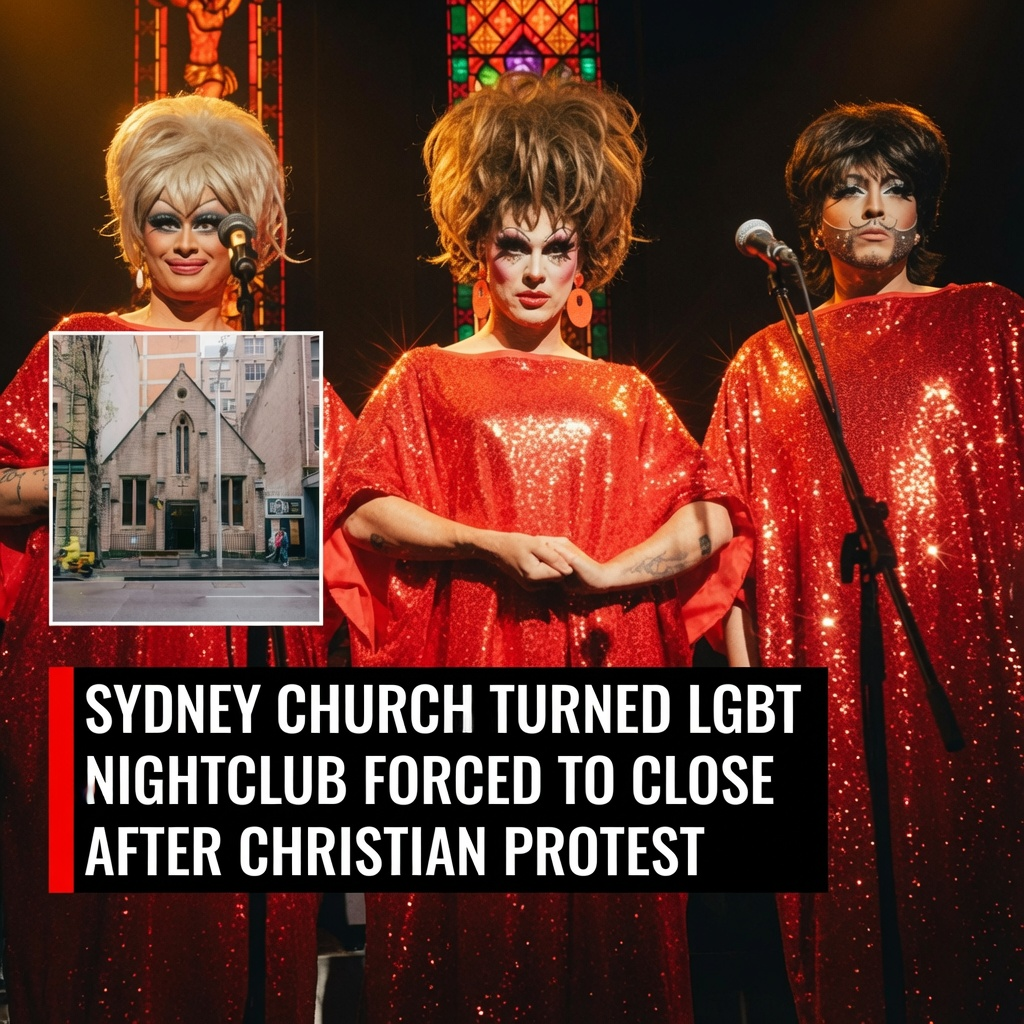
Divine Playhouse, an LGBT-focused nightclub and performance venue housed inside the 158-year-old former St John’s Church on Kent Street, confirmed it had been forced to close temporarily while considering its legal options after receiving a breach notice from the building’s landlord.
The closure followed widespread criticism from Christian groups, who accused organisers of mocking Christianity through themed performances, costumes and promotional material linked to the venue’s opening events.
The dispute quickly became one of Australia’s most closely watched cultural controversies, drawing in politicians, religious leaders, community organisations and advocates on both sides of the debate.
According to organisers, the venue was originally launched under the name Unholy Playhouse before being renamed Divine Playhouse shortly before opening following complaints that the original branding was offensive to Christians.
Despite the name change, concerns continued to grow over the content of its scheduled performances.
The opening event, titled The First Rite, featured performers dressed in costumes inspired by Christian imagery, including bearded men dressed as nuns and theatrical characters wearing stylised angel outfits. Promotional material also advertised future events referencing Christian themes, including a comedy performance and plans for what organisers described as a live theatrical exorcism later in the year.
For many Christians, particularly members of Sydney’s Catholic community, those performances crossed the line between artistic expression and deliberate mockery of sincerely held religious beliefs.
Approximately 100 demonstrators, many identifying as Catholics, gathered peacefully outside the venue on opening night.
Participants prayed, sang hymns and displayed banners reading “Jesus is King”, saying their purpose was not to disrupt the event but to publicly express concern about what they viewed as disrespect towards Christianity.
Groups involved in the demonstration stressed that protesters had been instructed to remain peaceful throughout the gathering.
Organisers repeatedly urged participants not to engage in confrontation, threats or abusive behaviour, emphasising that any disorder would be left to police to manage.
The protest remained peaceful and attracted considerable attention both online and across Australian media.
Days later, the venue’s operators received formal notice from the landlord alleging they had breached lease conditions by conducting activities considered offensive.
According to reports, lawyers acting for the property’s owners argued the performances had insulted and mocked the sincerely held religious beliefs of millions of Christian Australians.
The notice reportedly warned that failure to cease the disputed activities could result in eviction proceedings.
In response, Divine Playhouse announced through social media that it had been forced to suspend operations while exploring its legal options regarding the future of the venue.
The operators indicated they were disappointed by the decision but did not immediately announce whether future events would be relocated or permanently cancelled.
The building itself occupies an unusual place in Sydney’s history.
Originally constructed as St John’s Church more than 150 years ago, the property was deconsecrated after it ceased operating as an active Catholic place of worship.
Once a church has been formally deconsecrated, it is no longer used for religious services and may legally be adapted for other purposes, subject to planning approvals, lease conditions and heritage requirements.
Across Australia and internationally, numerous former churches have been converted into apartments, galleries, restaurants, theatres, libraries and community facilities after congregations declined or relocated.
However, conversions involving overtly religious themes or performances referencing the building’s original faith have frequently generated controversy.
In this case, the dispute extended beyond the venue itself after it emerged that Divine Playhouse had received a $100,000 grant from the New South Wales Government.
The funding prompted questions from critics about whether taxpayer money should support performances perceived by some religious communities as offensive.
New South Wales Premier Chris Minns subsequently said the grant process was being examined and remarked that it was difficult to understand why the former church had been considered the most appropriate location for the project.
The venue’s opening night nevertheless attracted several public figures, including Arts Minister John Graham and Sydney councillor Jess Miller, highlighting the politically sensitive nature of the controversy.
The Catholic Archdiocese of Sydney also issued a public response.
A spokesperson said the former church retained deep historical significance for many Catholics despite no longer functioning as an active parish.
The Archdiocese argued that performances built around themes such as the resurrection and purgatory were deeply hurtful for members of the Christian community.
Church representatives further questioned whether governments would apply the same standards if comparable performances targeted other religious traditions.
They argued that public funding decisions should be applied consistently regardless of which faith community was involved.
The dispute has reignited broader questions surrounding freedom of expression in Australia.
Supporters of the venue argue artistic expression should be protected even when it challenges or satirises religious institutions.
Many point out that satire has long formed part of theatre, comedy and performance art, and that controversial works frequently provoke debate without intending to incite hatred.
Others counter that freedom of expression also carries social responsibility, particularly when performances deliberately reference sacred beliefs that remain central to millions of Australians.
Legal experts note that Australia has no standalone national law prohibiting blasphemy, with historical blasphemy offences having largely disappeared from Australian jurisdictions.
Instead, disputes of this nature are generally resolved through contract law, planning rules, discrimination legislation, public order laws or private lease agreements rather than criminal prosecution.
In this instance, the landlord’s contractual rights appear to have become the decisive factor rather than any allegation of unlawful conduct.
The controversy also reflects wider cultural tensions over how heritage buildings should be repurposed once they cease functioning as places of worship.
Australia contains hundreds of former churches that have found new commercial or community uses, often balancing heritage preservation with financial viability.
While adaptive reuse is widely accepted, projects involving religious symbolism frequently generate stronger public reactions than conventional redevelopments.
The Christian groups involved in last week’s demonstration have announced plans for another peaceful gathering outside the venue.
In statements shared online, organisers said participants would continue praying and expressing support for the Christian faith while avoiding confrontation or intimidation.
They reiterated that the purpose of the demonstrations is to defend what they consider the dignity of Christianity rather than to threaten venue staff or patrons.
Whether Divine Playhouse ultimately resumes trading, relocates or pursues legal action remains uncertain.
What is clear is that the dispute has evolved well beyond a single nightclub opening.
It has become a national conversation touching on religious freedom, artistic expression, public funding, property rights and the respectful treatment of Australia’s diverse faith communities.
As governments, religious organisations, artists and community groups continue debating where those boundaries should lie, the closure of the Sydney venue is likely to remain a prominent reference point in Australia’s ongoing discussion about faith, culture and freedom of expression.






