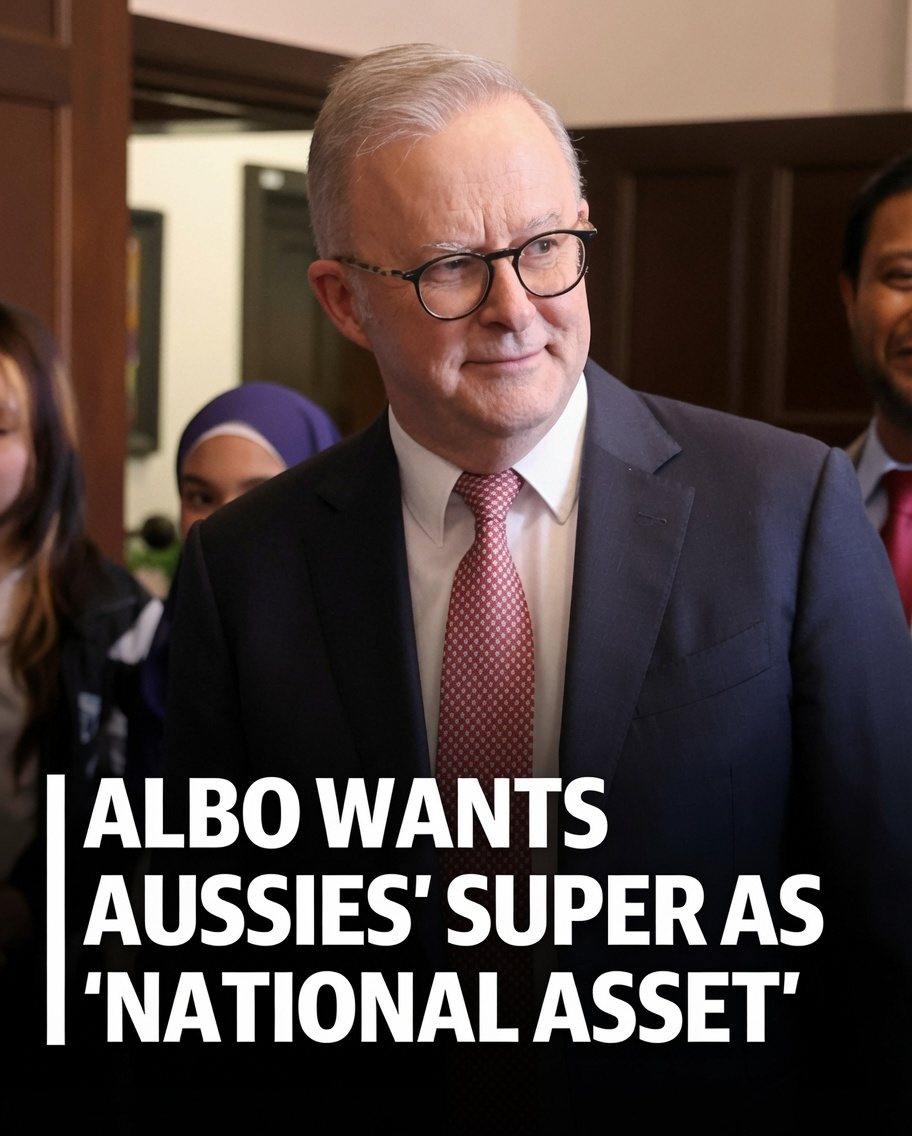
Australia’s superannuation industry has pushed back against Prime Minister Anthony Albanese’s suggestion that the nation’s retirement savings should increasingly be viewed as a “national asset”, warning that governments should not influence where Australians’ retirement money is invested.
The comments have reignited a long-running debate over the role of Australia’s compulsory superannuation system, which has grown into one of the world’s largest retirement savings pools and now holds almost $4.5 trillion in assets.
Speaking at the annual superannuation lending roundtable, Albanese encouraged the sector to increase investment in Australia’s corporate debt market, arguing there was significant potential to use superannuation capital in ways that could strengthen both retirement outcomes and the broader national economy.
He said the country’s retirement savings represented a “national asset” that could be deployed more effectively while still generating strong returns for members.
“There is real potential to see these funds as a national asset that can be used more appropriately and get better returns as well, not just for individuals and for retirees, but for the nation,” the Prime Minister said.
The remarks immediately prompted concern among superannuation executives and investment professionals, many of whom stressed that Australian law requires trustees to act solely in the best financial interests of fund members.
Under Australia’s superannuation framework, trustees have a fiduciary obligation to prioritise maximising long-term, risk-adjusted returns for members rather than pursuing broader government policy objectives.
That legal duty has become central to the industry’s response.
AMP chief economist Shane Oliver said governments should avoid directing investment decisions made by professional fund managers.
“Super funds should be left to decide what is the best investment strategy for their members,” Oliver said.
He argued trustees are already accountable under Australia’s regulatory framework and warned that political involvement in investment decisions would undermine confidence in the superannuation system.
UniSuper Chief Investment Officer John Pearce expressed similar concerns, saying the fund’s legal responsibility to members “cannot be compromised”.
Pearce warned that any attempt by governments to direct investment strategies could weaken confidence in compulsory superannuation and encourage more Australians to move into self-managed super funds.
He also rejected suggestions that funds are neglecting domestic investment opportunities.
According to Pearce, UniSuper already invests in Australian corporate debt through specialist external fund managers while also providing significant funding to Australian banks that lend to businesses across the country.
However, he noted that Australia’s private credit market remains relatively small compared with overseas investment opportunities, limiting the amount of capital that can be invested domestically without compromising diversification.
Westpac chief executive Anthony Miller delivered one of the strongest responses, urging governments not to interfere with the sector.
“Don’t touch the super complex, don’t direct it, don’t tell it where to go,” he said.
AustralianSuper, Australia’s largest superannuation fund, has also consistently argued that governments should not dictate where retirement savings are invested.
The fund has previously said global diversification remains essential for delivering strong long-term returns, particularly through investments in the United States, Europe and emerging markets.
AustralianSuper chief executive Paul Schroder has previously described direct government involvement in investment decisions as an “utter disaster”.
The debate comes as Australia’s superannuation pool continues to expand rapidly.
According to the Australian Bureau of Statistics, total superannuation assets reached approximately $4.47 trillion in household wealth during the March quarter, making the sector one of Australia’s largest sources of long-term investment capital.
Australia’s compulsory superannuation system has attracted international attention because of its size and the significant role institutional investors now play in financial markets.
Unlike many countries that rely primarily on government-funded pensions, Australia’s system requires employers to contribute a percentage of workers’ wages into privately managed retirement accounts throughout their careers.
The objective is to reduce long-term reliance on the Age Pension by helping Australians accumulate sufficient retirement savings during their working lives.
Because contributions continue flowing into the system every payday, superannuation funds have become major investors in Australian and international shares, infrastructure, property, fixed income securities, private equity and alternative assets.
Questions about how that money should be invested have surfaced repeatedly over the past decade.
Governments of different political persuasions have periodically argued that superannuation could play a larger role in financing major national priorities such as housing, transport infrastructure, renewable energy and economic development.
Former Victorian premier Daniel Andrews echoed that view during the same roundtable, suggesting retirement savings could contribute to addressing productivity challenges, including housing, infrastructure, energy transition, water security and future pandemic preparedness.
Supporters of greater domestic investment argue Australia’s retirement savings could help finance projects that both strengthen the economy and potentially generate attractive long-term returns.
Large infrastructure assets such as airports, ports, toll roads and renewable energy projects have historically attracted significant interest from institutional investors because they can provide stable income over many decades.
Critics, however, caution that governments should not assume every public project represents an appropriate commercial investment.
They argue that while many super funds already invest extensively in Australian infrastructure, every investment should be judged solely on its financial merits rather than its political appeal.
The discussion has also intensified following AustralianSuper’s recent $500 million investment in India, announced during Prime Minister Albanese’s visit with Indian Prime Minister Narendra Modi.
Although many investment managers regard India as one of the world’s fastest-growing major economies, the timing prompted renewed debate about whether investment decisions could become intertwined with broader foreign policy objectives.
Fund managers have maintained that overseas investments are selected because they are expected to deliver competitive long-term returns rather than to advance government priorities.
Previous proposals to use superannuation for public projects have generated similar controversy.
Late last year, Victorian Premier Jacinta Allan suggested the sector could contribute more towards schools, hospitals and other public infrastructure, prompting criticism from economists and industry representatives who argued governments should finance public services through taxation, borrowing and conventional budget processes.
Oliver has previously argued that superannuation should never become a substitute for government spending.
He warned retirement savings are neither a “piggy bank” for governments nor a funding source for politically attractive projects that may not deliver the best returns for members.
Despite the strong public reaction, the Prime Minister did not propose changing the legal duties governing superannuation trustees.
Nevertheless, his comments have highlighted the continuing tension between two competing ideas: viewing Australia’s enormous retirement savings pool as a source of national economic capital, and preserving the long-established principle that every investment decision must first and foremost serve the financial interests of individual members.
As Australia’s superannuation assets continue growing over coming decades, that debate is likely to remain central to discussions about retirement policy, infrastructure investment and the broader role institutional capital should play in Australia’s economic future.






