A Sudanese refugee who returned to Africa as an adult to fight in the South Sudan civil war before coming back to Australia has been sentenced to more than 12 years in prison after stalking another man through the streets of Melbourne and stabbing him 14 times in what a Victorian judge described as a “pitiless” and almost fatal attack.
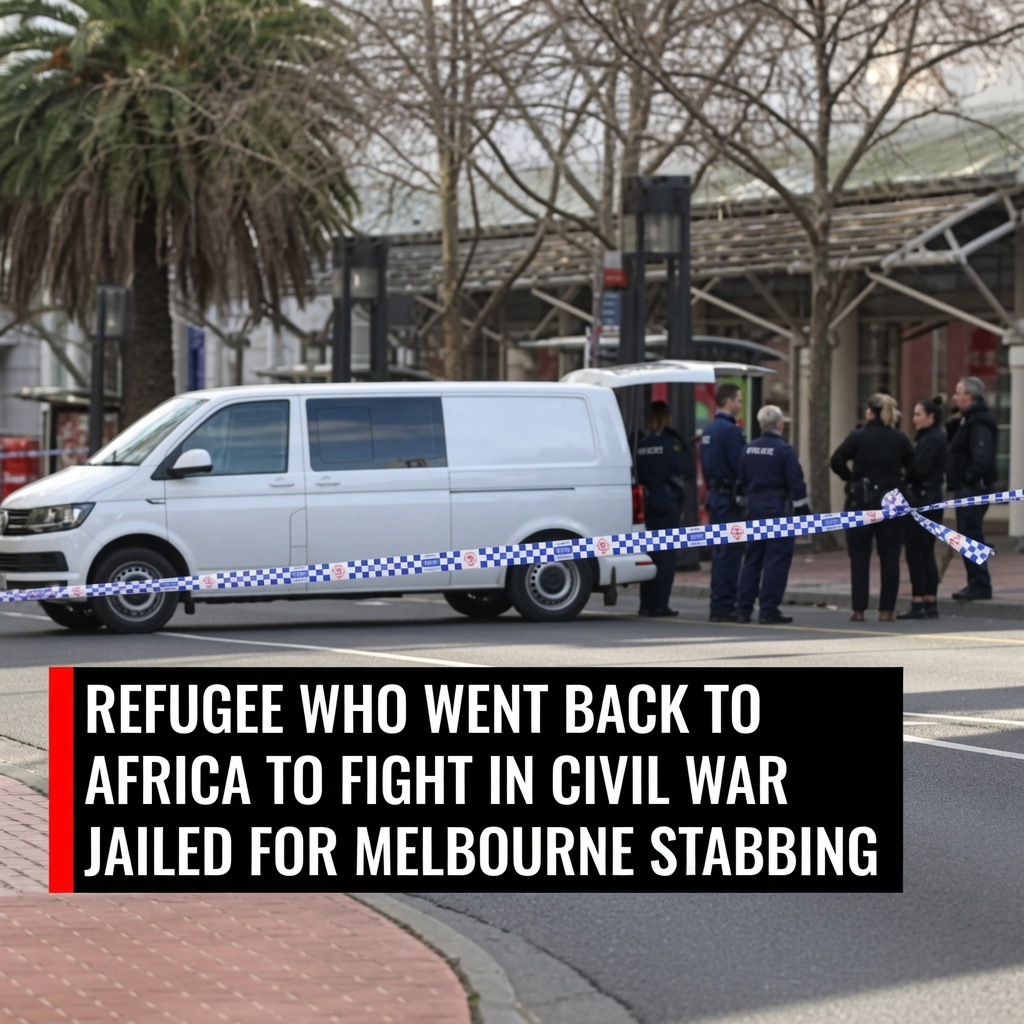
Gatluak Gatluak, 34, was sentenced in the County Court of Victoria after a jury found him guilty of intentionally causing injury and affray over the violent assault on Origi Kwajakwan in Dandenong during the early hours of July 15, 2022.
The court heard that Gatluak followed Mr Kwajakwan for approximately 20 minutes after both men left the Players Hotel before catching up with him near the Ramada Encore Hotel. There, he repeatedly punched, kicked and stabbed the unarmed victim, inflicting injuries that doctors later described as life-threatening.
Judge John Kelly said the attack demonstrated a sustained intention to inflict serious harm and rejected suggestions that it was a spontaneous confrontation.
Evidence presented during the trial showed that Mr Kwajakwan suffered 14 separate stab wounds, including injuries to his chest, abdomen and muscles. The assault also caused a collapsed lung, traumatic brain injuries, severe blood loss and internal damage that required emergency surgery.
During sentencing, the judge accepted that the knife’s 10-centimetre blade had been driven into the victim up to its hilt during the frenzied attack, highlighting the extraordinary level of force used.
Medical intervention ultimately saved Mr Kwajakwan’s life.
Judge Kelly observed that without rapid treatment, the victim would almost certainly have died from his injuries.
“Callous, calculated, comprehensive and almost fatal” was how the judge characterised the attack while explaining the reasons behind the lengthy prison sentence.
The prosecution relied heavily on CCTV footage that captured Gatluak’s movements before and after the stabbing. Investigators told the court that the accused could be identified through his distinctive red shoes, while additional footage allegedly showed what the judge described as a “red right hand” shortly after the incident.
Mr Kwajakwan, who had known Gatluak for about 18 months before the assault, also gave evidence identifying him as the attacker.
According to the victim, Gatluak confronted him shortly before the stabbing and declared that he had wanted to fight him for a long time.
Despite that evidence, Gatluak maintained a plea of not guilty throughout the proceedings.
One of the central issues during sentencing concerned whether Gatluak’s background should substantially reduce his moral culpability.
Defence lawyers argued that he had experienced significant childhood trauma after arriving in Australia as a refugee from Sudan before later choosing to return to Africa, where he served as a captain in the Sudanese military during the civil war.
The defence submitted that his wartime experiences—including witnessing killings, torture and the deaths of children—left him suffering from post-traumatic stress disorder (PTSD), which should be considered when determining an appropriate sentence.
The court heard Gatluak claimed to have been deeply traumatised by his military service.
Psychological material presented during sentencing indicated he had been diagnosed with PTSD and had endured a violent upbringing. Additional evidence referred to drug use, previous injuries—including losing teeth during a machete attack in 2025—and difficult family circumstances.
The defence also referred to the serious injuries suffered by Gatluak’s brother, who now requires long-term support after a motor vehicle accident.
However, Judge Kelly concluded that while those experiences warranted some consideration, they could not excuse the seriousness of the offending.
In one of the most significant passages of the sentencing remarks, the judge noted that Gatluak had voluntarily returned to fight in the Sudanese civil war as an adult rather than being conscripted.
According to the court, Gatluak told psychologists he had led attacks, served as a bodyguard for senior military commanders and eventually reached the rank of captain before returning to Australia after suffering a grenade injury that required medical treatment.
The judge accepted that exposure to prolonged violence may have influenced Gatluak’s behaviour to some degree.
Nevertheless, he ruled that the need to protect the Victorian community outweighed any substantial reduction in moral responsibility.
“At 18, you chose to fight in the Sudanese civil war,” Judge Kelly told the offender.
“You thrived in that environment.”
The judge continued by acknowledging that childhood trauma and wartime experiences had some mitigating effect but said the reduction “needs to be offset by the need for the community’s protection from someone who has been trained by war to dispense savagery.”
Another major factor influencing the sentence was Gatluak’s extensive criminal history.
Before the stabbing, he had accumulated convictions for robbery, intentionally causing injury, unlawful assault, family violence offences and multiple assaults spanning more than a decade.
The court heard that in one 2020 incident at a Dandenong service station, Gatluak repeatedly punched a stranger before dragging him to the ground and biting his thumb.
In another matter, he and another offender chased a man into his home before assaulting him with beer bottles.
Later that same year, he was convicted of assaulting his own brother so severely that the victim was rendered unconscious.
Although the judge acknowledged that Gatluak’s earlier convictions were less serious than the current offending, they nevertheless demonstrated an established pattern of violent behaviour.
The court also considered Gatluak’s personal circumstances.
Evidence showed he has fathered three children with two different women. Two children live in Uganda with his first wife, while another child lives in Australia’s Northern Territory with her mother.
However, sentencing remarks noted that Gatluak had failed to cultivate meaningful relationships with any of his children.
Judge Kelly ultimately found that the stabbing was neither impulsive nor provoked.
Instead, he concluded the offender deliberately armed himself, pursued his victim for close to 20 minutes and attacked only after ensuring the victim was isolated and unable to obtain assistance.
“You tracked him for close to 20 minutes,” the judge said.
“You were armed and you were doubtless contemplating what to do to Mr Kwajakwan over that whole period.”
The judge further observed that Mr Kwajakwan posed no threat, offered no violence and had no realistic opportunity to defend himself before suffering the sustained knife attack.
Perhaps most strikingly, the court noted that Gatluak simply walked away after leaving the victim bleeding in the street.
The motive for the attack remains unclear.
Judge Kelly specifically observed that Gatluak’s actions were effectively “unexplained and motiveless,” despite evidence suggesting he had harboured animosity toward Mr Kwajakwan beforehand.
Ultimately, the court imposed a sentence of 12 years and three months’ imprisonment.
Gatluak must serve a non-parole period of seven years and six months before becoming eligible to apply for release.
The sentencing judge also recognised 830 days already spent in custody awaiting trial and sentence as time already served.
Although the judge expressed guarded optimism about rehabilitation, he emphasised that meaningful change would depend on Gatluak engaging with psychological treatment and violence reduction programs while incarcerated.
“You have a loving and supportive family,” Judge Kelly said.
“You need therapy for the horrors you witnessed in Sudan.”
He added that successful rehabilitation would ultimately benefit not only the offender but also the wider community by reducing the risk of future violent offending.
The case has also highlighted broader issues frequently considered by Australian courts when sentencing offenders with histories of war-related trauma.
Victorian courts have consistently recognised that PTSD, childhood abuse and exposure to armed conflict can be relevant mitigating factors. However, those considerations do not automatically result in substantially lighter penalties where offending demonstrates careful planning, extreme violence or presents an ongoing risk to public safety.
Australian sentencing law requires judges to balance rehabilitation against several competing principles, including punishment, denunciation, deterrence and the protection of the community.
In this case, Judge Kelly concluded that community protection and denunciation were the dominant considerations given the exceptional seriousness of the offending and Gatluak’s demonstrated history of violence.
During the sentencing hearing, Gatluak’s immigration status was not discussed.
As a result, the court made no findings about whether any action may later be taken under Commonwealth migration law following completion of his prison sentence.
Any decision regarding visa cancellation or deportation would fall outside the jurisdiction of the sentencing court and would be determined separately under Australia’s migration framework if applicable.






