A street interview conducted during an anti-One Nation demonstration in Brisbane has ignited a fresh political debate after an Indian-born migrant said he wanted Australia to become a socialist country.
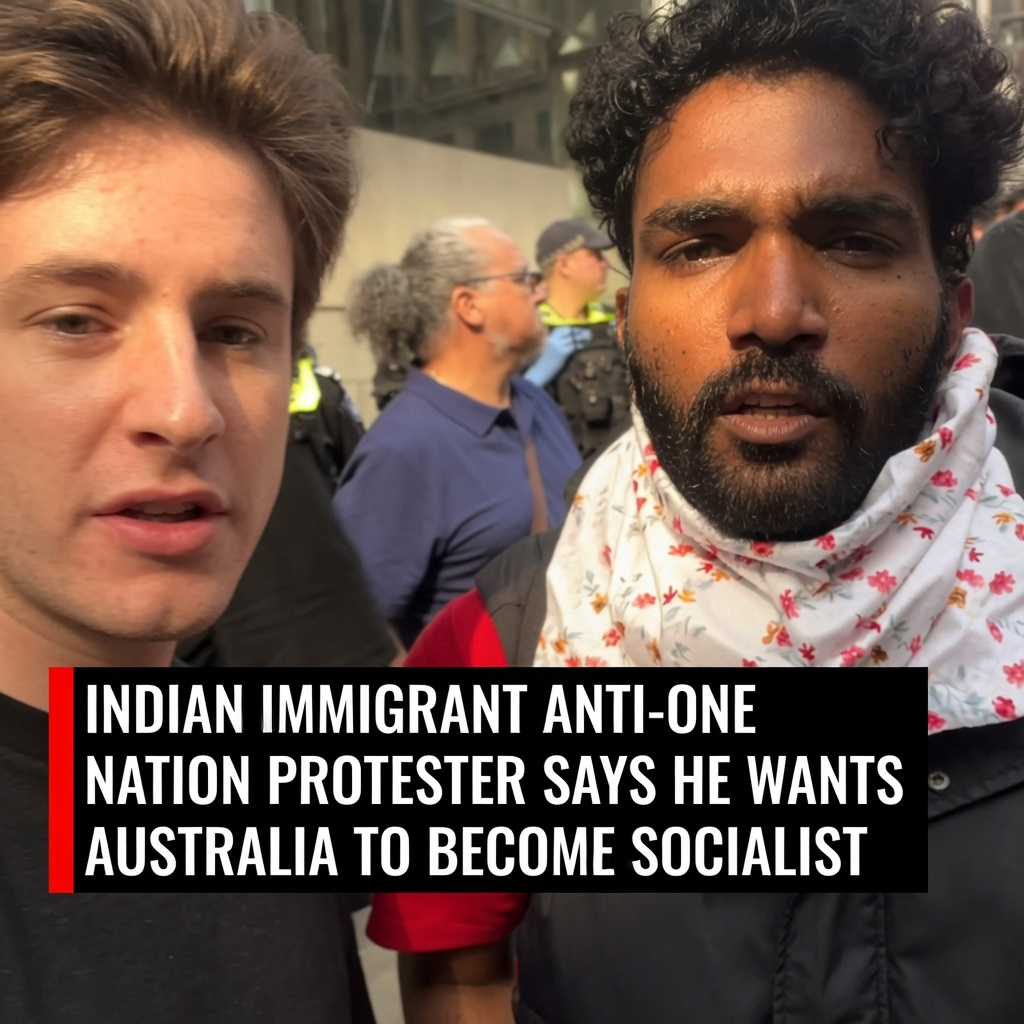
The exchange, filmed during a large counter-protest against a One Nation-linked rally earlier this month, was later shared by One Nation across its social media platforms before attracting wider attention after being reposted by political commentator Drew Pavlou.
In the video, the man was asked why he had joined the demonstration.
He responded with a single word: “Socialism.”
When asked whether he considered himself a socialist, he replied “yes”. During the conversation, he also said he had been born in India and had moved to Australia for work.
The interviewer then asked whether he wanted Australia to become socialist, to which the man again answered “yes”.
One Nation used the exchange to argue that some migrants arrive in Australia seeking economic opportunity while simultaneously advocating fundamental changes to the country’s political and economic system.
Posting the clip online, the party questioned whether Australians should accept what it described as a lack of gratitude from people who had chosen to migrate to the country.
The footage quickly spread across social media, generating thousands of comments from both supporters and critics.
Drew Pavlou, an independent political activist and commentator, also shared the interview, describing the migrant’s comments as an example of what he considered remarkable political ingratitude.
The video emerged from a much larger protest held in Brisbane on 12 July, where more than one thousand demonstrators marched against One Nation following the party’s involvement in a rally focused on proposed changes to Australia’s Sex Discrimination Act and transgender policy. The counter-protest drew supporters from a broad range of progressive organisations, including socialist groups, LGBTQ+ activists, union members and anti-racism campaigners. Police maintained a significant presence throughout the day as the two opposing demonstrations remained separated. :contentReference[oaicite:0]{index=0}
While the majority of the demonstration remained peaceful, several confrontations occurred on the fringes of the protest.
Video circulating online appeared to show a photographer being assaulted during the event, while other footage captured heated verbal exchanges between protesters and journalists.
Queensland Police monitored the demonstrations but no widespread disorder comparable to previous major political protests was reported publicly.
The interview shared by One Nation represented only one small interaction during a lengthy day of demonstrations, yet it quickly became the defining online moment of the event.
The controversy was amplified because it touched on several politically sensitive issues simultaneously: immigration, multiculturalism, socialism, freedom of political expression and national identity.
Australia has long welcomed migrants from around the world, including hundreds of thousands of skilled workers who contribute to the country’s economy each year.
Permanent residents and Australian citizens are free to support any lawful political ideology, campaign for policy change and participate in peaceful political demonstrations regardless of where they were born.
Supporters of the protest therefore argued that the man’s comments simply reflected his democratic right to express a political opinion.
Others took a very different view.
Critics argued there is an important distinction between participating in Australia’s democratic process and advocating the replacement of Australia’s existing political and economic system after migrating primarily for employment opportunities.
The disagreement reflects a broader national conversation about immigration, civic integration and the expectations placed upon new arrivals.
Opinion polls have consistently shown that Australians strongly support skilled migration while also expecting migrants to respect Australia’s democratic institutions, legal framework and social values.
Exactly what those expectations require, however, remains a matter of political disagreement.
One Nation has frequently argued that successful multiculturalism depends not only on economic participation but also on embracing what it describes as Australia’s core cultural values.
The party has repeatedly called for lower migration levels, stronger citizenship requirements and greater emphasis on social integration.
Its opponents argue that Australian democracy is built upon freedom of speech and political participation, meaning migrants enjoy the same right as anyone else to advocate peaceful political change, including support for socialism, environmentalism, conservatism or other lawful ideologies.
The Brisbane rally itself reflected the increasingly polarised nature of Australian politics.
Organisers described the march as a response to One Nation’s position on transgender rights and anti-discrimination laws, while participants carried a wide variety of banners representing different political movements and social causes. :contentReference[oaicite:1]{index=1}
Video released by One Nation from the same protest also featured interviews with several other demonstrators expressing sharply contrasting political views.
Some participants criticised Pauline Hanson personally, others spoke about minority rights, while several declined to answer questions or objected to being filmed.
The collection of interviews was presented by One Nation as evidence that the protest had been dominated by activists representing fringe political positions rather than ordinary Australians.
Supporters of the demonstration strongly rejected that characterisation, arguing the event included people from diverse backgrounds united by opposition to One Nation’s policies rather than any single political ideology.
Political observers note that the dispute extends beyond one interview or one protest. It reflects a broader shift in Australia’s political landscape, where debates about immigration, national identity and social values increasingly dominate public discussion.
Immigration has become one of the defining issues in Australian politics over the past decade. While governments of both major parties have continued to support skilled migration to address labour shortages and population growth, public concern has intensified over housing affordability, infrastructure pressures and the pace of population expansion.
Those concerns have created fertile political ground for parties advocating stricter migration policies, including One Nation, which has consistently argued that Australia’s migration program should be significantly reduced and more heavily focused on cultural integration.
At the same time, Australia remains one of the world’s most multicultural democracies. Nearly one-third of the population was born overseas, and successive governments have promoted migration as an important contributor to economic growth, innovation and workforce development.
That combination has produced an ongoing debate over what successful integration should look like.
Some Australians believe new arrivals should actively embrace Australia’s political traditions and cultural norms while retaining aspects of their own heritage. Others argue that Australia’s democratic system is strengthened by allowing migrants to participate fully in public debate, including advocating for political ideas that differ from those traditionally associated with Australian governments.
The man interviewed in Brisbane became the focus of that debate because his comments were interpreted very differently by different audiences.
For supporters of One Nation, his statement appeared to reinforce concerns that some migrants seek to reshape Australia’s political culture rather than integrate into it. They argued that people who migrate primarily for economic opportunity should appreciate Australia’s existing democratic institutions instead of calling for systemic political change.
Critics of One Nation reached the opposite conclusion.
They argued that supporting socialism, like supporting conservatism, liberalism or environmentalism, is a lawful political belief protected by Australia’s democratic traditions. In their view, expressing support for socialism does not demonstrate disrespect for Australia but rather participation in the very democratic freedoms that distinguish the country.
Australia has a long history of socialist and labour movements. The Australian Labor Party itself emerged from the trade union movement in the late nineteenth century, while various socialist parties have contested elections for decades. Although socialism has never commanded majority electoral support at the federal level, advocating socialist policies remains entirely lawful within Australia’s democratic system.
The incident therefore raises broader questions about the difference between supporting a political philosophy and advocating unlawful or anti-democratic conduct.
Unlike extremist organisations that promote violence or racial hatred, socialism is not prohibited under Australian law. Individuals are free to campaign peacefully for socialist, capitalist, conservative or other political systems provided they do so within the democratic process.
The Brisbane protest also highlighted the increasingly confrontational nature of modern political demonstrations.
Video from the event showed several heated exchanges between protesters and people recording the rally. One photographer was reportedly assaulted during the demonstration, while other participants verbally abused interviewers or attempted to obstruct filming.
Political violence has become an issue of growing concern across Australia in recent years. Leaders from across the political spectrum have repeatedly condemned assaults and intimidation occurring during protests, regardless of the political beliefs involved.
Most participants in Brisbane appeared to protest peacefully, but isolated confrontations attracted disproportionate attention online and became central to subsequent media coverage.
One Nation later released additional interview compilations featuring several protesters expressing a wide range of views on policing, transgender rights, Palestine and other political issues. The party argued the footage illustrated what it regarded as the increasingly radical character of anti-One Nation activism.
Organisers of the counter-protest rejected that characterisation, maintaining that the overwhelming majority of participants were ordinary Australians exercising their democratic right to oppose policies they disagreed with.
As with many politically charged demonstrations, both sides sought to present the event in ways that supported their broader political narratives.
The resulting online debate extended well beyond the original interview.
Supporters of tighter migration controls argued the exchange highlighted the importance of civic integration and shared national values. Others warned against judging Australia’s diverse migrant communities based on comments made by a single individual during a highly emotional political protest.
Migration experts have consistently noted that immigrants, like Australian-born citizens, hold a wide variety of political opinions shaped by personal experiences, education, religion and economic circumstances. No single protest participant can reasonably be viewed as representative of the broader migrant population.
Nevertheless, the interview resonated because it intersected with several contentious national debates at once.
Immigration levels, housing affordability, freedom of speech, political extremism and national identity remain among the most divisive issues in contemporary Australian politics. Short video clips touching on those subjects frequently generate far greater public engagement than longer policy discussions.
Whether the Brisbane interview ultimately influences public opinion is difficult to measure. Social media reactions often amplify the most polarising moments while providing limited insight into broader community attitudes.
What is clear is that the exchange has become another highly visible example of Australia’s increasingly polarised political environment, where brief interactions recorded on the street can rapidly evolve into national debates over immigration, democracy and the country’s future direction.
As parties continue preparing for future electoral contests, questions surrounding migration, cultural integration and political identity are likely to remain central issues shaping public discussion across Australia.