Opposition Leader Angus Taylor has launched his strongest attack yet on Pauline Hanson’s One Nation, arguing the party’s economic platform would leave Australia facing soaring debt, higher inflation and a potential sovereign debt crisis if it were ever entrusted with government.
Speaking at the Sydney Institute on Thursday, Taylor dismissed One Nation as a “column of smoke” that offered eye-catching promises without the economic discipline needed to govern. He claimed that just four of the party’s flagship commitments would cost around $1 trillion over the next decade while lacking any credible explanation of how they would be funded.
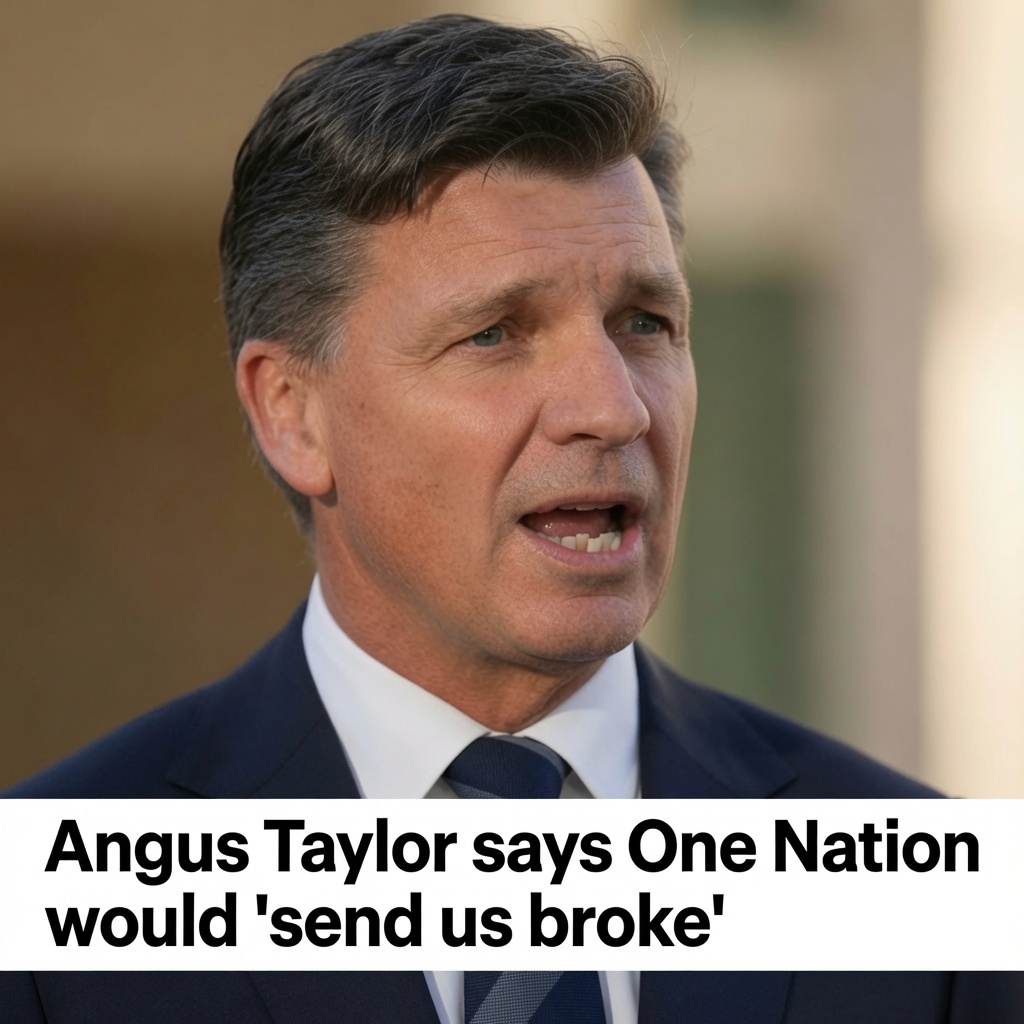
“Australians should never mistake anger with government for a licence to embrace economic recklessness,” Taylor argued, warning that frustration with Labor should not drive voters towards policies that he believes would ultimately leave the country worse off.
The remarks represent a significant shift in the Coalition’s political strategy. Rather than focusing solely on Labor, Taylor is increasingly targeting One Nation as polling suggests the right-wing party continues attracting support from conservative voters dissatisfied with both major parties.
According to Taylor, several expensive One Nation commitments—including proposals relating to income splitting, increased defence spending, fuel excise reductions and other major spending measures—would together impose around $1 trillion in additional costs over ten years. He argued the policies would add inflationary pressure, increase borrowing requirements and ultimately push up interest rates.
One Nation rejects that characterisation, arguing its policies are designed to restore affordability, reduce immigration and strengthen Australia’s economic sovereignty. The party has consistently promoted a more protectionist economic agenda while calling for lower migration, increased support for pensioners and greater domestic manufacturing.
However, Taylor’s criticism extends beyond individual policy proposals. His central argument is that governments cannot simply announce expensive commitments without demonstrating how they will be financed.
That criticism raises a broader constitutional and democratic question that is becoming increasingly relevant as Australia’s political landscape fragments: should parties seeking to replace Labor or the Coalition be expected to submit their policies for independent costing?
Australia already has a mechanism designed for precisely that purpose.
The Parliamentary Budget Office (PBO), established in 2012, provides confidential and independent costings of election commitments for parliamentarians and political parties. During election periods, parties can request official analysis of how proposed policies would affect government revenue, expenditure and the federal budget.
Major parties routinely rely on the Parliamentary Budget Office alongside Treasury and Finance advice when preparing election platforms. Independent MPs and minor parties also have access to the service, although there is currently no legal obligation requiring them to use it.
That voluntary system has attracted renewed attention following Taylor’s speech.
Supporters of mandatory policy costing argue that any party seeking to govern Australia should be prepared to demonstrate how its promises would affect the nation’s finances before asking voters for support.
Under that view, independent costings help voters distinguish between politically attractive promises and economically sustainable policies. They also improve transparency by allowing economists, journalists and the public to scrutinise assumptions before an election rather than after one.
Advocates suggest the requirement should apply equally to every party capable of influencing government formation, whether that means winning office outright or holding the balance of power in Parliament.
Critics, however, caution against creating barriers that disproportionately disadvantage smaller parties.
Minor parties often argue they possess fewer financial and staffing resources than Labor or the Coalition and therefore cannot produce policy development at the same scale. Some also contend that mandatory costings could discourage policy innovation or place excessive reliance on assumptions that may later change with economic conditions.
Others note that governments themselves frequently alter spending forecasts after elections as economic circumstances evolve, meaning even independently costed policies are not guarantees of future fiscal outcomes.
Nevertheless, transparency remains one of the strongest arguments for expanding the use of Parliamentary Budget Office analysis.
If a party presents itself as a realistic alternative government rather than simply a protest movement, many political observers argue voters deserve access to independently verified information about the affordability of its promises.
Taylor sought to reinforce exactly that distinction during his address.
He accused One Nation of functioning more as a vehicle for political dissatisfaction than as a government-in-waiting, describing the party as lacking the organisational depth and coherent economic framework necessary to manage Australia’s finances.
His comments also reflect growing concern within the Coalition about conservative vote leakage. Recent polling has shown One Nation improving its standing among right-of-centre voters, complicating the Coalition’s pathway back to government following its 2025 federal election defeat.
The political challenge is particularly acute because many voters attracted to One Nation are motivated by issues such as immigration, cost-of-living pressures, housing affordability and distrust of major political institutions.
Taylor attempted to acknowledge that frustration while arguing that abandoning fiscal discipline would ultimately worsen those same economic problems.
He claimed unfunded commitments would fuel inflation, increase government borrowing and eventually require difficult spending cuts elsewhere in the budget if debt became unsustainable.
Whether those warnings prove politically persuasive remains uncertain.
Australian elections increasingly feature a larger crossbench and a wider range of political parties than in previous decades. As voters continue moving away from traditional two-party loyalties, questions about policy transparency are becoming more prominent.
Some constitutional experts have suggested that stronger disclosure rules—covering not only fiscal costings but also funding assumptions and implementation timelines—could improve democratic accountability without preventing smaller parties from contesting elections.
Others believe existing arrangements already provide sufficient opportunities for parties to seek independent advice if they choose, leaving voters to judge whether refusing external scrutiny should influence their vote.
Ultimately, the debate highlighted by Taylor’s speech extends well beyond One Nation itself.
It raises a fundamental question about modern Australian democracy: if a political party asks Australians to entrust it with managing a multi-trillion-dollar national economy, should that party first demonstrate—through independent parliamentary analysis—that its promises can realistically be paid for?
Current law says no. Political accountability, however, increasingly suggests that voters may expect the answer to become yes.






