A Queensland police officer has sparked a fierce debate over protest rights and police powers after video showed her telling a Christian anti-abortion campaigner he was “under arrest” for alleged public nuisance, only to later inform him he was “unarrested at this time” and direct the group to leave the area for 24 hours.
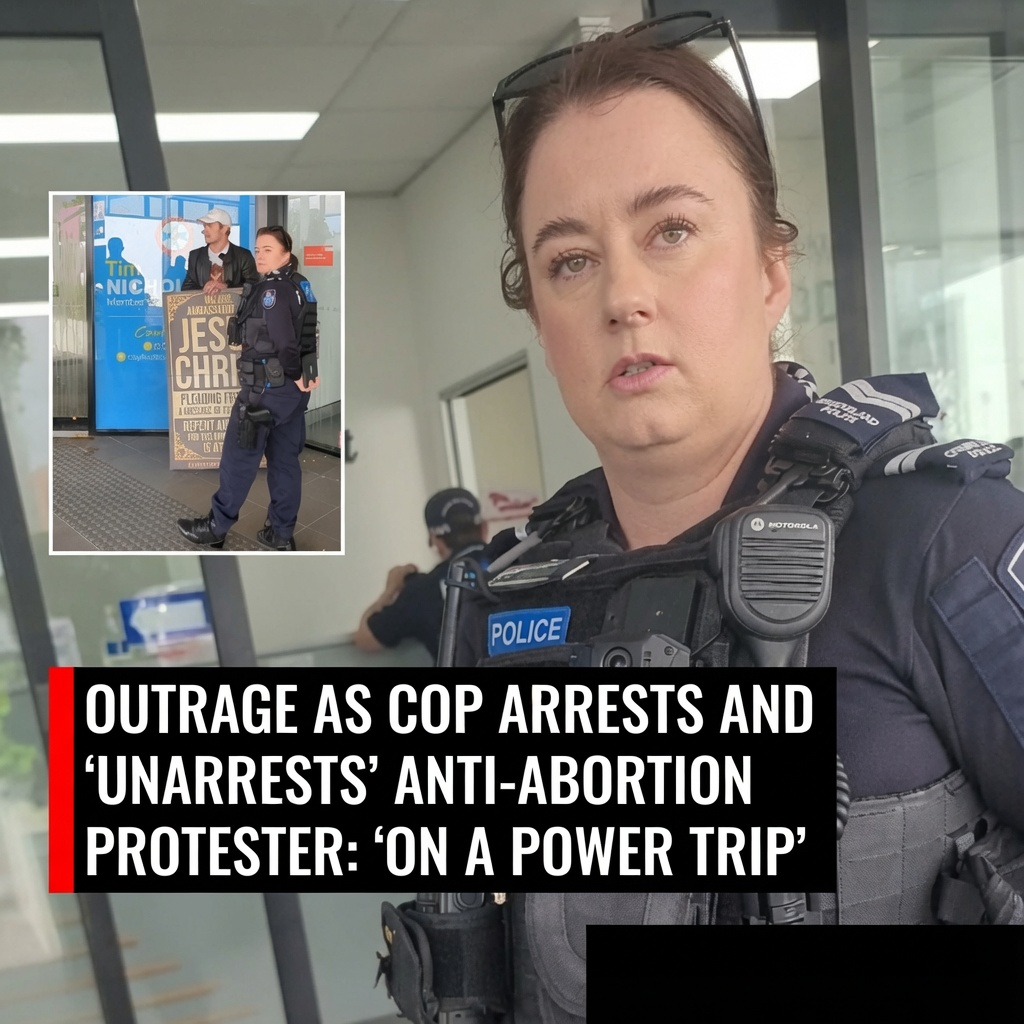
The footage was recorded outside Queensland Health Minister Tim Nicholls’ electorate office in Clayfield on May 29 but was only shared publicly this week by Ambassadors for Christ, the Christian activist group involved in the confrontation.
It shows several protesters standing near the office on Sandgate Road with religious and anti-abortion messages.
One man, identified by the group as Jarryn, held a large sign reading “we are ambassadors of Jesus Christ”.
Another demonstrator wore a T-shirt carrying the words “abolish abortion”.
The protesters appear calm throughout the publicly released footage and repeatedly question the legal basis for the police intervention.
At the centre of the controversy is an extraordinary sequence in which an officer declares Jarryn under arrest, questions the group and then later tells him: “Basically, you’re unarrested at this time.”
The video has prompted accusations online that the officer was on a “power trip” and attempting to police opinions she considered offensive.
However, the footage also raises more complicated legal questions about public nuisance, police move-on powers and Queensland’s specific restrictions on anti-abortion conduct near termination services.
Those issues are not necessarily the same.
According to the footage, police initially focused on whether the protesters were interfering with pedestrian access near the office.
The officer moved a camera tripod and told Jarryn he was “committing an offence of public nuisance”.
She accused him of disrupting the peaceful passage of people seeking to access a business.
Moments later, she told him: “You’re under arrest.”
The officer then began asking questions.
When another demonstrator asked whether the men were required to answer, she warned him that he could be obstructing the investigation.
“You’re going to be obstructing me,” the officer said.
“If you continue obstructing our investigation you’ll be arrested, okay?”
The exchange became more controversial when the officer repeatedly raised the content of the protesters’ anti-abortion messaging.
She told one protester that his “abolish abortion” shirt “could be considered offensive to members of the public”.
The man responded that he was expressing his political opinions.
The officer then referred to health services in the surrounding area.
“Obviously there’s a medical clinic down the road where people seek health facilities, and a pharmacy where people can access abortion medicines,” she said.
“Can you see how that would be considered offensive, where people are accessing their right to have healthcare?”
She added: “You’re literally within 50 metres of somewhere where people access medication.”
Those comments have become the main focus of criticism directed at the officer.
Many viewers interpreted them as an assertion that an anti-abortion message could itself justify police action because somebody nearby might find it offensive.
Queensland law, however, does not generally make political or religious expression a public nuisance merely because another person considers the message offensive.
Section 6 of Queensland’s Summary Offences Act 2005 creates the offence of public nuisance.
The provision applies where a person behaves in a disorderly, offensive, threatening or violent way and that behaviour interferes, or is likely to interfere, with the peaceful passage through or enjoyment of a public place by a member of the public.
The legislation therefore contains more than a simple test of whether somebody is offended by an opinion.
The prosecution must establish conduct falling within the statutory provision and the required interference, or likely interference, with the public’s peaceful passage or enjoyment of the public place.
The full factual circumstances matter.
A sign expressing a controversial view is not automatically unlawful simply because the subject is abortion.
Equally, a person describing themselves as a peaceful protester does not automatically prevent police from acting if officers reasonably suspect an offence has occurred or if conduct is obstructing access.
The publicly circulated video captures only part of the police interaction and does not establish everything officers may have observed before recording began.
But within the footage that has been released, the officer’s repeated emphasis on the possibility that people might find the anti-abortion message “offensive” has driven questions about the legal basis for the initial arrest declaration.
After speaking with three other officers, the officer returned to Jarryn and changed course.
“Okay, so basically you’re unarrested at this time,” she told him.
No public nuisance charge was announced in the footage.
Instead, the group was given a move-on direction.
“You’re all going to be getting a move-on direction, so you won’t be able to come back here for a period of 24 hours, and if you contravene that then you’ll be arrested,” the officer said.
There is no publicly available indication that Jarryn was subsequently charged over the May 29 incident.
The unusual use of the word “unarrested” has attracted particular attention online.
It is not a formal offence or court process.
In ordinary legal terms, police may arrest a person and subsequently release them without charge if continued detention is no longer considered necessary or the basis for further action changes.
The precise legal status of Jarryn during the filmed exchange would depend on the circumstances of the arrest, the officer’s exercise of police powers and the complete sequence of events.
Queensland Police have not publicly released a detailed account explaining why the arrest was initiated and then discontinued.
The footage has also generated confusion over Queensland’s abortion safe access zone laws.
Queensland established safe access zones under the Termination of Pregnancy Act 2018.
A safe access zone generally covers a termination services premises and the area within 150 metres of an entrance to those premises.
Within the zone, certain conduct relating to terminations is prohibited if it would be visible or audible to another person entering or leaving the premises and would be reasonably likely to deter that person from entering or leaving, or from requesting or undergoing a termination.
The law also addresses conduct reasonably likely to cause distress or anxiety to a person entering or leaving a termination services premises.
Recording people entering or leaving such premises is separately restricted in specified circumstances.
The legislation was designed to protect access to abortion services and the privacy of patients and staff.
But the existence of a medical clinic or pharmacy nearby does not, by itself, automatically transform every surrounding street into an abortion safe access zone.
The legal question is whether the relevant premises meets the statutory definition of a termination services premises.
The Queensland Government describes a termination services premises as premises at which terminations are performed.
A pharmacy dispensing medication used for a medical abortion is not necessarily, solely for that reason, a premises where a termination is performed.
Nothing in the publicly available account of the Clayfield confrontation establishes that the protesters were standing within a statutory safe access zone.
The officer in the video referred to a pharmacy where people could access abortion medication and a medical clinic down the road.
She did not, in the circulated footage, identify a specific termination services premises or tell the group they were being arrested for breaching the Termination of Pregnancy Act.
Instead, the stated initial allegation was public nuisance.
That distinction is central to understanding the controversy.
The protesters were not filmed immediately outside an identified abortion clinic.
They said they had deliberately gone to the electorate office of Tim Nicholls because of his role as Queensland Health Minister.
Mr Nicholls’ official parliamentary profile lists his Clayfield electorate office at Shop 1, 729 Sandgate Road.
The protest occurred during a renewed political battle over abortion policy in Queensland.
Only days after the May 29 confrontation, abortion again became the subject of heated debate in state Parliament.
Katter’s Australian Party moved to disallow regulatory changes concerning the prescribing of termination medication by endorsed midwives and nurse practitioners.
Mr Nicholls strongly opposed the Katter party’s interpretation of the changes.
He described its argument as misinformed and misconceived and said the government would not change Queensland’s termination of pregnancy laws.
One Nation’s Barnaby Joyce, meanwhile, addressed an anti-abortion rally outside Parliament during the dispute.
Against that political backdrop, Ambassadors for Christ says its demonstration outside the Health Minister’s office was intentional political and religious advocacy.
Jarryn has rejected suggestions circulating online that the group was protesting outside an abortion clinic.
“The reason for the arrest was not because I did anything wrong, it was because they didn’t like what we were saying nor who our authority was,” he told Noticer News.
That is Jarryn’s interpretation of the officer’s conduct and has not been established by an independent investigation.
He remains unapologetic about the group’s anti-abortion message.
“We can say abortion is murder because we have a justification for that statement, provided by our Christian worldview,” he said.
“Abortion is murder, but forgiveness for murder can be found in Christ.”
Jarryn went on to say Christians would “flood parliament, the culture, the high courts” and predicted abortion would ultimately be abolished in Australia.
Those comments underline the explicitly religious and political character of the group’s campaign.
Ambassadors for Christ is not presenting its anti-abortion position as neutral health information.
Its members are openly seeking cultural and political change based on their Christian beliefs.
That speech is deeply offensive to many Australians, particularly people who have had abortions or support reproductive rights.
It is equally strongly supported by some Christian and anti-abortion Australians.
The fact that a political message provokes anger does not, by itself, settle whether police can lawfully stop it.
That is why the Clayfield video has resonated beyond the abortion debate.
The footage presents a broader question about the role of police when controversial speech takes place in public.
Police officers routinely deal with disputes where one person’s claimed right to protest intersects with another person’s right to use a public space without obstruction, harassment or intimidation.
The legal line is often highly dependent on conduct.
Where people stand can matter.
Whether an entrance is blocked can matter.
The volume and persistence of communication can matter.
The target of the communication can matter.
And, in the case of abortion services, the existence of a statutory safe access zone can fundamentally change what conduct is permitted.
In the Clayfield footage, the officer told Jarryn he was disrupting people’s peaceful passage to a business.
The protesters disputed that claim.
Social media commenters have also pointed to moments in the video where several police officers themselves occupy part of the walkway during the interaction.
That comparison has fuelled accusations of hypocrisy, although a police response to an incident and the conduct that initially prompted officers to attend are not necessarily assessed in the same way.
The full interaction would need to be examined to determine whether the legal threshold for public nuisance was reasonably suspected at the time of the arrest.
No court has made such a finding.
Nor has there been a publicly announced police disciplinary finding that the officer acted unlawfully or engaged in misconduct.
The strongest public criticism has instead come through social media.
Political commentator Joel Jammal wrote: “She would do well in the UK police force. Go and police real crimes.”
Another commenter accused the officer of bias and argued that finding a message offensive did not create a right to silence it.
“Someone is on a power trip,” another wrote.
One viewer praised the protesters for remaining calm and respectful and described the officer’s handling of the situation as embarrassing and unprofessional.
Those reactions reflect what viewers saw in the edited video released by the protest group.
They are not official findings about the officer.
The distinction is particularly important because viral police footage can rapidly produce a public verdict before a complete incident record is available.
Body-worn camera footage, police logs, calls for service and statements from officers or members of the public could potentially provide additional context.
It is not publicly known whether Queensland Police has received a formal complaint about the incident.
It is also not clear whether the service has conducted or intends to conduct an internal review of the officer’s exercise of arrest and move-on powers.
The Police Powers and Responsibilities Act gives Queensland officers authority to issue move-on directions in prescribed circumstances.
Those powers are intended to deal with conduct in public places that causes anxiety, interferes with trade or business, disrupts events or interferes with the peaceful passage of people.
A person who fails to comply with a lawful move-on direction may commit an offence.
The law also places limits and procedural requirements around the use of police powers.
The existence of a move-on power does not mean officers have an unlimited authority to remove anyone expressing an unpopular view.
As with public nuisance, the factual and legal basis for the direction matters.
The video shows the protesters complying with the direction after being told they could not return for 24 hours.
There is no report that any member of the group was arrested for breaching that direction.
The incident therefore ended without the dramatic outcome suggested by the officer’s initial words.
Jarryn was told he was under arrest.
He was questioned.
Other officers were consulted.
He was then told he was “unarrested”.
The group was ordered to move on.
Weeks later, the video was published and the argument moved from a Clayfield footpath to social media.
For critics of the police response, the footage is an example of an officer confusing offence with offensiveness and using police powers to suppress a lawful political message.
For supporters of abortion access, the broader context includes the reason Queensland created safe access zones in the first place: to prevent patients from being harassed, intimidated or distressed when seeking health care.
But the legal and factual question in this particular incident cannot be answered simply by choosing a side in the abortion debate.
It turns on what the protesters were doing, whether they were obstructing or interfering with public passage, what officers reasonably suspected, and whether any nearby premises legally qualified for the specific protections of a termination safe access zone.
The publicly released footage leaves significant questions about the initial arrest decision.
The officer’s repeated references to the protesters’ message being “offensive” have understandably become the most controversial part of the exchange.
Yet there has been no court ruling on the incident and no public Queensland Police misconduct finding.
What is beyond dispute is the unusual language captured on camera.
“You’re under arrest,” the officer told Jarryn.
After consulting colleagues, she returned with a different message.
“Basically, you’re unarrested at this time.”
That reversal has now ensured a brief anti-abortion protest outside a Brisbane MP’s office will be debated as much for the conduct of police as for the message on the protesters’ signs.






