Australia’s debate over immigration was once again thrust into the spotlight after a small group of demonstrators gathered outside a major community event welcoming Indian Prime Minister Narendra Modi during his visit to Melbourne.
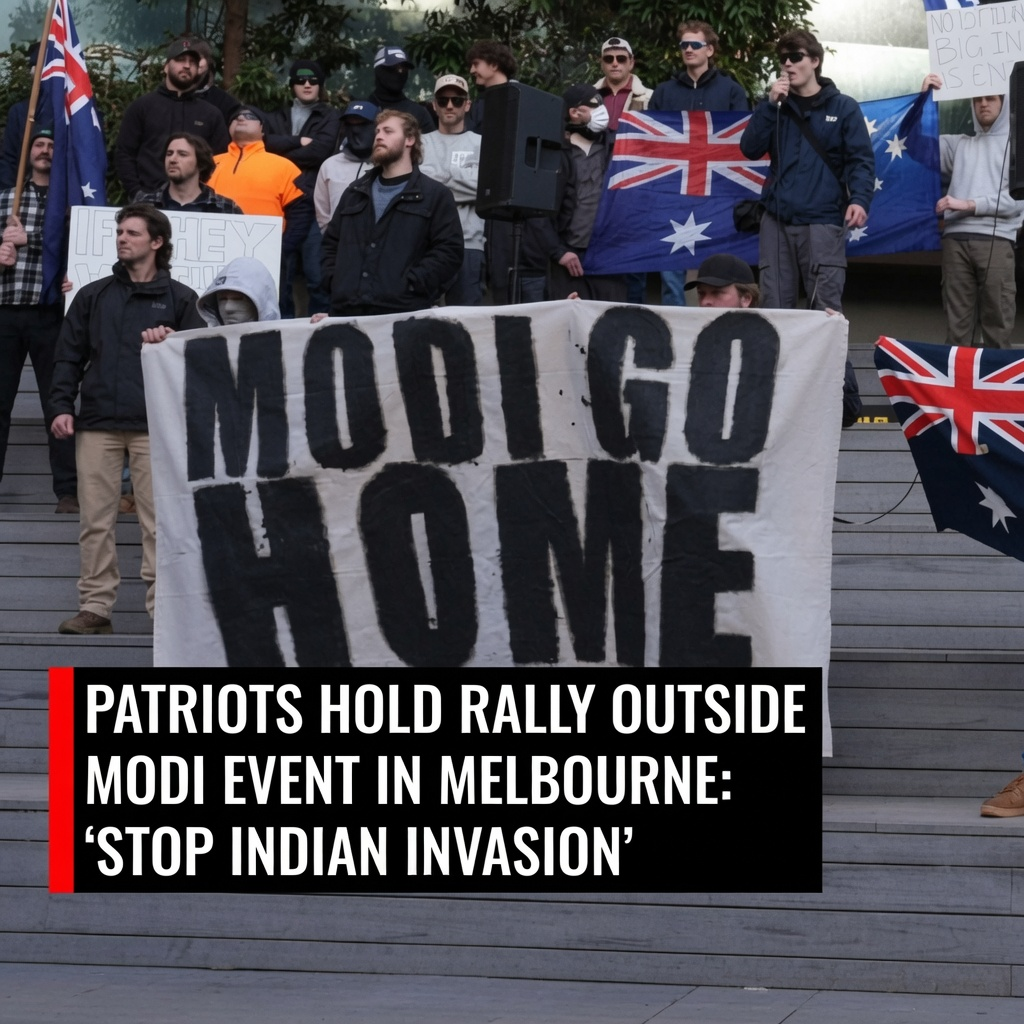
The protest took place outside the “Melbourne Meets Modi” event, where thousands of supporters gathered inside Marvel Stadium to welcome the Indian leader during his official visit to Australia.
Demonstrators carried banners reading “Modi go home: take the rest with you” and “Stop Indian invasion”, reflecting opposition to Australia’s current immigration settings and concerns among participants about the scale of migration from India.
The gathering remained focused on expressing political views about immigration policy rather than disrupting the official event itself. Images circulating online showed protesters standing outside the venue displaying signs directed both at Prime Minister Modi and Australia’s migration policies.
The demonstration occurred while Prime Minister Anthony Albanese joined Mr Modi inside the sold-out community event, where both leaders highlighted the growing relationship between Australia and India and praised the contribution of the Indian-Australian community. Tens of thousands of attendees packed Marvel Stadium in what organisers described as one of the largest community receptions ever held for a visiting foreign leader in Australia. Recent reporting described the event as attracting enormous public interest among Australia’s Indian diaspora.
The protest was one of several demonstrations linked to Mr Modi’s visit. Separate groups, including human rights advocates and Sikh organisations, also announced or staged protests raising concerns about issues including religious freedoms, minority rights and developments within India. Those demonstrations reflected a broad range of political perspectives rather than a single coordinated campaign.
For many Australians, however, the demonstration outside Marvel Stadium also highlighted a domestic issue that has become increasingly prominent in political debate: immigration.
Australia’s migration program has remained one of the country’s most discussed public policy issues over recent years. Successive governments have argued that skilled migration helps address labour shortages, supports economic growth and contributes to Australia’s long-term prosperity. Business organisations have frequently argued that migration is necessary to fill positions in sectors including healthcare, engineering, construction, technology and hospitality.
Critics, however, argue that rapid population growth has intensified pressure on housing affordability, rental availability, transport infrastructure and public services. Immigration has therefore become an increasingly significant political issue across federal and state politics.
India has become one of Australia’s largest sources of permanent and temporary migrants, particularly through skilled migration programs, university enrolments and temporary graduate visas. The Indian-born population has grown rapidly over the past decade, making it one of Australia’s largest overseas-born communities.
Many Indian migrants have established businesses, entered professional occupations and contributed to sectors experiencing workforce shortages. Government leaders from both major parties have regularly highlighted these contributions when discussing Australia’s multicultural society.
Prime Minister Albanese used the Melbourne event to describe India as one of Australia’s most important strategic partners, pointing to expanding cooperation across trade, defence, education, critical minerals and clean energy. Mr Modi likewise praised the role played by the Indian diaspora in strengthening bilateral ties between the two democracies.
Australia and India have significantly expanded their strategic relationship over recent years through defence cooperation, investment agreements and the Australia-India Economic Cooperation and Trade Agreement. Both countries also participate in the Quad partnership alongside the United States and Japan, with leaders describing closer cooperation as increasingly important for regional security.
Supporters of stronger Australia-India ties argue the relationship delivers substantial economic and geopolitical benefits while creating opportunities for businesses, students and researchers in both countries.
Others contend that diplomatic engagement should not prevent debate about Australia’s domestic migration settings or broader questions surrounding population growth.
Immigration has featured prominently in Australian political discussion as housing costs continue to rise in many major cities. Analysts have pointed to a combination of factors influencing affordability, including construction rates, interest costs, population growth, planning restrictions and housing supply.
Political parties have proposed a range of responses, including reducing migration, increasing housing construction, expanding infrastructure investment and reforming planning systems. The appropriate balance between economic growth and population growth remains the subject of ongoing public debate.
The slogans displayed during Thursday’s protest reflected one side of that broader conversation. While some Australians support significantly lower migration levels, others argue immigration remains essential to Australia’s economy and multicultural identity.
Freedom of political communication and peaceful assembly remain longstanding features of Australia’s democratic system. Public demonstrations are regularly held in Melbourne on issues ranging from international conflicts and environmental campaigns to industrial relations, public health measures and immigration policy. Federation Square and surrounding areas have long served as gathering places for political demonstrations, with authorities encouraging organisers to coordinate with police to help manage public safety.
Victoria Police maintained a presence around the Marvel Stadium precinct as thousands of people attended the community event, with no major public disorder reported in connection with the protest.
The contrasting scenes inside and outside the venue illustrated the sharply different views surrounding both Mr Modi and Australia’s immigration policies.
Inside the stadium, supporters celebrated India’s growing international influence and Australia’s deepening partnership with one of the world’s fastest-growing major economies. Outside, protesters used the occasion to express concerns about migration levels and Australia’s future direction.
As Australia’s political debate over migration continues, events such as the Melbourne protest demonstrate how international diplomacy and domestic policy discussions increasingly intersect. Visits by foreign leaders often become focal points for wider debates extending beyond bilateral relations, providing opportunities for both supporters and critics to publicly express their views.
Whether future governments maintain current migration settings or pursue significant reforms is likely to remain a major issue in Australian politics, particularly as housing affordability, infrastructure capacity and population growth continue to shape public discussion ahead of future elections.