Australia’s productivity slump has become one of the biggest economic concerns facing the country.
Now, a new warning from the Productivity Commission has added fuel to an already heated national debate about energy policy, government spending and the long-term cost of the transition away from coal-fired power.
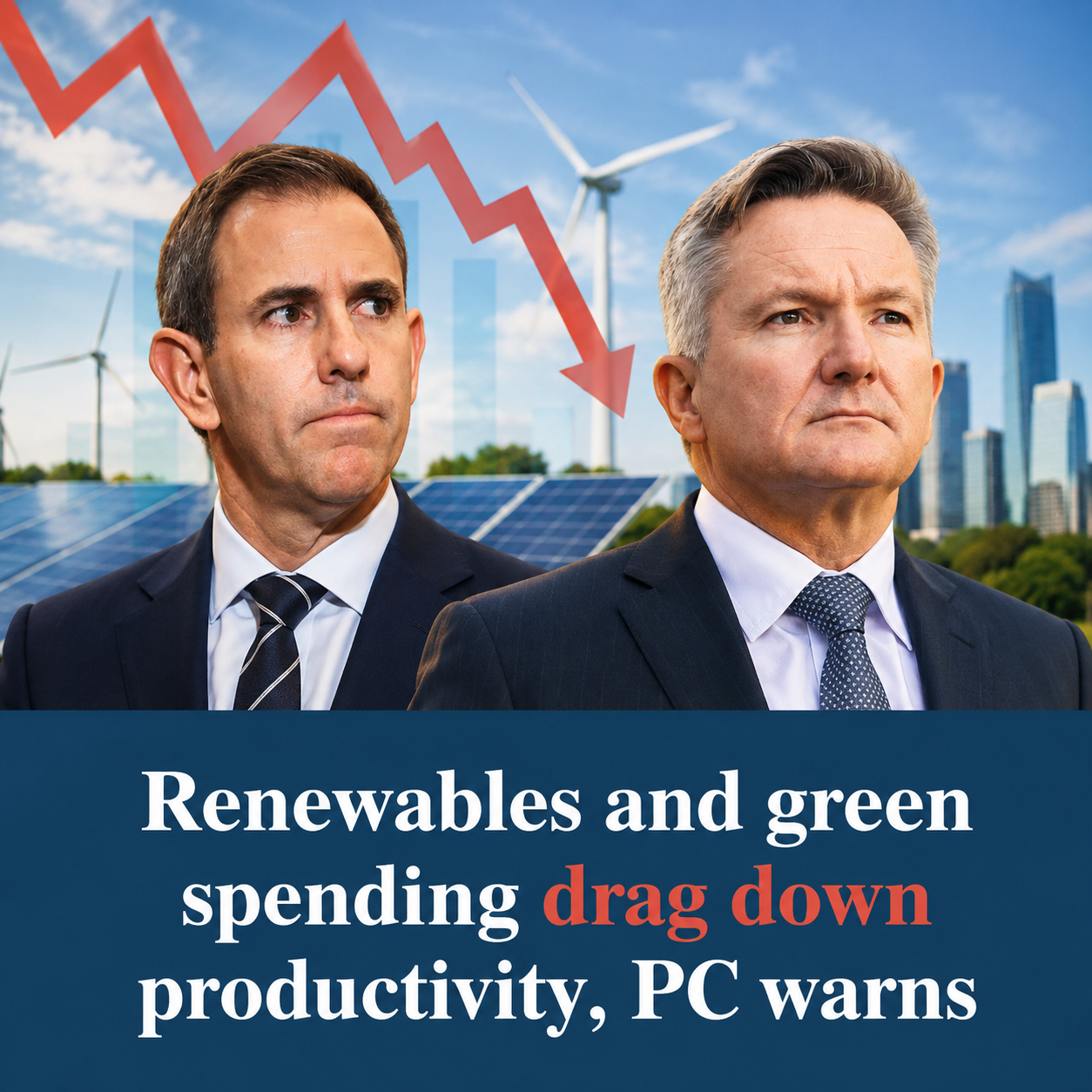
According to the commission, billions of dollars being poured into renewable energy infrastructure are contributing to weaker productivity figures across the economy.
The warning does not argue that Australia should abandon the energy transition.
Instead, it raises a difficult question.
How can the country modernise its energy system without sacrificing economic efficiency along the way?
The answer could have major implications for electricity prices, living standards and economic growth for years to come.
The Productivity Commission’s assessment comes at a time when productivity growth has become one of the central challenges confronting policymakers.
Productivity measures how efficiently an economy turns labour, capital and resources into goods and services.
When productivity rises, businesses can produce more with the same inputs.
When productivity falls, economic growth becomes harder to achieve and living standards can come under pressure.
Recent figures show Australia’s productivity performance remains weak by historical standards.
Labour productivity fell during the first quarter of 2026 and annual growth remains subdued, adding to concerns that the economy is struggling to generate stronger gains in efficiency.
Against that backdrop, the Productivity Commission has pointed to one important factor affecting the numbers.
The transition from coal-fired generation to renewable energy requires enormous capital investment.
New transmission lines, wind farms, solar facilities, storage projects and supporting infrastructure all require significant spending before they can deliver substantial economic output.
Deputy Chair Alex Robson noted that capital investment has surged dramatically over the past two decades while output growth has been much slower.
That imbalance is one reason measured productivity has weakened.
The argument is not necessarily that renewable energy is unproductive.
Rather, the commission’s concern is that the scale of investment required can temporarily reduce productivity measurements because capital is being deployed faster than economic output is increasing.
In simple terms, Australia is spending enormous sums today in anticipation of benefits that may arrive years later.
That creates a challenge for governments.
Voters are often told that renewable energy will ultimately deliver cleaner and cheaper power.
However, the transition period itself can involve substantial costs, construction delays and infrastructure bottlenecks.
Those costs can weigh on economic performance before the promised benefits fully emerge.
The commission therefore argues governments must focus relentlessly on efficiency.
Not every project will generate the same value.
Not every investment will produce the same economic return.
Its message is that scarce public resources should be directed towards projects that achieve emissions reductions at the lowest possible cost.
The findings arrive at a politically sensitive moment.
Labor has made the energy transition one of the defining projects of its economic agenda.
Billions of dollars are being directed towards renewable generation, transmission infrastructure and climate-related programs.
The government argues these investments are essential to modernising Australia’s economy and protecting households from future energy shocks.
Treasurer Jim Chalmers has repeatedly identified productivity growth as one of the government’s key economic priorities.
That makes the commission’s warning particularly significant.
It highlights the tension between long-term climate objectives and short-term economic performance.
Supporters of the transition argue critics focus too heavily on immediate costs while ignoring future benefits.
They point out that ageing coal-fired power stations require replacement regardless of climate policy.
They also argue that delaying investment could create even greater costs in the future through higher energy prices, reliability problems and climate-related economic damage.
Critics take a different view.
They argue Australia has rushed into an expensive transition without adequately considering the impact on productivity, industry competitiveness and electricity affordability.
For these critics, the commission’s findings validate concerns that economic performance is being sacrificed in pursuit of political targets.
The debate extends beyond electricity generation.
Energy costs influence almost every sector of the economy.
Manufacturing, mining, agriculture, transport and construction all depend on reliable and affordable power.
When energy becomes more expensive, businesses often face higher operating costs that can eventually flow through to consumers.
That is one reason productivity discussions attract such intense attention.
Productivity may sound like an abstract economic concept, but its consequences are deeply practical.
Over the long term, productivity growth is one of the strongest drivers of wages, business investment and living standards.
The Productivity Commission’s warning therefore goes well beyond a technical economic report.
It is a reminder that major economic transitions involve trade-offs.
Every dollar invested in new infrastructure must eventually generate value.
Every policy choice carries costs as well as benefits.
The challenge for governments is ensuring those costs remain as low as possible while pursuing broader national objectives.
That balancing act is likely to become even more important as Australia continues moving towards a lower-emissions economy.
The commission is not calling for the transition to stop.
Its message is more targeted than that.
If governments want stronger productivity growth, they must ensure every major investment delivers the maximum possible return for taxpayers, consumers and the broader economy.
As concerns about living costs, electricity prices and economic growth continue to dominate public debate, that warning is likely to resonate far beyond Canberra.






