Australia’s housing war has entered another volatile chapter, and this time the fight is no longer simply about affordability slogans.
It is becoming a direct confrontation over who gets to build wealth through property, how far the tax system should reward investment ownership, and whether the political class is prepared to fundamentally redraw one of Australia’s most emotionally charged financial rulebooks.
That is why Pauline Hanson’s latest intervention matters far beyond party politics.
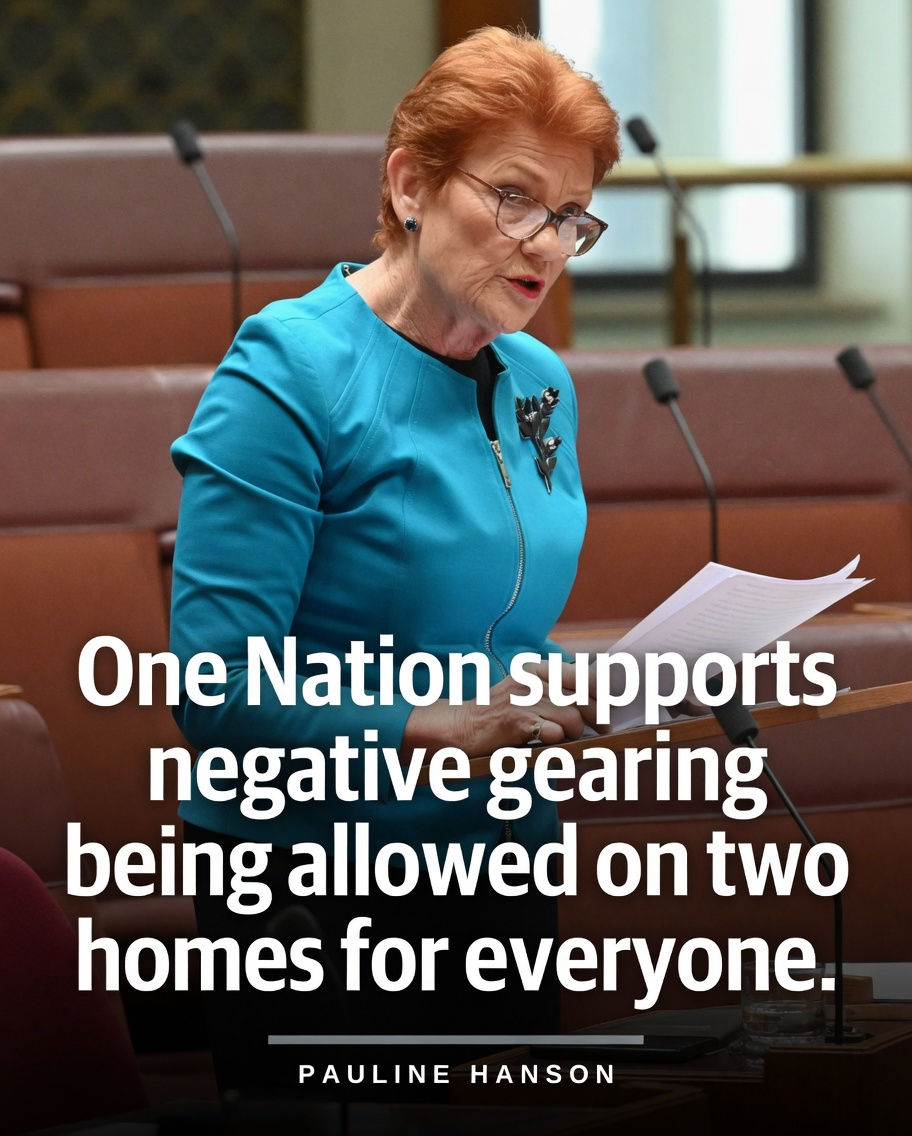
A fresh political push to cap investment property tax advantages is reopening major questions about housing affordability, investor confidence and the future shape of Australian wealth creation.
The proposal itself is straightforward enough to understand.
Rather than fully abolishing negative gearing access in the way some reform advocates have argued, Hanson has floated an alternative model where Australians could still use the concession, but only up to a maximum of two investment properties.
Simple proposal.
Enormous consequences.
Because housing policy in Australia is never just housing policy.
It is family wealth policy.
Retirement planning policy.
Intergenerational fairness policy.
Consumer confidence policy.
And, increasingly, political identity policy.
That is what makes this debate uniquely combustible.
Negative gearing has sat at the centre of Australian housing politics for decades because it sits right where emotion and economics collide.
Supporters see it as a legitimate investment mechanism.
You borrow, absorb losses during early years, offset those losses against taxable income, and aim to benefit later through rental income growth or capital appreciation.
In that worldview, it is simply rational financial planning.
Critics see something very different.
They argue the same system effectively rewards leveraged asset accumulation, inflates investor demand, and makes it harder for owner-occupiers — especially younger Australians — to compete for housing stock.
Both narratives have political force because both connect to genuine lived experiences.
The frustrated renter watching weekly housing costs rise.
The investor who spent years taking financial risk under rules they believed were stable.
The first-home buyer repeatedly outbid.
The retiree who sees property as long-term security rather than speculation.
That is why there are no emotionally easy answers here.
Hanson’s proposal attempts to carve out political middle ground.
Not a full abolition.
Not unlimited access.
A cap.
That framing is politically clever because it allows reform language without fully embracing aggressive anti-investor positioning.
But middle-ground tax policy can still create major market consequences.
Because investors do not only react to final legislation.
They react to changing expectations.
If the political consensus begins shifting toward the idea that investor tax concessions should be progressively narrowed, behaviour changes immediately.
Purchase timing changes.
Portfolio strategy changes.
Borrowing decisions change.
Risk appetite changes.
That matters because property markets run heavily on confidence and expectation, not just legal paperwork.
The broader housing context makes this especially sensitive.
Australia remains deep inside an affordability crisis that has become politically toxic.
Renters are under sustained pressure.
Mortgage holders are stretched.
Younger Australians increasingly question whether home ownership remains realistically achievable.
Supply constraints remain unresolved.
That environment creates fertile political ground for reform proposals that would once have looked untouchable.
And once politically untouchable ideas become mainstream debate, markets notice.
The investor confidence question is unavoidable.
Critics of tighter negative gearing rules argue discouraging investors could reduce rental supply and worsen pressure on tenants, especially in already constrained markets.
The logic is straightforward.
If fewer private investors buy rental stock, fewer rental homes may be available.
Less supply can mean higher rents.
That argument remains politically powerful because it is intuitive.
Reform advocates push back hard.
They argue investor-friendly tax settings have helped fuel speculative demand without solving affordability, meaning the current model protects incumbent wealth while locking out new entrants.
That side frames reform as fairness correction.
The truth is the housing system has become so politically distorted that almost every proposal now creates winners and losers.
That makes clean reform extraordinarily difficult.
The generational angle may be the most emotionally potent of all.
Older Australians who bought property under earlier conditions often interpret success through discipline, sacrifice and financial planning.
Younger Australians increasingly see the same system through a very different lens.
One where timing, policy design and structural asset inflation created barriers previous generations never faced at the same scale.
That fairness divide is politically dangerous because it maps directly onto voting behaviour.
Housing is no longer just economics.
It is cultural frustration.
The financial sector is watching closely too.
Housing tax reform affects far more than landlords.
It touches mortgage lending behaviour, household confidence, construction activity, consumer spending and broader perceptions of economic stability.
This is not a niche property investor debate.
It sits much closer to macroeconomic policy than many casual observers realise.
The politics are becoming even messier because the current environment is already unstable.
Labor’s broader housing tax changes have already shaken assumptions about what is politically possible.
The Greens want tougher reform.
The Coalition is hostile to sweeping investor crackdowns.
Crossbench arithmetic matters.
That creates uncertainty, and uncertainty is often enough to alter behaviour before laws even change.
The most important question is not whether Hanson’s exact model becomes law.
It is whether Australia has entered a structural political phase where investment property tax concessions are permanently open to renegotiation.
If the answer is yes, then the implications are much larger than one policy proposal.
Because the assumption of stability is what underpins long-term financial planning.
Once households lose confidence that the rules are durable, investment psychology shifts.
The deeper trust issue may matter most.
Do Australians believe housing reform is genuinely about affordability?
Do they believe political leaders have a coherent long-term plan?
Or do they see piecemeal interventions that create uncertainty without fixing supply?
That trust gap will shape how every future housing proposal is received.
Because this fight is no longer simply about negative gearing.
It is about whether Australia is rethinking the entire social contract around property ownership and middle-class wealth creation.






