One Nation leader Pauline Hanson is facing renewed scrutiny after previous comments she made about domestic violence, family law and victim support policies resurfaced in the wake of widespread criticism over her recent description of domestic violence as “a two-way street”.
The latest controversy began following a radio interview on Brisbane station 4BC in which Senator Hanson described domestic violence as “a two-way street” while discussing relationship violence and broader social issues.
The comments prompted immediate criticism from domestic violence organisations, legal experts, government ministers and advocacy groups, many of whom argued the remarks failed to reflect the realities faced by victim-survivors of abusive relationships.
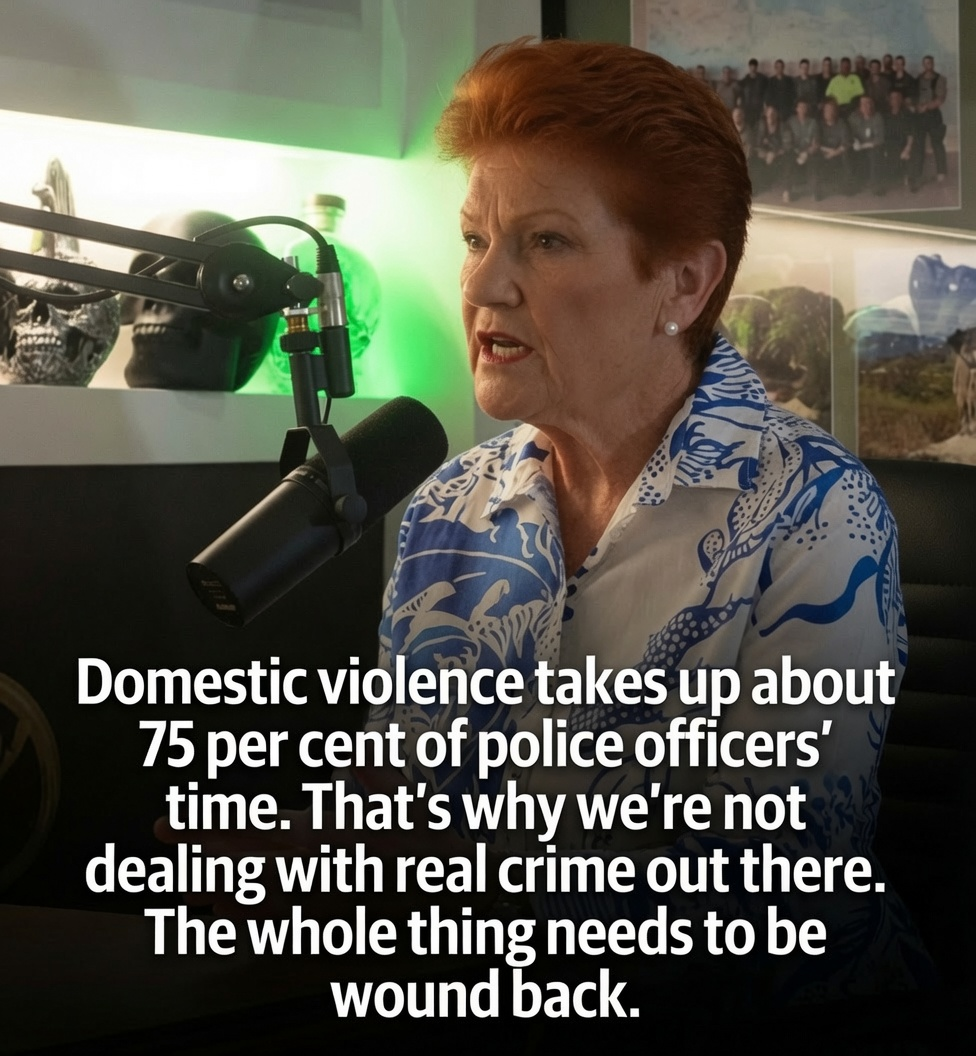
Shortly afterwards, attention shifted to an appearance Hanson made on the Broken Fathers podcast late last year, where she discussed Australia’s family law system, domestic violence legislation and police priorities.
During that interview, Hanson argued Australia’s family law framework had become unbalanced and claimed some legal protections designed for victim-survivors were being misused.
She criticised aspects of the Family Court system, saying it disadvantaged some fathers during parenting disputes and child support proceedings.
“I believe that you’ve got to wind back a lot of issues to do with the family law court,” Hanson said during the podcast.
She also questioned Australia’s paid family and domestic violence leave provisions, describing the entitlement as open to abuse and suggesting false allegations could occur.
In the same interview, Hanson claimed domestic violence investigations were consuming a substantial proportion of police resources and argued law enforcement attention should be redirected towards other forms of offending.
Those comments have attracted renewed attention because they appear consistent with Hanson’s broader argument this week that domestic violence should not always be viewed through the lens of male perpetrators and female victims.
During the 4BC interview, Hanson acknowledged that domestic violence was “a scourge” and said she had personally experienced domestic violence earlier in life.
However, when asked to condemn male perpetrators, she said violence was “also a two-way street” and added that “women can lose their cool as well.”
The remarks generated immediate backlash from domestic violence specialists who argued the comments risked minimising patterns of coercive control and intimate partner violence that disproportionately affect women.
Australia’s Sex Discrimination Commissioner Dr Anna Cody described any suggestion that victim-survivors share responsibility for abuse as “harmful, wrong and dangerous.”
National Children’s Commissioner Anne Hollonds similarly warned that families escaping domestic violence should be supported rather than judged and said public discussion should reflect the complexity of abusive relationships.
Domestic violence organisations also stressed that while violence can occur in relationships involving people of any gender, Australian criminal justice and health data consistently show women experience the overwhelming majority of serious intimate partner violence, coercive control and domestic homicide.
Specialists further emphasised that many abusive relationships involve sustained patterns of intimidation, isolation, financial abuse and psychological manipulation rather than isolated arguments between partners.
Following the criticism, Senator Hanson defended her position on social media.
Posting on X, she rejected suggestions that she had excused domestic violence or blamed victim-survivors.
“Here’s exactly what I said on 4BC about domestic violence so you don’t get it twisted by the media or the Labor Party,” she wrote before sharing the complete interview.
Hanson argued critics had selectively quoted portions of her comments while ignoring statements in which she condemned domestic violence and encouraged people not to remain in unsafe relationships.
The political fallout has continued to grow.
Education Minister Jason Clare said Hanson’s description of domestic violence as “a two-way street” fundamentally misunderstood the issue.
“One in four Australian women are victims of domestic violence,” he said.
“That’s one in four women who are violently attacked by people who tell them that they love them. That’s not a two-way street. That’s a crime.”
Clare suggested the controversy could influence public perceptions of One Nation as the party seeks to build on improved polling in recent months.
Coalition frontbencher Jonathon Duniam also criticised the remarks, describing them as an unhelpful contribution to an issue requiring serious discussion rather than simplistic political slogans.
His comments reflected broader concern across the political spectrum that public debate about domestic violence should remain focused on evidence-based policy and victim safety.
Experts note that leaving an abusive relationship is frequently the period of greatest danger for victim-survivors.
Research consistently shows the risk of serious assault or homicide often increases during separation, leading police and specialist domestic violence services to recommend carefully planned safety strategies rather than simply advising victims to leave immediately.
Advocates argue that financial dependence, housing shortages, concerns for children, emotional manipulation and fear of retaliation often prevent victim-survivors from leaving abusive relationships even when they recognise the danger.
Those realities have become increasingly important as Australian jurisdictions introduce coercive control laws recognising that domestic violence often extends beyond physical assault to include sustained psychological and financial abuse.
The debate has also reignited discussion about Australia’s family law system.
Some fathers’ advocacy organisations argue reforms are needed to improve outcomes for separated fathers and address false allegations where they occur.
Conversely, legal experts and domestic violence organisations maintain existing protections remain essential because false allegations represent only a small proportion of reported cases, while many genuine incidents of family violence continue to go unreported.
Successive Australian governments have introduced additional funding for frontline domestic violence services, emergency accommodation, legal assistance and prevention programs in response to persistent concerns about violence against women.
Despite political disagreement over aspects of family law and domestic violence policy, there is broad consensus across governments, police agencies and specialist organisations that domestic violence remains one of Australia’s most significant public safety and public health challenges.
For Senator Hanson, the renewed attention ensures her earlier podcast comments will continue to be examined alongside her more recent interview as debate continues over the language used by political leaders when discussing domestic and family violence.
While Hanson maintains her remarks have been misrepresented and taken out of context, critics argue public figures carry a responsibility to communicate carefully on an issue where inaccurate or oversimplified messaging may discourage victim-survivors from seeking help or undermine confidence in support services.






