Pauline Hanson has issued a stark warning that Australia is heading towards the same social divisions she says have transformed parts of Britain, declaring the country must “chart a different course” after a controversial tour of an English town with far-right activist Tommy Robinson.
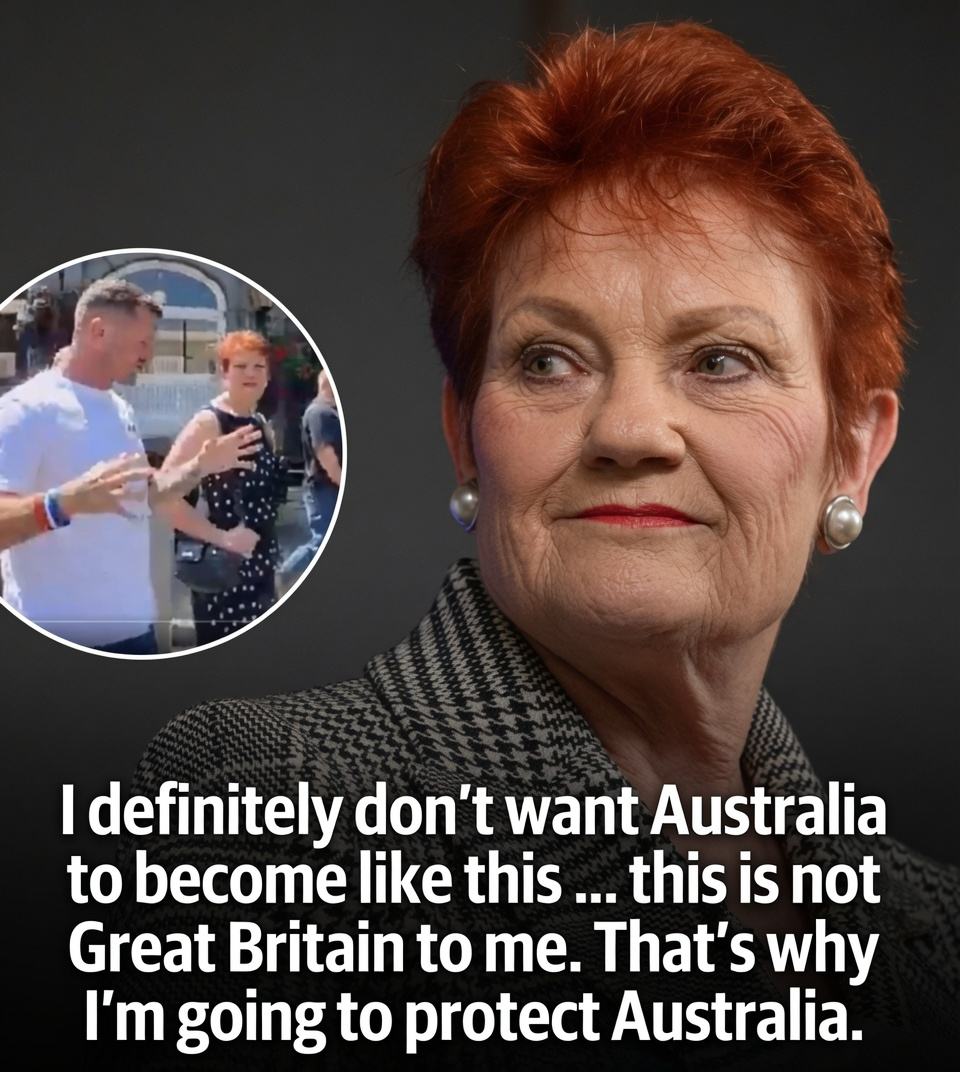
The One Nation leader said she was horrified by what she believed had happened in parts of the United Kingdom and argued Australia was travelling along a similar path.
“It is horrifying and very sad what has happened in parts of the UK,” Senator Hanson said in comments shared by One Nation.
“The fundamentals ensure that exactly the same thing will happen here. This is not scaremongering.
“It will happen as surely as night follows day. This is the journey we are on.
“There is an alternative. A path that involves us smelling the coffee and charting a different course.”
The warning follows Senator Hanson’s visit to Luton, north of London, with Robinson, whose real name is Stephen Yaxley-Lennon.
During the tour, Hanson said she was “gobsmacked” and declared: “I definitely don’t want Australia to become like this.”
“This is not Great Britain to me, and that’s why I’m going to protect Australia,” she said.
The footage has become one of the most provocative moments of Hanson’s latest overseas trip and has intensified debate in Australia over One Nation’s increasingly explicit campaign against mass migration and multiculturalism.
It has also placed renewed scrutiny on Hanson’s relationship with Robinson, a deeply divisive British political activist with a lengthy history of criminal convictions.
Robinson took the Queensland senator through his hometown of Luton, about 45 kilometres north-west of central London.
At the beginning of footage circulated online, Robinson said he intended to show Hanson what he described as the “rapid decline” of the town because of mass Islamic immigration.
He told viewers the pair would drive through what he called “the Muslim area” and look at how “Islamified” the town had become.
Those descriptions are Robinson’s political characterisation of Luton and should not be treated as neutral or independently established findings about the town.
But Hanson clearly emerged from the visit accepting the central warning Robinson wanted to present.
As the pair walked through the streets, Robinson repeatedly directed Hanson’s attention to the town’s population and asked what she thought of its demographic character.
“I’m gobsmacked because I wouldn’t think that I was in England,” Hanson responded.
She later expanded on her reaction from inside a vehicle.
“I definitely don’t want Australia to become like this,” she said.
“This is not Great Britain to me, and that’s why I’m going to protect Australia.”
The pair received mixed reactions while moving through Luton.
Some people stopped to speak with them and posed for photographs with Robinson.
Others confronted the British activist.
“We don’t want you around here,” one person told him.
“You’re a racist.”
At another point, Robinson attempted to film inside the Discover Islam centre but was refused permission.
He subsequently made allegations about the centre, describing it as a “jihadi centre”.
No evidence establishing that characterisation was presented in the footage, and the claim should be understood as Robinson’s allegation rather than a verified fact.
The encounter demonstrates the central difficulty in separating what Hanson personally observed during the short visit from the political narrative constructed around the tour.
She was not conducting an official inquiry into British migration policy, community cohesion or demographics.
She was being guided through Luton by an activist who has spent years campaigning against Islam and immigration and who had already told viewers what he believed the town represented.
Hanson nevertheless used the experience to reinforce an argument she has been making increasingly forcefully in Australia.
Her position is that mass migration, multiculturalism and the acceptance of radical Islamist ideology are changing Western countries in ways their existing populations did not consent to.
In a version of her warning circulated online, Hanson said Australia risked following Britain “down the pathway of multiculturalism and acceptance of radical Islam”.
“This is the journey we are on,” she said.
“There is an alternative.”
The language is consistent with Hanson’s recent National Press Club address, where she challenged multiculturalism and argued Australia should instead pursue what she called a “monocultural” society.
Hanson has insisted that her use of the term does not mean Australians must share the same ethnicity, religion or ancestry.
She has framed monoculturalism as a demand for a shared national identity, common values and assimilation into Australian society.
Critics say the concept ignores the reality of modern Australia and risks turning religious and cultural minorities into political targets.
The dispute has become one of the clearest dividing lines between One Nation and the major parties.
Hanson’s trip to Britain has now given her a powerful visual example to use in that argument.
For One Nation supporters, the Luton footage is being presented as a warning about Australia’s future.
For Hanson’s opponents, it shows an Australian senator allowing one of Britain’s most controversial activists to shape her understanding of a complex town through a deliberately political tour.
Robinson has long been a prominent figure in Britain’s anti-Islam movement.
He founded the English Defence League in 2009 and has accumulated convictions for offences including assault, fraud and using another person’s passport to enter the United States.
He has also served prison sentences for contempt of court.
Robinson describes himself as a journalist and activist campaigning against Islamist extremism.
Major British media organisations and political figures commonly describe him as a far-right activist.
His supporters argue he has raised issues about grooming gangs, Islamist extremism and failures by British institutions that establishment politicians were unwilling to confront.
His critics accuse him of repeatedly generalising about Muslims and using inflammatory rhetoric that worsens social division.
That history made Hanson’s decision to appear alongside him politically significant in Australia.
The two had sat down for a podcast interview before the Luton tour.
Hanson described Robinson as a “brave man” who had “always had the best interest of his nation at heart”.
Robinson returned the praise.
He described Hanson as one of the “bravest” women on the planet and said she was “fearless, relentless, consistent” and fighting for Australians.
He also expressed hope that she would become Australia’s next national leader.
After taking Hanson through Luton, Robinson told his social media followers she had been given “a glimpse of what Australia could end up” becoming.
“Hopefully Aussies vote her party in to stop the rot,” he wrote.
The political reaction in Australia was swift.
Opposition Leader Angus Taylor said he would not meet Robinson and distanced himself from Hanson’s decision to associate with the British activist.
Asked about the meeting, Taylor said Robinson was not somebody he would engage with.
The response is particularly notable because Hanson has recently been publicly urging the Coalition to work with One Nation rather than attacking the minor party.
She has told Taylor that One Nation is not his enemy and argued the two parties share an interest in defeating Labor and the Greens.
But the Robinson controversy has created another obstacle to any closer relationship.
LNP MP Garth Hamilton described Hanson’s association with Robinson as “extraordinary” and suggested it would “play out poorly” for One Nation.
The criticism reflects a wider concern within Coalition ranks about how to respond to One Nation’s rise.
One Nation has been attracting growing support from voters dissatisfied with immigration levels, housing pressures and the major parties.
At the same time, Coalition MPs risk alienating moderate voters if they are seen as moving too close to figures or movements associated with the far right.
Hanson appears willing to test that boundary.
Her British visit has included meetings and appearances with political figures and activists on the right, as she seeks to draw a connection between political changes in Europe, Britain, the United States and Australia.
She has also met Australian-born actor and conservative activist Holly Valance during the trip.
Valance has publicly praised Hanson and said support for the One Nation leader is growing.
The One Nation leader’s broader argument is that Western voters are rejecting political establishments that have ignored concerns about migration, national identity and cost-of-living pressures.
“Australians are saying they’ve had enough — they’ve had a gutful,” Hanson told Robinson.
“They’re sick of politicians and they want true representation.”
She also attacked what she called “mass migration” and “climate change BS”.
The immigration argument has become particularly potent in Australia because it intersects with the housing crisis.
Australia experienced historically high net overseas migration after international borders reopened following the COVID-19 pandemic.
Net overseas migration peaked at more than half a million people in the 2022–23 financial year before falling from that high as the government tightened parts of the migration system.
Housing construction, meanwhile, has struggled to keep pace with population growth.
Vacancy rates have remained tight in many cities, rents have risen sharply and first home buyers face significant barriers entering the property market.
One Nation argues the solution requires dramatically lower immigration.
Hanson has repeatedly accused Labor and the Coalition of using high migration to support headline economic growth while ordinary Australians bear the consequences through housing shortages and pressure on infrastructure.
Economists and housing experts generally describe Australia’s housing shortage as the result of multiple factors, including long-term undersupply, planning restrictions, construction capacity, infrastructure constraints and population growth.
Migration increases demand for housing, particularly in the short term, but it is not the only cause of Australia’s affordability crisis.
The political potency of the issue comes from the fact that housing supply cannot expand as quickly as population can.
When migration rises rapidly during a period of constrained construction, the immediate pressure is often most visible in the rental market.
Hanson is now linking that economic argument to a cultural one.
Her warning is no longer simply that Australia is accepting more people than it can house.
She argues that large-scale migration from societies with different cultural and religious traditions can permanently change the national character if newcomers do not assimilate.
Islam is at the centre of that argument.
During her British trip, Hanson told the Daily Telegraph she would ban the burqa and end immigration from what she described as fundamentalist Islamic countries under a One Nation government.
“There’s a change in the identity of Britain. They feel they’re losing their country,” Hanson said.
“There are at least 50 other Muslim nations for the fundamentalists to choose from.
“Australia will not be one of them under a One Nation government.”
The distinction between Islam, Islamism and violent Islamist extremism is important in any serious discussion of the issue.
Islam is a religion followed by millions of people around the world and hundreds of thousands of Australians.
Islamism generally refers to political ideologies seeking to organise society or government around particular interpretations of Islam, while violent Islamist extremism involves support for or use of violence in pursuit of extremist goals.
Treating all Muslims as adherents of radical Islamist ideology would be inaccurate.
Hanson says her concern is with fundamentalism and people who refuse to accept Australian values.
Her critics argue her rhetoric frequently draws much broader conclusions about Muslim communities.
That debate is now being played out through the images from Luton.
The Bedfordshire town is one of Britain’s most ethnically and religiously diverse communities.
According to the 2021 Census for England and Wales, Luton’s population includes large Asian, Black, mixed and white communities.
Muslims make up a substantial share of the local population, while Christianity remains another major religious identification and a significant proportion of residents report no religion.
The town has also faced genuine challenges involving Islamist extremism.
Several individuals connected to serious extremist cases have had links to Luton, and the town became an important location in debates over radicalisation and counter-terrorism.
But Luton cannot accurately be reduced to a single story about extremism.
It is a town of more than 200,000 people with diverse communities, ordinary businesses, schools, families and local political disputes.
Whether its demographic transformation represents decline, successful multiculturalism or a mixture of serious challenges and ordinary social change is a matter of fierce political disagreement.
Robinson presented one answer to Hanson.
She left the tour convinced Australia should treat Luton as a warning.
“I’m gobsmacked because I wouldn’t think that I was in England,” Hanson said.
Her subsequent statement went further, arguing the same outcome was effectively inevitable in Australia if current policy settings continued.
“This is not scaremongering,” she said.
“It will happen as surely as night follows day.”
That is a political prediction, not an established demographic certainty.
Australia and Britain have different migration systems, population patterns, constitutional arrangements and histories of multicultural policy.
The two countries also share important similarities, including high levels of overseas migration and longstanding debates over integration and national identity.
Whether Australia is destined to repeat Britain’s experience depends heavily on what is meant by “the same thing”.
Hanson has not presented a detailed statistical model demonstrating that Australian suburbs will inevitably develop in precisely the same way as Luton.
Her argument is broader and political: if governments continue high migration and multicultural policies without demanding assimilation, she believes the national culture will change beyond recognition.
One Nation is betting that a growing number of Australians share that fear.
The party’s opponents are betting that Hanson’s association with Robinson will remind voters why they have previously rejected her more confrontational politics.
The Luton tour has therefore become about far more than one English town.
It is a preview of the political fight Hanson wants to have in Australia.
She is asking voters to look at Britain, accept her interpretation of what has happened there and act before Australia reaches what she believes is the same destination.
Her critics are asking Australians to examine the messenger, the guide who took her through Luton and the evidence behind the sweeping prediction.
Hanson’s response is that the danger is already visible.
“This is the journey we are on,” she said.
“There is an alternative.”
With immigration, housing and national identity becoming increasingly connected in Australian political debate, her warning is unlikely to disappear when she returns from Britain.
Instead, the Luton footage appears set to become part of One Nation’s central case to voters: that Australia still has time to choose a different course, but not indefinitely.






