One Nation has formally launched its campaign for the 2026 Victorian state election, with party leader Pauline Hanson unveiling Warren Pickering as the party’s Victorian leader while simultaneously escalating her long-running dispute with sections of Australia’s mainstream media.
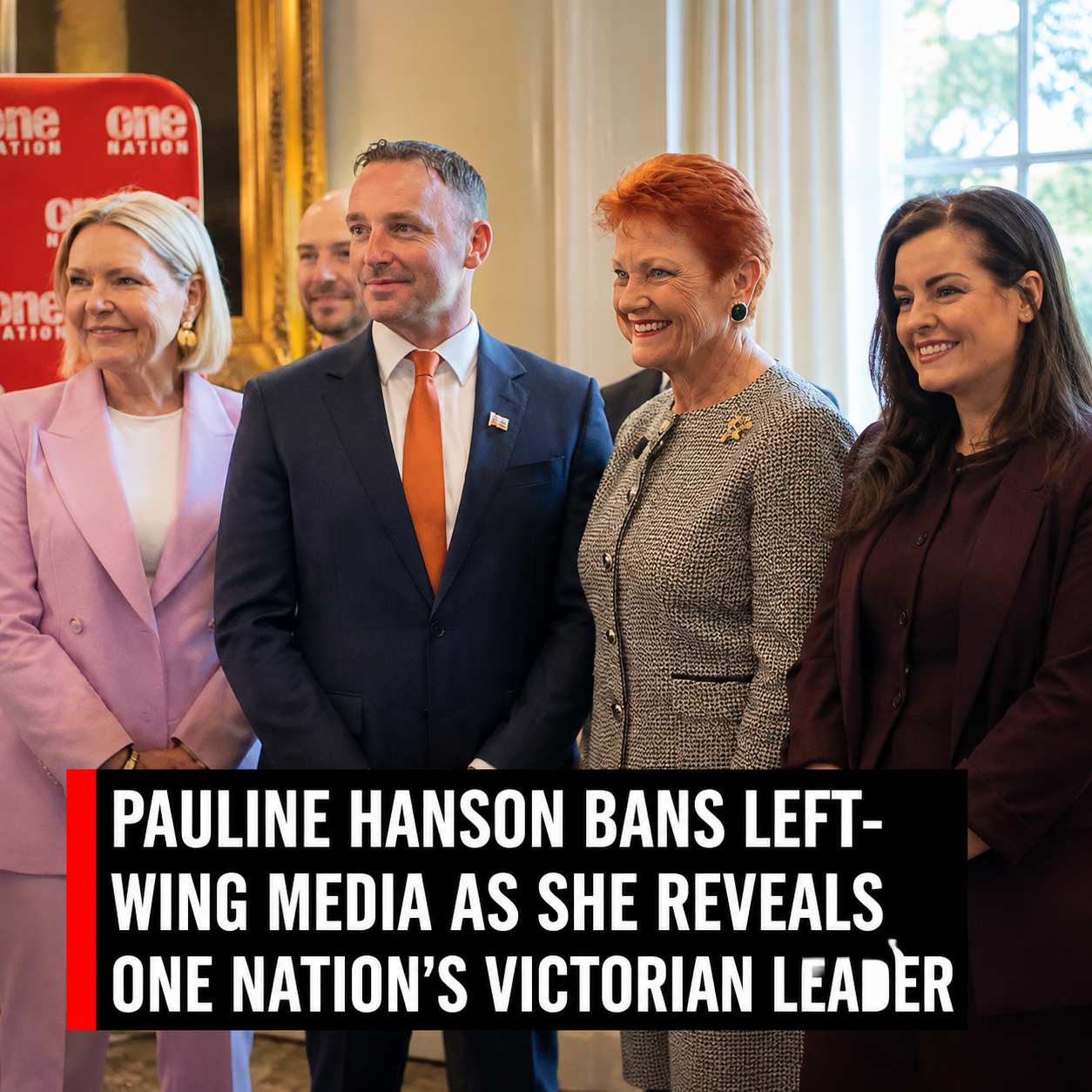
The Melbourne campaign launch marked the beginning of One Nation’s most ambitious attempt yet to establish a significant parliamentary presence in Victoria, a state traditionally viewed as one of the party’s most difficult electoral battlegrounds.
However, much of the attention centred not on policy announcements or candidate selections, but on Hanson’s decision to exclude journalists from the ABC, The Guardian and The Age from attending the press conference.
Explaining the decision, Hanson accused the three media organisations of consistently producing biased coverage of One Nation.
“I’m not putting up with their rubbish, their spin, their lies whatsoever,” Hanson said.
She argued the outlets had repeatedly treated One Nation differently from Australia’s major political parties and insisted she wanted reporting that she considered truthful and fair.
“I’m not putting up with their spin, gotcha moments, wanting to have a go at me or treat us totally different to what you do all the other major political parties. Enough is enough,” she said.
The decision meant journalists from the three organisations were not informed of the event’s location or timing, preventing them from attending the campaign launch.
Other media organisations, including commercial outlets, were permitted to cover the announcement.
The move immediately reignited debate over press freedom and political accountability.
The Guardian responded by saying that holding public figures to account is a fundamental role of a free press and an essential part of Australia’s democratic process.
The publication said it was disappointing that One Nation continued to prevent journalists from attending its press conferences, arguing reporters should be able to ask questions in the public interest without being prevented from performing their role.
The media dispute overshadowed what was otherwise a significant organisational announcement for One Nation.
Hanson confirmed Warren Pickering, previously the party’s Victorian president, would become state leader and contest the marginal lower house seat of Pakenham at November’s election.
Pakenham is currently held by Labor on an extremely narrow margin of just 0.4 per cent following the 2022 election, although sitting MP Emma Vulin is not seeking re-election.
The electorate has historically been considered a Liberal stronghold before Labor gained the seat, making it one of Victoria’s key battleground electorates this year.
Pickering’s appointment also reflected a change in One Nation’s electoral strategy.
He had originally been expected to contest an upper house position in the Eastern Victoria Region before the party decided its Victorian leader should instead seek election to the Legislative Assembly.
Addressing reporters after his appointment, Pickering acknowledged that candidates should expect robust public scrutiny during the campaign.
However, he warned that what he described as fabricated attempts to damage the reputations of One Nation candidates would be met with legal action.
“We expect a healthy amount of scrutiny of our candidates and our policies,” Pickering said.
“However, any blatant character assassination attempts based on fabrications of our candidates will be met with swift legal action.”
Alongside Pickering, One Nation introduced much of its Victorian upper house team.
The candidates include incumbent Northern Victoria MP Rikkie-Lee Tyrrell, former Liberal Party official Colleen Harkin in South-Eastern Metropolitan, Geelong councillor Chris Burson in Western Victoria, animator and company director Mark Nicholson in Northern Metropolitan, lawyer Aaron Sandford in Southern Metropolitan, human resources manager Fiona Lopez in Western Metropolitan and office manager Natalie Adams in North-Eastern Metropolitan.
The party says it intends to contest every seat at the Victorian election, although not every lower house candidate has yet been announced.
The Victorian election represents a major opportunity for One Nation following a period of growing electoral support nationally.
The party secured a breakthrough victory at the federal by-election in the New South Wales electorate of Farrer earlier this year and has recorded strong polling across several states.
Recent Victorian polling has suggested One Nation could attract close to one-fifth of the primary vote, potentially placing it in a position to influence the balance of power in Parliament after the November election.
Nationally, Hanson also announced changes to the party’s senior leadership.
Long-time chief of staff James Ashby will become One Nation’s national director, focusing on election strategy and campaign operations ahead of upcoming state and federal contests.
Former Scott Morrison adviser Chris Taylor will replace Ashby as Hanson’s chief of staff.
Hanson praised Ashby’s role in building the party’s campaign organisation and said she wanted him concentrating full-time on strengthening One Nation’s electoral performance across Australia.
The dispute over media access continues a broader pattern of tensions between Hanson and several major news organisations.
Earlier this year, Hanson criticised The Guardian during a National Press Club appearance and indicated some journalists could be excluded from future One Nation events.
Those comments drew criticism from both Labor and Coalition politicians, as well as the Media, Entertainment and Arts Alliance, which argued politicians should remain open to scrutiny from all accredited media organisations regardless of editorial differences.
Supporters of Hanson argue political parties have the right to decide which media organisations attend privately organised campaign events and contend that One Nation has faced years of hostile reporting.
Critics, however, say excluding major news organisations undermines transparency by limiting opportunities for independent questioning of political leaders during an election campaign.
The issue has also prompted broader discussion about how Australian political parties increasingly rely on social media, livestreams and direct communication with supporters rather than traditional press conferences to communicate their messages.
Despite the controversy, Hanson indicated decisions about future media access during the Victorian campaign would largely be determined by the state branch.
She also said any future One Nation MPs elected to the Victorian Parliament would make their own decisions regarding media engagement, noting that she would not be serving in the state’s Parliament herself.
Policy details remain relatively limited at this early stage of the campaign.
Pickering said One Nation would progressively release its Victorian election platform over the coming weeks ahead of polling day on 28 November.
Among the issues already flagged are opposition to the Suburban Rail Loop project, greater support for agriculture, a possible royal commission into Victoria’s construction sector and further proposals relating to education, crime and government spending.
For One Nation, the Victorian election is widely viewed as one of the party’s most significant electoral tests in years.
Success in traditionally difficult territory would strengthen the party’s momentum heading into the 2027 New South Wales election and the next federal election, while failure could raise questions about whether recent polling gains can be converted into parliamentary representation.
As campaigning intensifies over the coming months, the party’s policy agenda is likely to compete for public attention with continuing debate over its relationship with the media and Hanson’s decision to exclude several of Australia’s largest news organisations from one of the most important campaign events held so far.






