A leadership forum in Perth descended into a heated exchange after One Nation leader Pauline Hanson was asked whether her position on Islamic immigration amounted to “a version of the White Australia Policy”, prompting loud boos and jeers from sections of the audience.
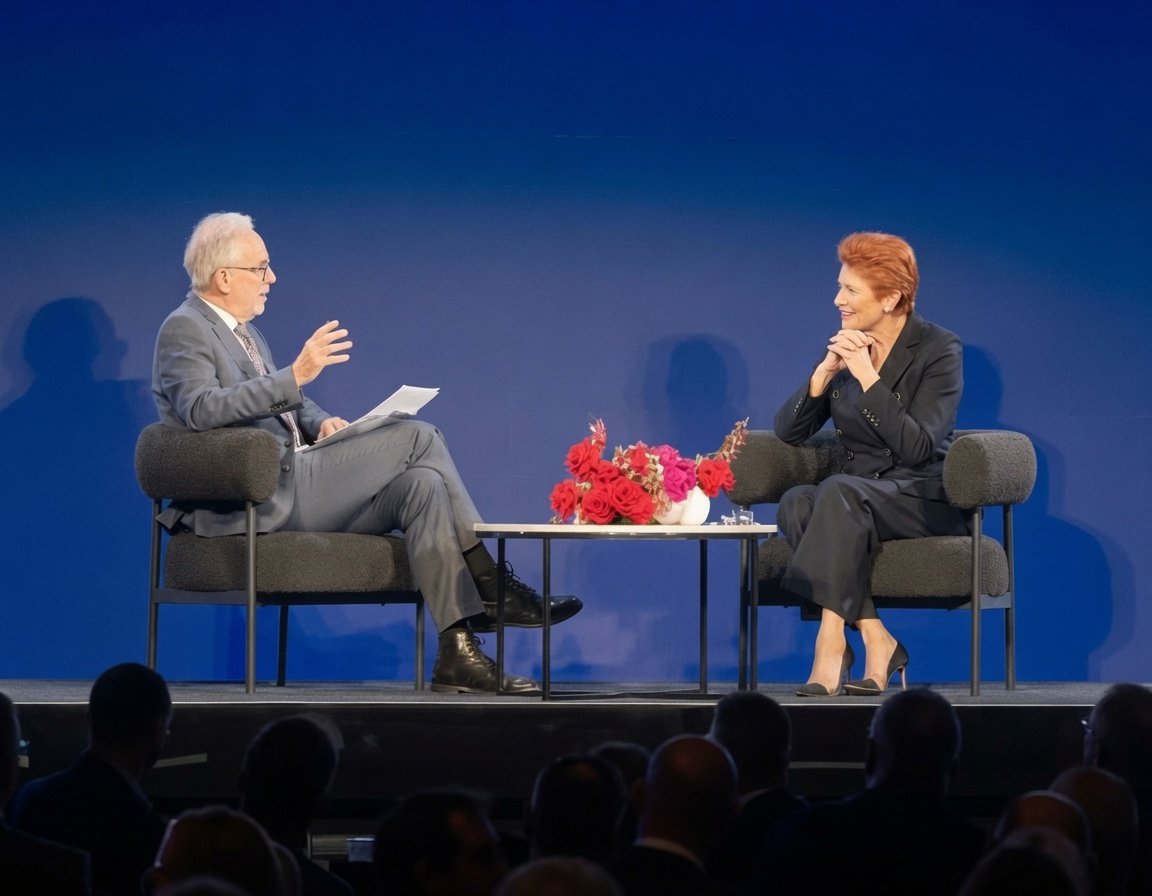
The confrontation occurred during a public discussion featuring Senator Hanson, whose views on immigration and national security have remained among the most polarising in Australian politics for nearly three decades.
As the moderator questioned whether her calls for tighter restrictions on immigration from predominantly Muslim countries resembled elements of Australia’s former White Australia Policy, audience members immediately reacted with audible disapproval, interrupting the exchange with sustained boos.
Hanson rejected the comparison, arguing that her political positions have consistently focused on national security, social cohesion and immigration policy rather than race or ethnicity.
She maintained that her concerns relate to what she considers the risks posed by religious extremism and inadequate integration, rather than opposition to people based on their background.
The exchange quickly became one of the most discussed moments of the event, reflecting the enduring sensitivity surrounding immigration, multiculturalism and religious freedom in Australia.
Since first entering federal politics in 1996, Hanson has built much of her political profile around calls for lower immigration levels, stricter border controls and stronger scrutiny of Islamist extremism.
Over the years she has advocated measures including a temporary halt to immigration from countries affected by Islamist terrorism, expanded security screening for visa applicants and stronger action against individuals promoting violent extremism.
Those proposals have consistently attracted both strong support and significant criticism.
Supporters argue Hanson raises legitimate questions about border security, community integration and the challenges posed by radicalisation.
Critics contend that some of her rhetoric unfairly targets Muslim Australians and risks contributing to prejudice against communities that overwhelmingly reject violence and extremism.
The comparison made during the Perth event centred on the historical White Australia Policy, one of the most controversial chapters in Australia’s immigration history.
Introduced following Federation in 1901 through the Immigration Restriction Act, the policy was designed to severely limit non-European immigration and preserve what was then regarded as Australia’s British identity.
Although the legislation did not explicitly mention race in every provision, it became the foundation of immigration policies that discriminated against people on racial and ethnic grounds for decades.
Successive Australian governments gradually dismantled the policy between the 1950s and the early 1970s, with multiculturalism eventually replacing racial exclusion as the guiding principle of national immigration policy.
Today, the White Australia Policy is widely regarded as inconsistent with contemporary Australian values of equality and non-discrimination.
For that reason, comparisons to the policy continue to generate strong reactions whenever they arise in political debate.
Hanson has repeatedly rejected suggestions that her immigration policies are racially motivated.
Instead, she argues that Australia should determine immigration levels according to national interest, economic capacity, housing availability and public safety.
She has also maintained that criticism of extremist interpretations of Islam should not be interpreted as criticism of all Muslims.
One Nation’s official platform supports reducing overall migration, strengthening border security, increasing counter-terrorism measures and introducing tougher requirements for permanent residency and citizenship.
The party has also advocated stronger action against individuals convicted of terrorism offences and greater powers to deport non-citizens who pose security risks.
Those policies have helped the party attract voters concerned about immigration and law-and-order issues, particularly in regional Australia.
At the same time, they have drawn sustained criticism from political opponents, multicultural organisations and civil liberties groups, who argue that Australia’s immigration system should continue to avoid discrimination based on religion or ethnicity.
The Perth exchange comes at a time when immigration has re-emerged as one of Australia’s most contested political issues.
Rapid population growth, housing affordability pressures, infrastructure demand and workforce shortages have all contributed to renewed debate over the appropriate level of migration.
National security has also remained a prominent issue following several terrorism-related investigations over the past decade, although Australian security agencies have consistently stressed that the overwhelming majority of Muslim Australians reject violent extremism and make valuable contributions to Australian society.
Successive federal governments from both major parties have emphasised that counter-terrorism efforts should focus on individuals engaged in or supporting violence rather than communities defined by religion.
The Albanese Government continues to support Australia’s multicultural framework while maintaining that border protection, intelligence operations and counter-terrorism remain national priorities.
Political analysts note that debates over immigration frequently generate passionate public responses because they intersect with questions of national identity, economic management, cultural diversity and public safety.
That was evident during the Perth forum, where audience members responded as strongly to the wording of the moderator’s question as they did to Hanson’s answer.
Whether the comparison was appropriate quickly became a subject of discussion beyond the event itself.
Some commentators argued that challenging political leaders with difficult historical comparisons is a legitimate part of democratic debate.
Others suggested the analogy oversimplified complex policy differences by comparing proposals based primarily on security and immigration controls with a historical system founded on racial exclusion.
The incident illustrates how Australia’s conversations about immigration continue to evolve while remaining deeply influenced by both contemporary security concerns and historical experiences.
For Senator Hanson, whose political career has long been defined by outspoken positions on immigration, the exchange reinforced her reputation as one of Australia’s most divisive political figures.
For the broader public, the reaction at the Perth forum demonstrated that debates over immigration policy—and the language used to describe it—remain capable of provoking strong responses from audiences across the political spectrum.






