A bitter new fight has erupted over footage of school students protesting Pauline Hanson, with claims that lawyers acting for parents are demanding the removal of a viral video filmed during the highly charged rally outside South Australia’s Parliament House.
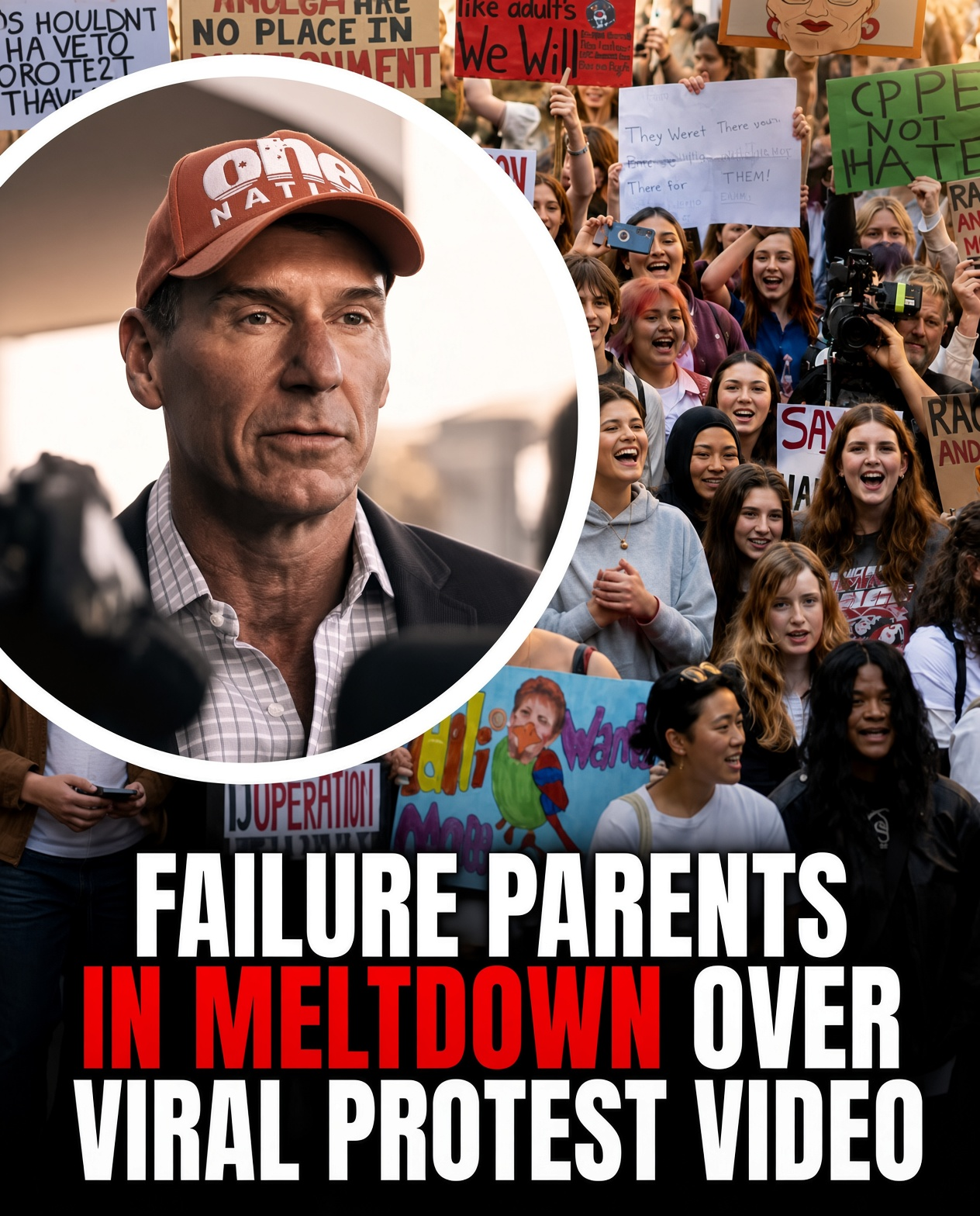
The dispute raises a difficult question that has followed the nationwide student demonstrations from the beginning: when young people deliberately enter a major public political protest, chant in front of television cameras and confront politicians, how should their status as minors affect the way those actions are subsequently reported and shared?
The publisher behind the video says it has received formal legal threats from lawyers representing parents of children who attended the Adelaide protest, demanding that footage of the rally be removed.
That allegation has not been independently verified. No legal correspondence has been made publicly available for examination, and there is no known court ruling requiring the footage to be taken down.
But the underlying event itself is well documented.
Thousands of high school and university students walked out of classes across Australia on August 13 as part of a National Union of Students-organised day of action against Hanson and One Nation.
In Adelaide, SA Police estimated about 2,000 students participated. InDaily reported students from at least 46 schools were represented at the Parliament House rally.
The demonstration was held openly on North Terrace, attracted extensive media coverage and involved speeches, banners and repeated political chants.
Some of the language was deliberately confrontational.
Protesters repeatedly chanted “f*** Pauline Hanson”, while One Nation’s South Australian leader Cory Bernardi was later met with chants of “f*** Cory Bernardi” after entering the crowd while filming on his phone.
The confrontation then became a national story for another reason: Bernardi himself was condemned after footage he posted showed him using an anti-trans slur and describing demonstrators as “incels”, “losers” and other insulting terms.
The result was a protest in which both sides accused the other of unacceptable behaviour — and in which dozens of phones, television cameras and social-media accounts were documenting events in real time.
The rally was designed to be seen
The Adelaide event was not a private gathering accidentally exposed to public attention.
It was a political demonstration held outside Parliament House with the explicit purpose of attracting attention to opposition against Hanson and One Nation.
Students carried signs, delivered speeches and chanted slogans in front of journalists and cameras.
The nationwide action had been promoted beforehand, and organisers openly encouraged young people to leave school and participate.
That matters when considering claims that some attendees should never have appeared in published footage.
There is generally a much weaker expectation of visual privacy when someone voluntarily participates in a large public demonstration than when that person is at home, at school or in another genuinely private environment.
South Australian legal guidance states there are no general restrictions under the state’s surveillance legislation on photographing or filming activity taking place in a public place.
A public political rally on the steps of Parliament House falls naturally within the kind of setting where journalists, politicians, protesters and members of the public can expect cameras to be present.
But that is only the beginning of the legal and ethical analysis — particularly when children are involved.
Being filmed does not remove every legal protection
The proposition that “it happened in public, therefore anything can be published” is too broad.
South Australian law contains specific restrictions concerning indecent filming, humiliating or degrading imagery, material protected by court orders and other forms of unlawful publication.
Defamation law can also become relevant depending on the claims made about an identifiable person.
More broadly, modern privacy law increasingly examines not merely whether an image was captured in public, but the circumstances in which personal information is later used and whether there was a reasonable expectation of privacy.
Age can be one factor in that assessment.
There is therefore an important distinction between showing accurate footage of a public demonstration and taking an identifiable school student from that footage, attaching unproven allegations to them and exposing them to a substantially different form of publicity.
The former is ordinary political reporting.
The latter can create additional legal and ethical questions.
None of this establishes whether the alleged demands to remove the Adelaide video have legal merit. Without seeing the correspondence, the identities involved, the footage complained about and the precise legal causes of action asserted, no responsible conclusion can be reached.
Were the students making ‘threats’?
The raw claim accompanying the legal dispute goes further, accusing some students of making threats and using abusive language while knowing cameras were present.
The abusive language is independently documented.
ABC footage and reporting confirm repeated profanity directed at Hanson and Bernardi.
Other nationwide rallies included chants such as “high school, uni, teachers too, Pauline Hanson, we’re coming for you”.
But describing every aggressive political chant as a literal threat would require evidence about context, words and intent.
A slogan shouted by hundreds of protesters can be offensive or inflammatory without necessarily constituting a criminal threat.
The verified material establishes heated rhetoric and profanity. It does not establish that every student shown in footage engaged in unlawful threatening behaviour.
That distinction becomes particularly important when the subjects are identifiable minors.
Students were not passive participants
At the same time, portraying every school-age attendee as an unwilling child swept into an event by adults would also misrepresent the protest.
Young organisers spoke publicly and forcefully about why they were there.
A Year 11 organiser in Adelaide defended the demonstration when questioned about its language and criticised Bernardi’s own behaviour towards students.
Other students interviewed around Australia said they believed One Nation represented a threat to racial minorities, migrants and LGBTQ Australians.
Some had parental permission to leave school.
Others said teachers had opposed their decision to walk out.
The protests were explicitly intended as political action by young people, not simply an excursion organised on their behalf.
That gives students agency.
Agency, however, does not mean adults can ignore their age when deciding how to publish or amplify their conduct.
Both propositions can be true at once: teenagers can make deliberate political choices, and adults — whether journalists, politicians, activists or parents — can still carry heightened responsibilities when dealing with them publicly.
Parents and schools were already part of the political argument
The question of adult responsibility emerged almost immediately after the demonstrations.
One Nation called on South Australian Education Minister Lucy Hood to investigate which schools had promoted or facilitated the protest.
The party accused elements of the education system of political activism and argued students should have remained in class.
InDaily reported the protest included students from at least 46 schools, although attendance by a student from a particular school does not itself establish that the school endorsed the event.
Nationally, students gave mixed accounts.
Some said teachers opposed their participation, while others attended with parental approval.
There were also parents physically present at demonstrations.
Those nuances make broad assertions that “schools encouraged the protest” difficult to sustain without evidence about individual institutions.
What is undeniable is that many adults supported the students’ right to demonstrate, while others argued encouraging children to abandon classes for partisan political action crossed a line.
Bernardi’s own footage complicates the accountability argument
The Adelaide controversy became particularly combustible because one of the politicians criticising the students was himself recording them.
Bernardi arrived at the demonstration while hundreds of protesters were gathered outside parliament and filmed as he moved through the crowd.
His videos later attracted widespread criticism.
ABC reporting showed the One Nation MP repeatedly using a derogatory term for transgender people and referring to protesters as “incels”.
He also described attendees as “losers” and an “assortment of weirdos”.
One 17-year-old organiser accused the 56-year-old politician of bullying teenagers and attempting to intimidate people exercising their right to protest.
Another organiser called Bernardi’s behaviour “pathetic”.
Bernardi, for his part, said protesters did not understand the issues facing them and argued they should be more concerned about debt, unaffordable housing and taxes.
The exchange demonstrates why a simple morality tale about accountability is difficult.
The protesters deliberately subjected One Nation politicians to aggressive public criticism.
Bernardi deliberately subjected protesters — including teenagers — to his own aggressive commentary.
Both sides then used social media to amplify the confrontation.
Does a protester consent to unlimited circulation?
There is also a difference between knowing cameras are present and consenting to every possible subsequent use of an image.
A person attending a public rally should reasonably anticipate news photography, livestreams and social-media footage.
That does not necessarily mean they have agreed to their image being repackaged indefinitely for unrelated commercial purposes, falsely captioned or attached to allegations unsupported by what the footage shows.
This is especially relevant with viral video.
Traditional news footage might show a crowd for several seconds during a report about a protest.
Social-media content can instead isolate one person, replay the same seconds millions of times and generate thousands of comments directed at an identifiable individual.
The legal rules governing those uses are not reduced to a single principle of “public means fair game”.
For minors, responsible publishers have an additional reason to consider proportionality even when publication is lawful.
Accountability cannot operate in only one direction
The strongest point underlying the raw source is nevertheless a legitimate one.
Political participation carries consequences.
A person who chooses to address a public demonstration, shout a slogan into a microphone or confront a politician in front of television cameras cannot realistically expect the event to remain private afterwards.
Young Australians are entitled to political voices.
But treating teenagers as politically sophisticated enough to leave school, campaign publicly and demand accountability from elected officials while simultaneously insisting that nothing they say can be reported would create an obvious contradiction.
The answer is not to deny their agency.
Nor is it to pretend age is irrelevant.
The more defensible standard is accuracy and proportionality.
If a student publicly says something newsworthy at a public protest, media can report what occurred.
If someone claims the student committed a crime, made a genuine threat or behaved in a way the footage does not establish, that requires evidence.
If the person is a minor, unnecessary identification should be approached with greater care than it would be for an elected politician.
And the same standard should apply to adults on the other side of the confrontation.
The legal threats remain the missing piece
That is ultimately what prevents the latest dispute from being resolved on the available information.
The publisher says lawyers representing parents have demanded deletion of its viral footage.
But the public has not seen those letters.
It is not known whether the complaints concern the mere act of filming, identification of minors, commentary attached to the footage, defamation, harassment, privacy or some other alleged legal wrong.
Those distinctions could completely change the merits of the dispute.
A demand asserting that nobody may film a political protest in a public place would raise obvious difficulties under the general South Australian legal position.
A complaint alleging that a particular child had been falsely accused of threatening violence would be a very different matter.
Until the letters or a court action become public, claims that parents are simply attempting to evade accountability remain an interpretation rather than an established fact.
A clash over what political participation means
The controversy matters because the anti-Hanson rallies were promoted as evidence that teenagers should have a meaningful voice in Australian democracy.
Thousands accepted that invitation.
They left classrooms, gathered in city centres, criticised a major political party and deliberately made themselves heard.
The aftermath is now demonstrating another part of democratic participation: public speech can draw scrutiny, criticism and counter-speech.
Politicians are subjected to it constantly.
Activists are not automatically exempt.
But accountability also binds the people holding the cameras.
Publication should accurately reflect what footage proves. Children should not be assigned conduct they did not engage in simply because they were part of a crowd. Political opponents should not turn the existence of minors into permission for gratuitous humiliation.
Likewise, adults cannot credibly encourage teenagers to become visible political actors and then be surprised that public political conduct is reported.
The Adelaide protest was public, deliberate and designed to attract national attention. That makes accurate footage of what happened legitimate material for public debate. Whether the particular viral video now under threat crossed a separate legal line depends on details that have not yet been made public — and until they are, neither side can honestly claim the legal argument is already settled.






