What began as an anxious search across one of Australia’s most unforgiving landscapes has ended with an emotional reunion after a missing dog named Tank was found alive on a remote outback highway by a passing truck driver.
Tank disappeared while being transported across the Australian interior, leaving his owners uncertain whether he could survive for long in an environment known for extreme temperatures, vast distances and limited access to food or water. As word of his disappearance spread, local communities, transport workers and animal lovers shared updates in the hope that someone travelling through the region might spot him.
Their hopes were realised when a truck driver travelling along the isolated highway noticed a lone dog walking near the roadside. Recognising that an unattended animal in such conditions was unlikely to survive without assistance, the driver safely stopped, approached Tank and secured him before contacting people involved in the search.
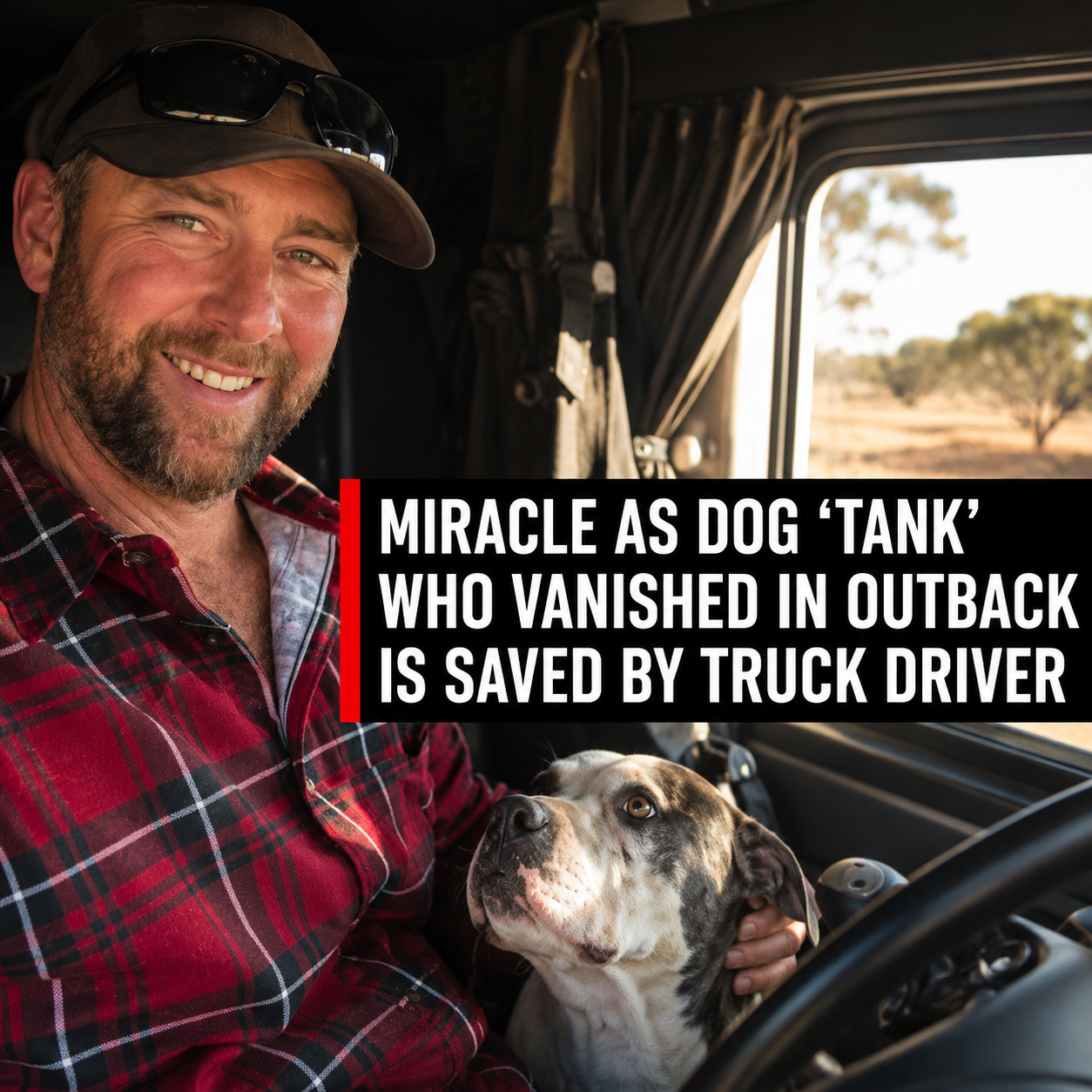
For the owners, the phone call confirming Tank had been found brought an end to days of uncertainty. Like many pet owners faced with a missing animal, they had continued hoping that someone travelling through the area would eventually come across him despite the enormous distances involved.
Australia’s outback presents unique challenges for lost animals. High daytime temperatures, cold nights, sparse water sources and long stretches between towns can quickly become life-threatening. Wildlife, road traffic and exhaustion add further risks, making the chances of survival difficult to predict when pets disappear in remote regions.
Truck drivers are often among the few people regularly travelling these isolated highways. Covering thousands of kilometres each week, they frequently become the first to notice stranded motorists, injured wildlife and lost livestock. Animal rescue organisations have long acknowledged that transport workers play an important role in reporting emergencies and assisting animals found far from populated areas.
Stories like Tank’s also demonstrate how quickly local communities can mobilise when a pet goes missing. Social media posts, community noticeboards and word-of-mouth communication increasingly help connect travellers with owners, allowing sightings to be shared across large geographic areas within hours. Although not every search ends successfully, these informal networks have become an important part of many recovery efforts.
Animal behaviour specialists note that dogs lost in unfamiliar environments often continue moving in search of people, water or familiar scents rather than remaining in one location. That behaviour can make searches more challenging, particularly in remote areas where there are few landmarks and limited opportunities for sightings.
Veterinarians also encourage owners transporting pets over long distances to ensure animals are securely restrained, wear identification tags and, where possible, have microchips with up-to-date contact details. These precautions can significantly improve the chances of a safe reunion if an animal becomes separated during travel.
For Tank, the outcome depended on a combination of resilience, good fortune and the attentiveness of a passing truck driver who chose to stop rather than continue his journey. In remote parts of Australia, where help may be hours away, small decisions by travellers can sometimes make the difference between survival and tragedy.
The story has resonated with many Australians because it highlights more than the rescue of a single dog. It reflects the spirit of cooperation often found in regional and remote communities, where people travelling the country’s vast road network routinely look out for one another—and, on this occasion, for a four-legged traveller who simply needed someone to notice him.
After an ordeal that could easily have ended differently, Tank is now safely back with his family. His rescue serves as a reminder of both the harsh realities of the Australian outback and the kindness that can emerge when strangers take the time to help an animal in need.






