Nationalist activists staged anti-immigration demonstrations in New Zealand during Indian Prime Minister Narendra Modi’s landmark visit, highlighting growing tensions over migration, national identity and the country’s increasingly diverse population.
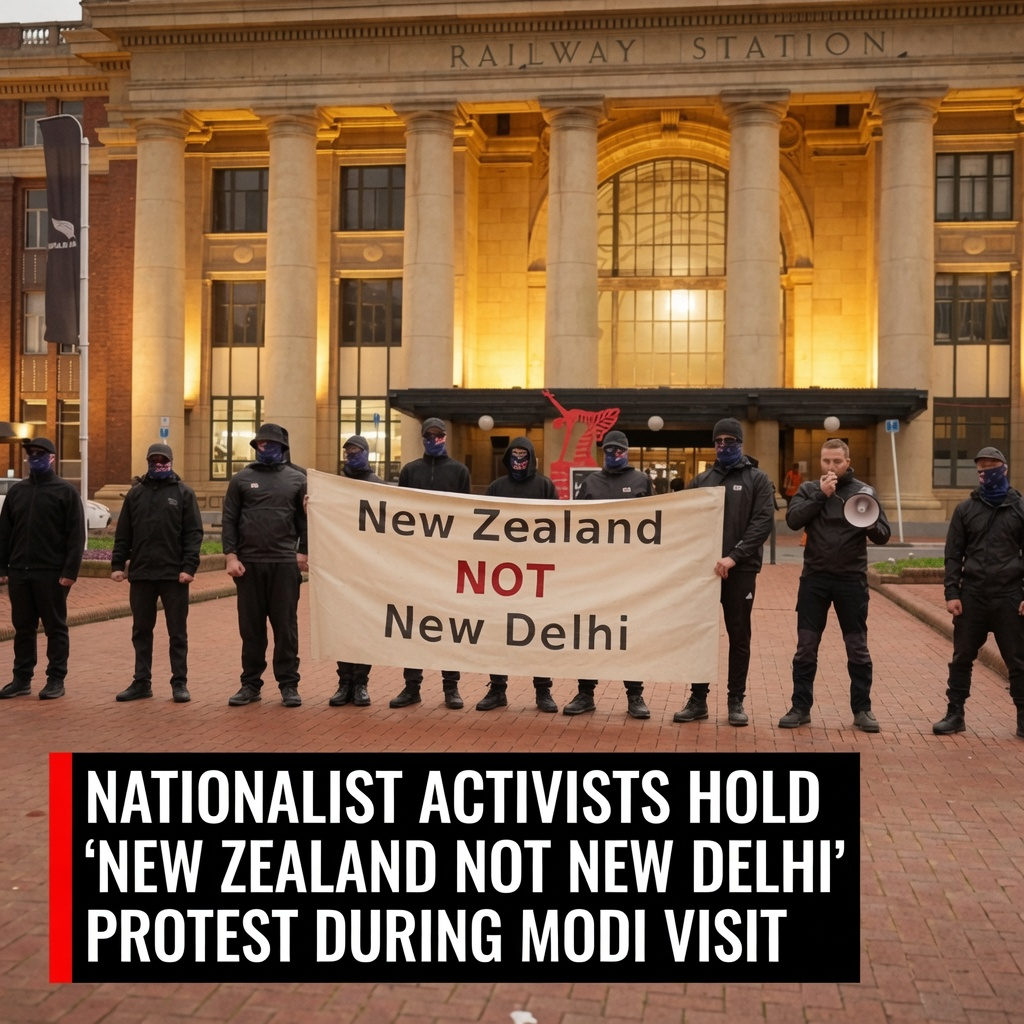
More than a dozen members of the nationalist group White New Zealand gathered outside Wellington Railway Station on Saturday carrying a large banner reading “New Zealand, not New Delhi”.
The demonstrators, most dressed in black clothing with their faces covered, timed the protest to coincide with Prime Minister Narendra Modi’s first official visit to New Zealand by an Indian leader in four decades.
One organiser, who addressed the gathering through a megaphone, accused successive governments of allowing excessive immigration and claimed New Zealand’s cultural identity was under threat.
During the speech, the protest leader made a series of inflammatory remarks about Indian migration, describing the country in derogatory terms and arguing that large-scale immigration would permanently alter New Zealand society. He also made racially charged claims suggesting some migrants were incapable of assimilating into New Zealand culture.
The group later uploaded footage of the demonstration to its Telegram channels, claiming New Zealand’s government was deliberately encouraging immigration while calling for existing immigration policies to be reversed.
The language used by the group has been widely regarded as overtly racist, with its messaging focusing on preserving what it describes as the country’s Anglo-Celtic heritage.
The Wellington demonstration was not the only protest surrounding Mr Modi’s visit.
In Auckland, another anti-immigration rally formed outside Spark Arena, where approximately 10,000 supporters gathered for the “Kia Ora Modi” community event.
Some protesters displayed signs reading “Remigration Now” and “End Mass Migration”, while others criticised New Zealand’s immigration settings more broadly.
Separate demonstrations were also held by Sikh separatists supporting the Khalistan movement, who protested against Mr Modi’s government before facing off with many of the predominantly Hindu supporters attending the event.
A smaller group of pro-Palestinian activists also attended the area, adding another political dimension to an already highly charged atmosphere.
Police maintained a significant security presence throughout the events as competing groups gathered outside the venue.
Mr Modi arrived in New Zealand late on Friday for what has been widely described as a historic diplomatic visit.
He met New Zealand Prime Minister Christopher Luxon for bilateral talks before attending business and community events in Auckland.
The leaders announced that New Zealand and India would elevate their relationship to a Strategic Partnership, expanding cooperation across defence, trade, maritime security and regional affairs. The visit marked the first by an Indian prime minister to New Zealand in approximately 40 years.
Mr Modi’s trip followed negotiations that have significantly strengthened ties between the two countries, including progress on a free trade agreement and broader cooperation throughout the Indo-Pacific region.
The demonstrations occurred against a backdrop of growing political debate over immigration in New Zealand.
The country experienced exceptionally strong population growth after pandemic border restrictions ended, fuelled largely by record net migration.
Migration has become a contentious political issue as concerns over housing affordability, infrastructure capacity, healthcare services and transport congestion have increasingly featured in public debate.
Indian New Zealanders now represent one of the country’s fastest-growing ethnic communities, with hundreds of thousands of residents identifying as being of Indian heritage according to recent census data.
Successive governments have argued that skilled migration is necessary to address labour shortages and support economic growth.
Critics, however, contend that rapid population increases have placed additional pressure on already stretched public services and housing supply.
Although concerns about immigration levels have become more common across parts of the political spectrum, the rhetoric employed by White New Zealand goes considerably further than mainstream political debate.
The organisation has previously attracted attention for promoting white nationalist ideology and advocating ethnically based immigration policies.
Its messaging has drawn criticism from anti-racism campaigners, community organisations and political figures who argue such rhetoric risks inflaming racial tensions.
At the same time, Mr Modi’s visit generated strong enthusiasm among many members of New Zealand’s Indian community, with thousands attending cultural celebrations welcoming the Indian leader.
For the New Zealand Government, the visit represented an opportunity to deepen economic and strategic ties with one of the world’s fastest-growing major economies.
India has become an increasingly important partner for New Zealand across trade, education, technology and security cooperation, while both governments have emphasised shared democratic values and a common interest in maintaining stability throughout the Indo-Pacific region.
Nevertheless, the contrasting scenes of enthusiastic supporters, nationalist protesters, Sikh separatists and other activist groups illustrated how Mr Modi’s presence also exposed broader debates over immigration, multiculturalism and national identity that continue to shape political discussion both in New Zealand and internationally.