A former senior Australian Federal Police detective has launched a blistering attack on a proposal to reduce the role of ideology and religious motivation in Australia’s legal definition of terrorism, warning the change could cripple efforts to understand and disrupt extremist threats.
Former AFP detective superintendent David Craig described the idea as “naive and blatantly stupid” after Australia’s Special Envoy to Combat Islamophobia, Aftab Malik, urged the government to reconsider how terrorism and extremism are defined and discussed.
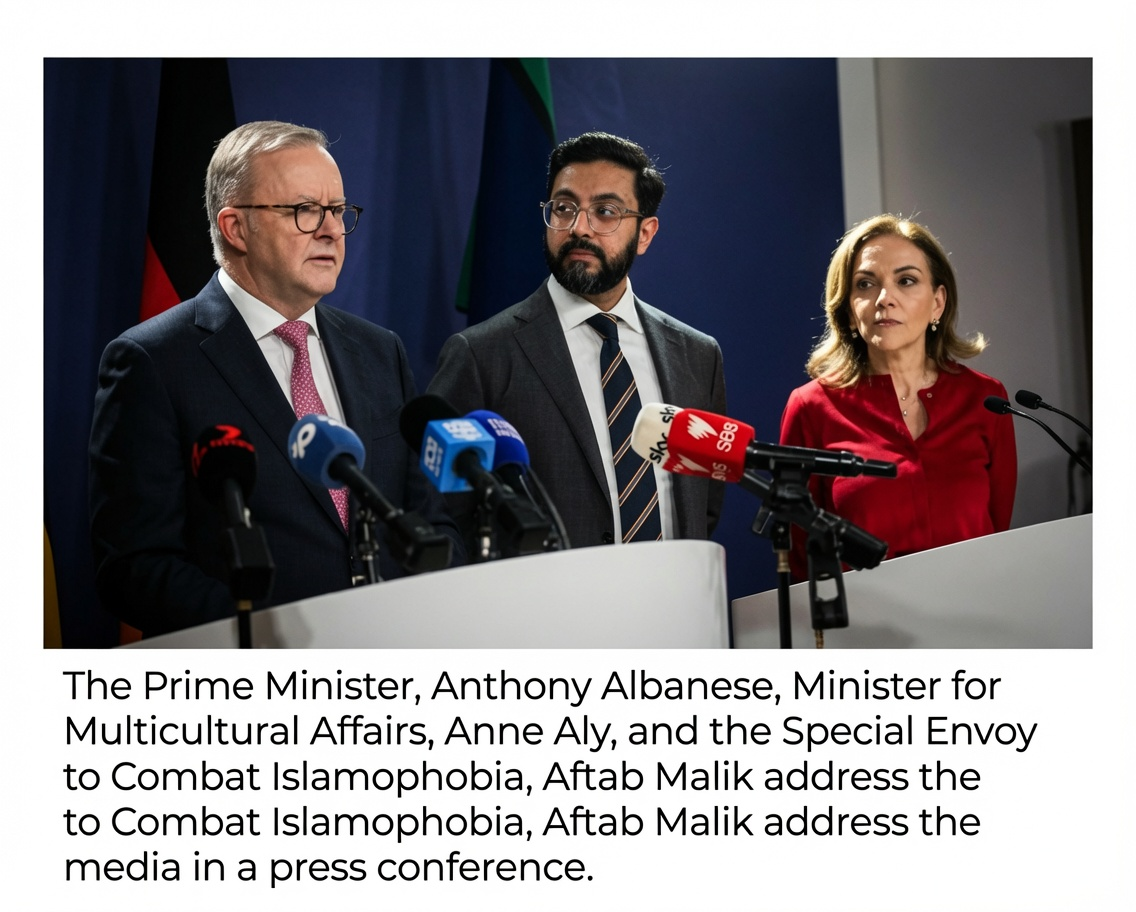
Malik’s recommendations were contained in a submission to the Royal Commission on Antisemitism and Social Cohesion and form part of a broader argument that Australia’s post-September 11 national security framework has disproportionately associated terrorism with Muslims.
Among 17 recommendations, Malik called for section 100.1 of the Commonwealth Criminal Code to be amended to “reduce a reliance on the ideological, political or religious motivation as a central criterion” in the definition of a terrorist act.
He also advocated an “ideology-agnostic framework” for extremism in legislation and policy, focusing instead on an individual’s or organisation’s capacity to mobilise harm, incite violence and erode social cohesion.
Craig says that approach fundamentally misunderstands how counter-terrorism works.
“It is a naive and blatantly stupid idea,” he told Sky News.
“I’ve never seen something that would be so defeating of the good efforts that have been put in to fight crime in every respect, not just terrorism, but terrorism and extremism in all its forms.”
His argument is straightforward: ideology is not an embarrassing label attached to terrorism after an attack. It is information used to understand why threats develop, how extremists recruit and where violence may emerge next.
“To discount that means you lose the ability to measure it. React to it, put social services around it, intervene when you need to,” Craig said.
He warned that removing ideological distinctions from the national security conversation could allow radical Islamist and antisemitic extremism to “fester and grow”.
The language is blunt.
But the dispute exposes one of the most difficult questions now confronting Australia’s national security system.
Is the ideological motive behind violence essential to understanding terrorism, or has Australia’s reliance on motive created a framework that unfairly stigmatises entire communities?
Malik believes the system needs significant reform.
Craig believes reform along the lines proposed could destroy precisely the intelligence needed to keep Australians safe.
Home Affairs Minister Tony Burke has so far given little indication the government is prepared to accept Malik’s central argument.
Asked whether ideology was at the core of terrorism, Burke responded: “Absolutely, that’s the definition.”
“My priority on anything relating to terrorism legislation, my starting point is the best way to keep people safe … and the finishing point, that’s my only concern,” he said.
Australia’s current terrorism law deliberately requires more than serious violence.
Under section 100.1 of the Criminal Code, an action can fall within the definition of a terrorist act where it is done with the intention of advancing a political, religious or ideological cause.
The action must also be intended to coerce or influence by intimidation an Australian or foreign government, or intimidate the public or a section of the public.
It must then involve specified serious consequences or risks, such as serious physical harm, death, serious property damage, danger to life, a serious risk to public health or safety, or serious interference with critical systems.
There are protections for advocacy, protest, dissent and industrial action where the conduct is not intended to cause the serious harms specified by the law.
In practical terms, the ideological or political purpose helps distinguish terrorism from other forms of horrific criminal violence.
A murder can terrify a community without legally being terrorism.
An arson attack can cause enormous destruction without being terrorism.
A mass casualty event can involve extreme violence without necessarily satisfying the statutory definition of a terrorist act.
The legal label turns partly on purpose.
Was the act intended to advance a political, religious or ideological cause?
Was it intended to coerce government or intimidate the public?
Those questions are not incidental to the current law. They sit near its centre.
Malik’s concern is that this architecture has developed within a national security culture heavily shaped by the response to Islamist terrorism after September 11.
In his submission, Malik criticised what he described as 25 years of “hyper-securitisation”.
He argues that Muslim communities have experienced the consequences of terrorism policy being repeatedly framed through religious identity and that the language used by politicians, institutions and media can encourage the public to conflate Islam with terrorism.
His concern is not merely semantic.
Malik has argued that stigmatisation can damage trust between Muslim communities and government institutions, ultimately making effective security and social cohesion more difficult.
From that perspective, an ideology-agnostic model would concentrate on the danger posed by conduct rather than beginning with labels such as Islamist, neo-Nazi or another ideological category.
Extremism would be assessed by its capacity to mobilise people towards harm, incite violence and undermine social cohesion.
Malik has also called for government officials to reduce the use of ideological labels when responding to terrorist incidents and proposed a cabinet protocol intended to create greater consistency and reduce the politicisation of operational decisions.
His submission comes after his earlier report on countering Islamophobia produced 54 recommendations.
The Albanese government has not yet delivered its formal response to that broader report.
The latest submission extends Malik’s argument into national security law at an unusually sensitive moment for Australia.
Craig says the attempt to remove or downgrade motive makes “no sense whatsoever”.
His objection reflects a core principle of intelligence work: different extremist movements do not necessarily radicalise, communicate, recruit or select targets in the same way.
“Of course motive is primarily important to any sort of crime,” Craig said.
He pointed to differences between Islamist and neo-Nazi terrorism and argued that each form of terrorism has a pathway that authorities need to understand.
“Regardless of where it is, we need to measure these things accurately so we can deal with them both in a policy level and an operational level,” he said.
“The truth is the truth, we just want data. We don’t want vilification of any group or anything, but we do need accurate data to deal with crime matters.”
That distinction is critical to Craig’s case.
Identifying an ideology associated with an individual terrorist does not logically mean every person who shares a religion, nationality or broad political identity is implicated in terrorism.
A security agency can investigate Islamist terrorism without treating Muslims generally as terrorists.
It can investigate neo-Nazi terrorism without treating every conservative or immigration sceptic as a neo-Nazi.
It can investigate violent anarchist, separatist or other ideologically motivated threats without criminalising peaceful political disagreement.
The operational challenge is to make those distinctions accurately.
Craig’s fear is that refusing to identify ideological patterns in an effort to avoid stigmatisation would sacrifice useful intelligence rather than improve fairness.
The disagreement is not occurring in a legal vacuum.
The Independent National Security Legislation Monitor is already conducting a formal review of the definition of a “terrorist act” in section 100.1 of the Criminal Code.
The Monitor’s review is examining the operation, effectiveness and implications of the definition, together with the offences and powers that depend upon it.
It is also considering whether the definition remains necessary and proportionate to Australia’s current terrorism threat.
This matters because the definition does much more than determine the language used at a police press conference.
It is an element in serious Commonwealth criminal offences.
It also activates a broad range of law enforcement and national security powers under federal, state and territory legislation.
How Australia defines terrorism therefore affects investigation, disruption, prosecution and the extraordinary powers governments have created to prevent terrorist violence.
The definition has been in the Commonwealth Criminal Code since 2002.
Australia’s security environment has changed substantially since then.
The post-September 11 period was dominated by international jihadist organisations, foreign terrorist fighters and major plots inspired or directed by groups including al-Qaeda and Islamic State.
More recent years have brought increased concern about extreme right-wing violence, accelerationism, mixed and unclear ideologies, online radicalisation and individuals whose belief systems do not fit neatly into established categories.
Security agencies have repeatedly warned that some contemporary extremists consume fragmented collections of grievances rather than following a single coherent doctrine.
That development creates a genuine legal problem.
If a person commits ideologically influenced mass violence but their beliefs are confused, contradictory or highly personal, proving that they intended to advance a particular political, religious or ideological cause may become difficult.
That is one reason national security lawyers and experts have been debating whether the existing definition remains properly calibrated.
But modernising the definition is not necessarily the same as pretending ideology is irrelevant.
The Law Council of Australia, in its submission to the INSLM review, described terrorism as a form of political violence that undermines the democratic process and exposes Australians to death and serious injury.
Its position reflects the longstanding concern that terrorism must remain legally distinguishable from ordinary serious crime.
If motive and political purpose are stripped too far from the definition, a new problem emerges.
What separates terrorism from murder?
What separates a terrorist bombing from an explosion caused by an organised crime dispute?
What separates ideologically driven mass violence intended to intimidate a population from another mass casualty offence?
The answer cannot simply be that terrorism is violence that causes fear.
Many serious crimes cause fear.
Nor can the definition be allowed to expand until every act of extreme violence becomes terrorism.
Australia’s criminal law already contains offences dealing with murder, assault, arson, threats, explosives and organised crime.
Terrorism legislation carries a particular legal and political significance because it addresses violence directed towards wider political or social coercion.
The challenge for reformers is to accommodate modern, hybrid forms of extremism without dissolving that distinction.
Malik’s argument raises a second question: does official language itself create security risks?
He believes repeated ideological labelling can stigmatise Muslim Australians and undermine social cohesion.
There is evidence that terrorism can produce backlash against communities perceived to share the identity of an attacker.
Muslim Australians have reported discrimination, threats and abuse, particularly during periods of heightened political and security tension.
Conflating a terrorist ideology with an entire faith community is both inaccurate and dangerous.
The Bondi attack intensified this debate.
Malik has argued that public reaction following the attack demonstrated how quickly some people move from discussing terrorism to condemning Islam or Muslims generally.
That concern deserves serious treatment.
But it does not automatically establish that Australia’s statutory terrorism definition should abandon ideological motive.
There is a difference between police accurately describing the ideological motivation of an alleged terrorist and politicians or commentators using an attack to vilify millions of people.
One is threat classification.
The other is collective blame.
A functioning national security system should be capable of avoiding the second without disabling the first.
Tony Burke’s initial response suggests the government currently sees ideology as inseparable from terrorism.
Asked about Malik’s recommendations at a Sydney press conference, the Home Affairs Minister emphasised Australia’s international security partnerships.
“The definitions of terrorism that are used tend to be international, and we tend to work pretty cooperatively particularly with our Five Eyes partners in how we work through those principles,” Burke said.
He said Australia’s current definitions interacted effectively with its international partners.
When directly asked whether ideology was at the core of terrorism, his answer was unequivocal.
“Absolutely, that’s the definition.”
That is not a formal rejection of every recommendation Malik has made.
The government says it will respond to his Islamophobia report in time.
Nor has the INSLM completed the broader public debate about the definition of a terrorist act.
But Burke’s comments indicate there is little immediate political appetite to radically detach terrorism from ideological motivation.
For a Home Affairs Minister, the risk calculation is obvious.
Any reform to terrorism laws will be judged not only on legal elegance or social cohesion outcomes but on what happens if an attack occurs after the law changes.
A government that weakens a definition against the advice of counter-terrorism practitioners would face devastating scrutiny if authorities later argued the change reduced their ability to identify or disrupt a threat.
Equally, governments should not preserve outdated laws merely because changing national security legislation is politically dangerous.
That is why the independent review process matters.
The strongest case for retaining ideology is not that one particular form of extremism should receive more attention.
It is that Australia needs to understand every form of extremist violence accurately.
If radical Islamist networks are changing, agencies need data about those changes.
If neo-Nazi groups are recruiting younger Australians, authorities need to know.
If antisemitic violence is being driven by particular ideological ecosystems, that should be measured.
If misogynist, accelerationist or hybrid online movements are producing pathways towards violence, intelligence agencies need language capable of identifying the pattern.
An ideology-agnostic approach may offer advantages if it prevents agencies becoming trapped by outdated labels and focuses attention on actual capacity for harm.
But “agnostic” cannot mean blind.
A threat assessment that records violence while refusing to examine the belief system motivating it would tell authorities what happened without necessarily explaining why it happened or who might follow.
Craig’s criticism is deliberately abrasive.
His underlying warning is harder to dismiss.
Counter-terrorism is not only about prosecuting an attacker after blood has been spilled.
It is about recognising pathways, networks, propaganda, grievances and patterns early enough to intervene.
Ideology can be part of that picture.
Sometimes it may be fragmented.
Sometimes it may be deliberately concealed.
Sometimes an attacker may draw from several extremist traditions at once.
But if Australia changes its laws or policy language, the test cannot simply be whether the new framework sounds less stigmatising.
The test must be whether police and intelligence agencies can identify dangerous movements more accurately, intervene earlier and keep Australians safer.
Malik has put a significant challenge to the existing national security framework.
Craig has responded with an equally significant warning about the consequences of getting reform wrong.
The Independent National Security Legislation Monitor’s review now provides the proper forum for the legal question beneath the political argument.
Australia should absolutely avoid treating a religion as a synonym for terrorism.
It should also be extremely cautious about constructing a terrorism framework that is afraid to name the motive behind organised violence.
Because when authorities are trying to stop the next attack, knowing what an extremist believes may be one of the clues to understanding what they intend to do.






