A violent confrontation at Melbourne’s Flinders Street Station has once again pushed community safety to the forefront of public debate.
The incident unfolded at one of Australia’s busiest transport hubs, a place used every day by commuters, students, tourists and families.
When violence erupts in locations that people rely on for daily life, the impact extends far beyond those directly involved.
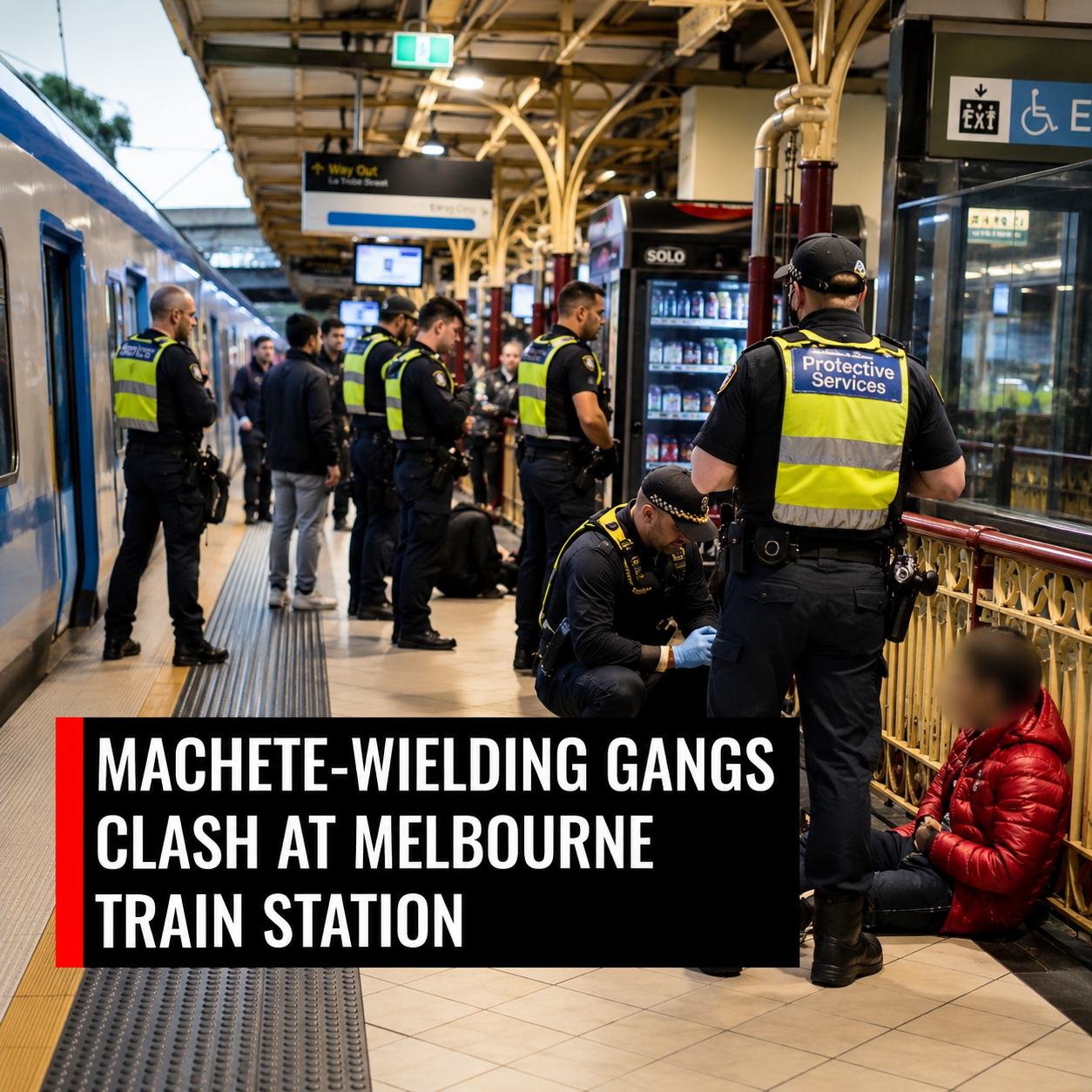
Witnesses described scenes of chaos as a confrontation involving multiple individuals escalated inside the station precinct.
Police moved quickly to the area and several people were taken into custody following the incident.
A teenager was reportedly injured during the altercation and required medical treatment.
The event immediately reignited concerns that have been building across Victoria for some time.
Many residents are asking a simple question.
Do people still feel safe in public spaces?
For most Australians, train stations are not places where they expect to encounter violent crime.
They are essential parts of everyday life.
People pass through them on their way to work, school, sporting events and family gatherings.
When serious incidents occur in those locations, public confidence can be shaken.
The latest confrontation comes amid ongoing discussion about youth crime, weapon offences and repeat offending.
Victoria has already introduced a range of measures aimed at reducing knife and machete-related violence.
Authorities have invested significant resources into enforcement operations, weapon seizures and legislative reforms.
Yet incidents involving edged weapons continue to generate headlines and public concern.
That reality has intensified debate over whether existing measures are delivering the outcomes that communities expect.
Some residents believe stronger consequences are needed for serious offences involving weapons.
Others argue that long-term solutions must also address the underlying factors that contribute to youth violence.
The challenge for policymakers is that both arguments contain elements of truth.
Communities want immediate protection from dangerous behaviour.
At the same time, governments are expected to reduce offending before it reaches the point of violence.
The economic impact is often overlooked.
Public transport networks play a critical role in supporting city economies.
Retailers, hospitality venues and tourism operators all benefit from people feeling comfortable travelling through major transport hubs.
When highly publicised incidents occur, perceptions of safety can influence behaviour.
Even if most journeys remain completely uneventful, repeated headlines about violence can affect public confidence.
For businesses already facing cost pressures, declining consumer confidence can create additional challenges.
The discussion also extends into the justice system.
Australians frequently debate the balance between rehabilitation, deterrence and community protection.
Cases involving young offenders often attract particularly strong reactions because they raise questions about prevention as well as punishment.
Many people want to know whether intervention programs are working.
Others focus on whether the consequences for serious offending are sufficient to deter future crimes.
There are no simple answers.
Crime policy remains one of the most difficult areas of government because it requires balancing public safety, legal rights and long-term social outcomes.
What is clear is that community expectations are changing.
People increasingly expect visible action when incidents involve weapons in crowded public places.
They want reassurance that transport hubs remain safe.
They want confidence that dangerous behaviour will be addressed quickly.
And they want governments to demonstrate that lessons are being learned from each major incident.
Melbourne remains one of the world’s most liveable cities by many measures.
Millions of journeys occur safely across the transport network every week.
Yet highly visible incidents can have an outsized effect on public perception.
That is why events like the latest station brawl attract such intense attention.
They touch on a concern shared by people across political and social divides.
Everyone wants to feel safe using public spaces.
Everyone wants confidence that their family can travel without fear.
And everyone wants assurance that major transport hubs remain places of movement and opportunity rather than places associated with violence.
As investigations continue and legal proceedings unfold, the broader debate is unlikely to disappear.
For many Victorians, the incident has become part of a larger conversation about crime, accountability and what must happen next to strengthen public safety across the state.






