Victoria’s treaty process has again become the focus of political debate after newly elected members of the First Peoples’ Assembly of Victoria delivered a series of outspoken inaugural speeches, including one from Andrew Thorpe, the son of independent Senator Lidia Thorpe.
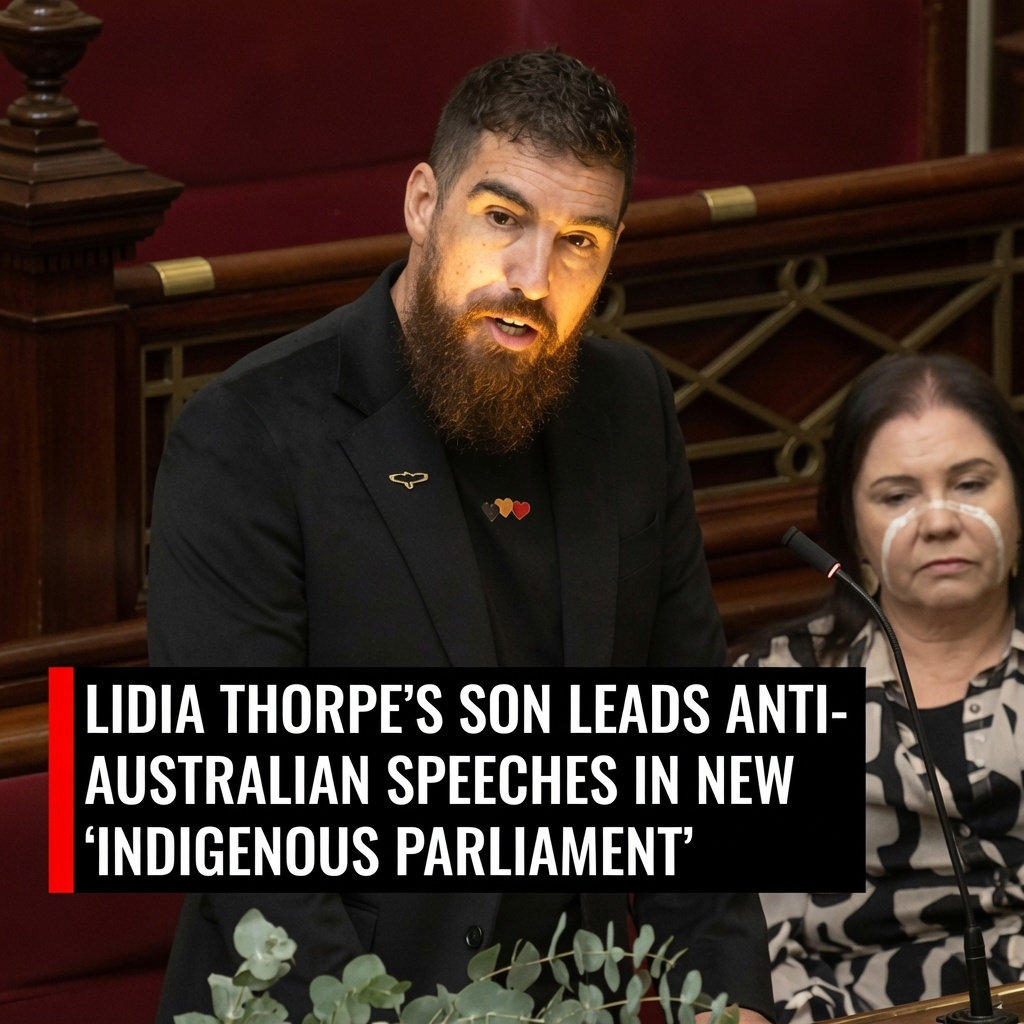
Speaking during the Assembly’s first sitting following this year’s elections, Andrew Thorpe opened his address by acknowledging what he described as “the land that was stolen that this building is placed upon” before outlining concerns about Aboriginal disadvantage, child protection and the future direction of Victoria’s Treaty process.
His remarks were among several speeches that attracted political attention because of their language surrounding Australia’s colonial history, Indigenous sovereignty and the role of the Victorian Treaty.
Thorpe, who represents the South East Region, also referred to Victoria as “so-called Victoria” during his address and thanked his family for supporting his involvement in what he described as challenging existing systems.
He argued that Treaty should be viewed as a pathway rather than an endpoint and expressed concern about the number of Aboriginal children in out-of-home care across Victoria.
Other newly elected Assembly members delivered similarly forceful speeches.
Keicha Day, representing the Gunditj Mirring Traditional Owners Aboriginal Corporation, repeated the phrase “sovereignty has never been ceded” before discussing historical violence during European settlement, while other representatives described colonisation as an ongoing source of harm for Aboriginal communities.
Lisa Rose Thorpe referred to what she described as an “ongoing genocide”, while Esme Bamblett said the land “continues to be ours and will be ours forever”.
The comments have generated criticism from opponents of Victoria’s Treaty framework, who argue the speeches demonstrate why the Assembly has become politically divisive.
Supporters, however, argue the Assembly exists precisely to provide First Peoples with an opportunity to express perspectives that have historically received limited representation within mainstream political institutions.
The First Peoples’ Assembly was originally established to negotiate Victoria’s Treaty before later evolving into a permanent statutory institution under legislation passed by the Allan Government. Under the Statewide Treaty framework, the Assembly now forms part of a broader body known as Gellung Warl and continues to advise government on matters affecting First Peoples while exercising responsibilities established under Treaty legislation.
The Victorian Government describes Treaty as an opportunity to create a renewed relationship between the State and First Peoples based on respect, accountability and self-determination. Government material also states that the Assembly does not function as a third chamber of Parliament and does not possess a veto over legislation.
According to the Government, the Assembly’s role includes advising ministers, participating in decision-making on specific matters affecting First Peoples and helping implement commitments contained within Victoria’s Treaty arrangements.
Critics remain unconvinced.
Opposition figures have argued that the Assembly gives disproportionate influence to a relatively small elected body representing only Aboriginal Victorians and have questioned whether it enjoys sufficient democratic legitimacy.
The most recent Assembly election attracted only a fraction of eligible voters. Around 43,000 Aboriginal Victorians were eligible to enrol, with approximately 10,000 enrolling to vote and roughly half ultimately casting ballots.
Those turnout figures have become a recurring argument for opponents of the Treaty process, who contend the Assembly cannot claim to represent the views of all Indigenous Victorians.
Members of the Assembly receive remuneration comparable to other senior public office holders while carrying out full-time responsibilities involving consultation, policy development and Treaty implementation.
The broader political dispute extends well beyond the Assembly itself.
Victoria became the first Australian jurisdiction to implement a statewide Treaty with First Peoples, following years of negotiations between the State Government and the Assembly. The Treaty formally commenced in December 2025 after legislation passed Parliament and established a permanent framework for future decision-making and negotiations.
Government documents describe the Treaty as recognising the impact of colonisation while creating mechanisms intended to improve outcomes in areas such as health, housing, education and community governance. They also state the Treaty does not alter Australia’s Constitution, create a new house of Parliament or remove existing legal rights from other Victorians.
Nevertheless, the policy remains one of the most contested issues in Victorian politics.
The Victorian Liberal Party has pledged to dismantle the permanent Assembly if elected at the November state election, arguing the Government has created unnecessary bureaucracy and division.
The Allan Government, by contrast, argues Treaty represents one of the state’s most significant reconciliation initiatives and says it will provide Aboriginal communities with greater involvement in decisions affecting their lives.
Andrew Thorpe’s election also attracted interest because of his family background.
His mother, Senator Lidia Thorpe, has long been one of Australia’s most prominent Indigenous political activists, frequently advocating for Aboriginal sovereignty, land rights and structural reform while criticising Australia’s constitutional and political institutions.
During the Assembly election campaign earlier this year, Andrew Thorpe told media he wanted to move from activism into formal representative leadership, saying he hoped to help deliver practical improvements for Aboriginal communities whether through Treaty or broader community work.
His maiden speech suggests he intends to continue advocating strongly for Indigenous rights while participating in Victoria’s evolving Treaty institutions.
Whether that approach broadens public support for Treaty or further polarises debate is likely to become clearer as Victoria heads towards what is expected to be one of its most closely watched state elections in recent years.
With Treaty implementation continuing, the Assembly expanding its responsibilities and political parties offering sharply different visions for its future, questions surrounding Indigenous representation, constitutional recognition and reconciliation are expected to remain central issues in Victoria’s political landscape throughout the election campaign.






