Australians panicking about falling house prices have been given a blunt message from the Barefoot Investor: the correction is not a catastrophe — it may be exactly what the country needs.
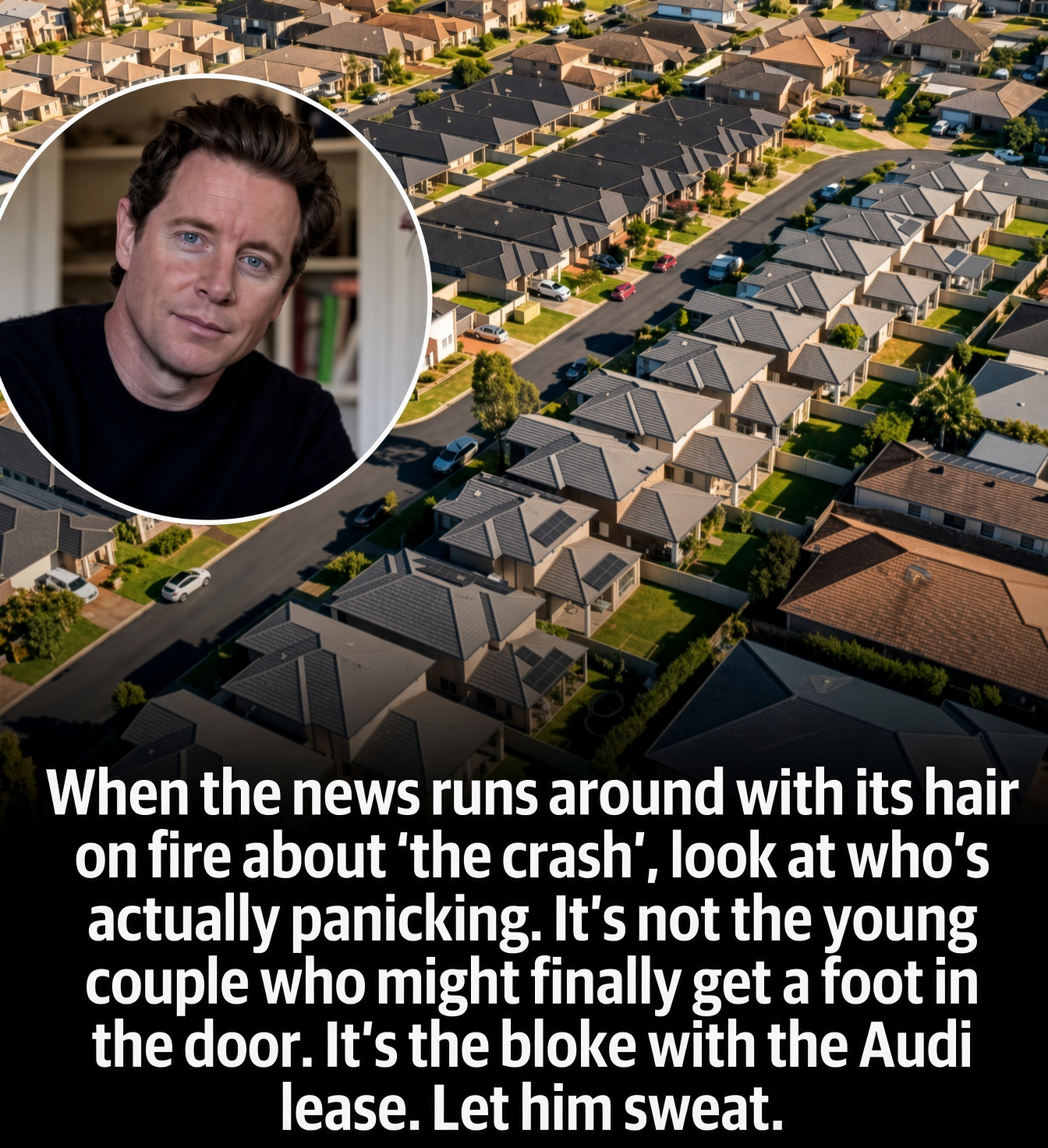
Finance commentator Scott Pape has welcomed Australia’s property slowdown as a long-overdue opportunity to restore some balance to a housing market in which prices have raced ahead of wages for decades.
His intervention comes as the Reserve Bank of Australia held the cash rate at 4.35 per cent on Tuesday following three increases earlier this year, while evidence mounts that higher borrowing costs are putting households and the property market under increasing pressure.
New industry research cited by the Finance Brokers Association of Australia points to an 18 per cent rise in mortgage default risk, while auction clearance rates have weakened, listings have risen and prices are falling across several major markets.
For heavily indebted homeowners, those conditions are painful.
For Australians locked out of home ownership, Pape argues they could represent something very different.
“House prices are falling, and that’s a good thing,” he said.
His message to the sections of the property industry treating every decline as a crisis was even simpler.
“Let him sweat.”
RBA holds rates at 4.35 per cent
The Reserve Bank’s Monetary Policy Board decided on Tuesday to leave the cash rate target unchanged at 4.35 per cent.
The decision follows three increases earlier in 2026 and offers borrowers at least a temporary reprieve from another immediate rise in mortgage repayments.
But the RBA has made clear that Australia’s inflation problem is not over.
In its August economic assessment, the Bank said inflation remained too high and was not expected to return to the middle of its 2–3 per cent target range until early next year.
That leaves the Bank confronting an increasingly uncomfortable combination: inflation requiring restrictive monetary policy while households carrying large mortgages are becoming more financially vulnerable.
Mortgage default risk jumps 18 per cent
Hours before the RBA decision, the Finance Brokers Association of Australia urged the central bank not to push rates higher.
The association cited new data from comparison group OurTop10 showing an 18 per cent increase in national mortgage default risk.
FBAA chief executive Leo Gagic said the deterioration should not come as a surprise.
He said research dating back to 2021 had already identified thousands of borrowers who could become vulnerable even to relatively modest increases in interest rates after the long period of exceptionally cheap money.
The problem now is cumulative.
Higher interest rates have combined with elevated living costs while many households have already run down the savings buffers accumulated during earlier years.
For some borrowers, Gagic warned, that combination is pushing household finances towards a tipping point.
He urged mortgage holders experiencing difficulties to contact their lender or seek assistance before missing a repayment.
The 18 per cent figure should, however, be understood for what it is: an estimate of increased default risk produced by OurTop10 and promoted by an industry association.
It does not mean 18 per cent of Australian mortgages are in default, nor is it an official RBA measure of mortgage arrears.
‘We’re in a property recession’
Meanwhile, some property professionals are using increasingly dramatic language to describe conditions on the ground.
Price Buyers Agents founder Glenn Price has declared parts of south-east Queensland to be in a “property recession” after encountering extraordinarily weak buyer turnout.
Price said he attended seven properties priced between roughly $950,000 and $1.1 million over a weekend — a bracket that until recently would have generated intense competition.
At more than half, he said, he was the only prospective buyer present.
He also pointed to more than 60 per cent of auctions in his region failing to sell.
“That’s not a slow market,” Price wrote.
“That’s a market that’s stopped.”
The assessment is anecdotal and relates to a particular part of Queensland rather than Australia as a whole.
But broader data confirms that national housing conditions have deteriorated substantially.
Cotality confirms the market has turned
Cotality’s June Home Value Index showed Australia’s national housing market moving decisively into a downturn.
National home values fell 0.4 per cent in June, the largest monthly decline since December 2022.
Across the June quarter, the national index fell 0.7 per cent, while combined capital-city values dropped 1.3 per cent.
Sydney led the major-market downturn, falling 3.2 per cent over the quarter.
Melbourne declined 2.6 per cent and the ACT fell 1.3 per cent.
Conditions remained more resilient elsewhere: Adelaide was flat over June, while Brisbane and Perth were still recording modest monthly gains of 0.3 and 0.7 per cent respectively.
That geographical divergence is important.
Australia does not have one uniform property market, and claims of a nationwide “crash” can obscure substantial differences between cities and regions.
What has clearly changed is momentum.
Auction market sends another warning
The auction market has provided some of the clearest evidence of the slowdown.
Cotality reported that the combined capital-city clearance rate remained below 50 per cent for five consecutive weeks through late June.
In the week ending June 28, 1,748 homes went to auction across the combined capitals and the final weighted clearance rate was just 45 per cent.
That means more than half of auctioned properties did not sell.
The weakness was not limited to one unusual weekend.
Two weeks earlier, Cotality recorded a 48.3 per cent final clearance rate, with 737 properties passed in and another 345 withdrawn.
Capital-city sales over the three months to June were also estimated to be 16.2 per cent lower than the same period last year and 14.5 per cent below the five-year seasonal average.
For sellers accustomed to rapid price growth and aggressive bidding, the change is substantial.
Barefoot Investor: this is good news
Pape sees that weakness very differently from much of the real estate industry.
For younger Australians who have spent years watching property ownership move further beyond their reach, he argues falling prices are a welcome development.
“House prices are falling, and that’s a good thing,” Pape said.
He mocked the breathless reaction from parts of the property industry, where weak auction results and declining values are routinely presented as disastrous.
His argument is essentially one of perspective.
Even a sizeable correction would follow an extraordinary multi-decade increase in Australian residential property values.
Pape said average house prices had risen more than 400 per cent since 2000, substantially outpacing wage growth.
That long-term divergence, he argued, is a major reason Australia now faces such severe housing affordability problems.
‘A correction we’ve needed for 20 years’
Pape’s position is more radical than simply saying homeowners should remain calm during a temporary downturn.
He believes Australia actually needs lower property prices.
“This is a correction we’ve needed for 20 years,” he said.
He also argued recent government changes intended to reduce the attractiveness of property investment were pushing the market in the right direction.
For years, Australia’s investment-property model depended heavily on capital appreciation.
Rental yields alone often provided comparatively modest returns relative to the enormous amount of capital tied up in a property.
If investors can no longer assume prices will rise rapidly and consistently, Pape argues the financial calculation changes considerably.
Owning a rental property then involves accepting maintenance costs, taxes, vacancies, interest expenses and management headaches without being able to rely on large capital gains to compensate.
His colourful summary was that investors could find themselves volunteering to repair somebody else’s dishwasher late on a Sunday night.
But Cotality data needs an important correction
One statistic attributed to Pape in reporting on his comments does not match Cotality’s own published June-quarter index.
The commentary cited combined-capital prices falling 2.5 per cent during the June quarter.
Cotality’s July 1 Home Value Index release instead reports a 1.3 per cent quarterly decline across the combined capital cities and a 0.7 per cent decline nationally.
Melbourne individually recorded a decline close to the figure cited — 2.6 per cent — while Sydney fell 3.2 per cent.
The distinction does not change the direction of the market, but it matters when assessing the scale of the downturn.
Australia’s property market has weakened sharply.
The primary Cotality data does not support describing the combined-capital June-quarter decline as 2.5 per cent.
Falling prices do not automatically mean affordable homes
This is where the housing story becomes more complicated.
A lower sticker price should make a property more affordable.
But most buyers do not purchase homes with cash.
They purchase them with mortgages.
And Cotality’s analysis shows that rising interest rates have substantially increased the income required to service those mortgages, offsetting the benefit of lower prices in Sydney and Melbourne.
The effect is particularly striking in Brisbane and Perth, where values have remained comparatively resilient while borrowing costs have risen.
Cotality calculated that a household buying Brisbane’s median-priced house in May required more than $17,000 in additional annual income compared with January simply to service a typical mortgage.
For Perth, the increase was about $16,500.
Even buyers targeting lower-quartile houses faced substantially higher income requirements.
So while falling prices may improve the long-term prospects of first-home buyers, high interest rates can simultaneously make it harder to qualify for and service the loan needed to buy.
First-home buyers are not flooding back
That helps explain another surprising feature of the downturn.
Cheaper prices have not yet unleashed the rush of first-home buyers some expected.
Property tracker Spachus founder Phil Symmonds said his data showed no evidence of first-home buyers entering the market in large numbers either immediately before or after the May 12 federal budget.
The raw figures cited by Symmonds point to a sharp slowdown in transactions across major markets.
In Melbourne, 10,691 properties below $1 million reportedly sold between February and May 12, compared with 4,820 in the period after the budget covered by his analysis.
Almost three-quarters of those post-budget transactions were said to have sold below asking price.
Sydney and Brisbane also recorded substantial declines in sales volumes across both sub-$1 million and $1 million-to-$2 million price brackets.
Aussie Home Loans separately reported in early July that first-home buyer applications had fallen by about 20 per cent since the budget, while investor loan applications were down 25 per cent, according to the source material.
Those figures reinforce the distinction between cheaper property and affordable property.
Buyers still need sufficient income, a deposit and borrowing capacity.
Do 61 per cent of Australians really want prices down?
Pape also cited polling showing substantial public support for bringing house prices down.
A Resolve Political Monitor survey attracted headlines after 61 per cent of respondents supported the objective of reducing property prices.
But the wording deserves context.
Respondents were asked whether they supported or opposed the objective of bringing house prices down in the context of housing tax and home-building subsidy policies.
That is not quite the same as asking every homeowner whether they personally want the market value of their own property to fall.
The polling nevertheless points to an important political shift.
Housing affordability has become severe enough that falling property prices are no longer automatically regarded by voters as bad economic news.
For parents whose adult children cannot afford a home, a reduction in their own paper wealth may be an acceptable trade-off if it improves the next generation’s chances of buying.
Australia has started treating homes like shares
That generational issue sits at the heart of Pape’s argument.
He believes Australia’s attitude towards housing has become distorted by decades of rapid capital gains.
Homes increasingly came to be discussed like financial securities — assets whose values were constantly monitored, celebrated when they rose and leveraged to purchase more assets.
But a home has another, more fundamental purpose.
It is somewhere to live.
From that perspective, endlessly rising prices create winners and losers.
Existing owners accumulate wealth on paper, while people trying to enter the market need progressively larger deposits and mortgages to buy exactly the same essential asset.
That is why Pape rejects the assumption that a property downturn must necessarily be treated as a national economic tragedy.
Homeowners face a very different risk
None of this means falling prices are painless.
Recent buyers with highly leveraged mortgages are particularly exposed.
A homeowner who bought near the peak with a small deposit could see much of their equity disappear if values decline substantially.
If they need to sell during that period because of job loss, divorce, relocation or financial hardship, the paper loss can become a real one.
Investors can face the same problem while simultaneously dealing with higher interest costs.
And borrowers already experiencing mortgage stress gain little comfort from knowing that their property is becoming more affordable to somebody else.
The 18 per cent increase in default risk cited by the FBAA illustrates why the current correction cannot simply be celebrated without acknowledging its consequences.
The next phase could be much larger
Some property analysts believe the downturn still has considerably further to run.
Property consultant Cameron Kusher has forecast national prices could fall by as much as 2 per cent by the end of 2026 before declining between 10 and 12 per cent by December 2027, according to the source reporting.
If realised, Kusher said that would amount to the largest downturn Australia had experienced in more than 45 years.
But he also made an important point about the historical comparison.
Such a result would partly demonstrate how modest Australian housing downturns have typically been.
Decades of strong growth mean even a double-digit fall needs to be considered against the much larger increase that preceded it.
A correction with winners and losers
Australia is therefore entering an unusual housing environment.
Prices are falling in some of its largest markets.
Auction results are weak.
Listings are building.
Sales volumes have declined.
Investors are becoming less active.
And mortgage stress is rising.
Yet for millions of younger Australians, those same conditions could eventually provide the first meaningful improvement in housing affordability they have seen in years.
The problem is that lower prices alone cannot deliver that outcome while borrowing costs remain high and household incomes struggle to keep pace.
Tuesday’s RBA decision prevents another immediate increase in the cash rate, but at 4.35 per cent monetary policy remains restrictive and mortgage servicing remains expensive.
Pape’s argument nevertheless challenges one of Australia’s most deeply embedded economic assumptions: that rising house prices are inherently good and falling prices inherently bad.
For a homeowner measuring wealth through equity, a downturn hurts.
For an investor dependent on perpetual capital growth, it can be worse.
But for the 28-year-old still living in a childhood bedroom because the deposit required for an ordinary home keeps moving faster than their savings, the same correction can look like opportunity.
That is why Pape is not joining the panic.
When the property industry starts treating falling prices like the end of the world, his message is to remember who benefited from the extraordinary rise that came before it — and who did not.
Or, in the Barefoot Investor’s considerably shorter formulation:
“Let him sweat.”






