A proposal by one of Australia’s largest manufacturing unions to remove the Union Jack from the national flag has reignited debate over the country’s identity just days before the Australian Labor Party’s National Conference.
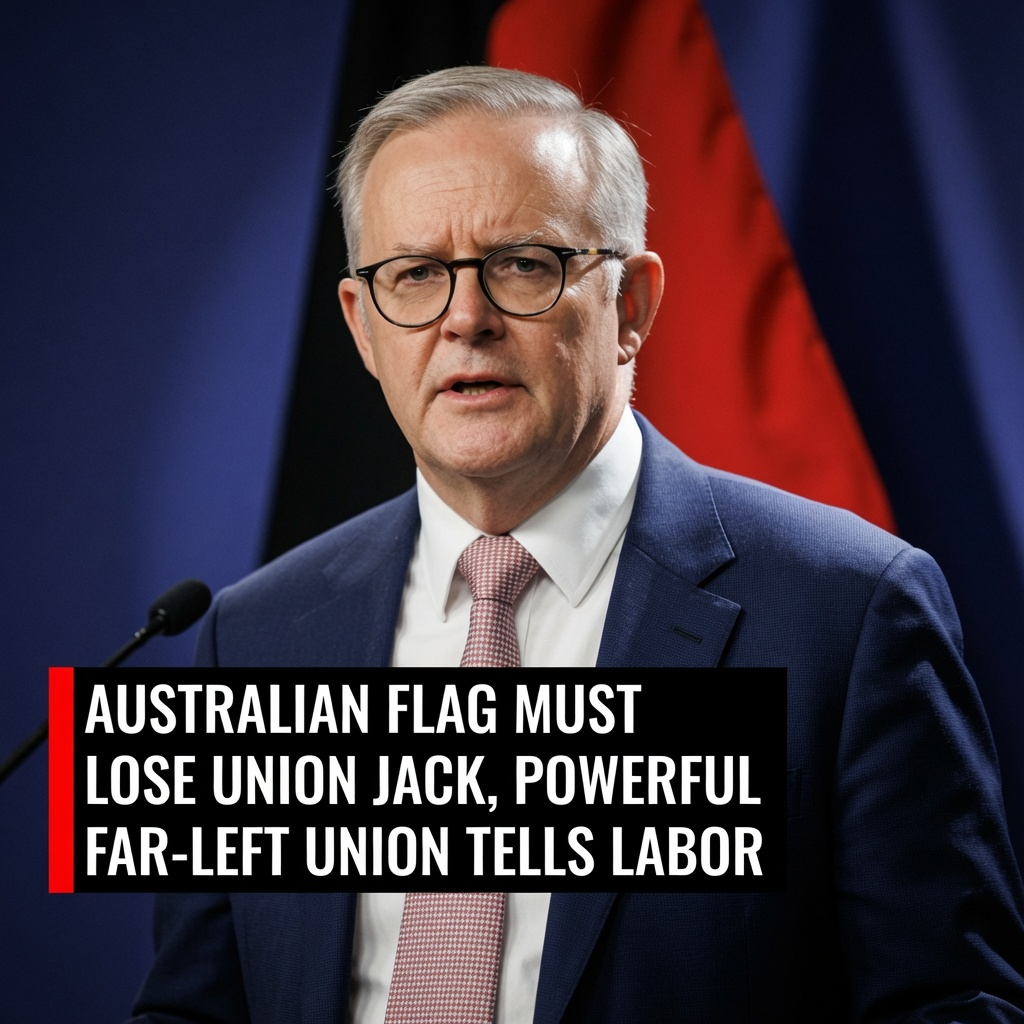
The Australian Manufacturing Workers’ Union (AMWU) has called for the Union Jack to be removed from the Australian flag, arguing it remains a symbol of colonial oppression that no longer reflects modern Australia.
The proposal appears in the union’s Blueprint of Action, a policy document prepared ahead of Labor’s National Conference in Adelaide, where hundreds of delegates from affiliated unions and party branches will debate policy priorities for the party’s next term in government.
Within the section titled Solidarity with First Nations peoples, the AMWU argues that Australia should remove what it describes as enduring symbols of colonial rule.
“We need to strip away the constant reminders of the old ruling class and colonial empire,” the document states.
The blueprint specifically identifies the Union Jack on Australia’s national flag and colonial-era statues as symbols that should be removed from public life, arguing they represent historical violence and dispossession experienced by Indigenous Australians.
The union’s recommendations extend beyond national symbols. The document also renews support for implementing an Indigenous Voice to Parliament, despite Australians rejecting the proposal at the 2023 referendum, and argues that Australia continues to grapple with the legacy of colonisation.
While the proposal has attracted widespread attention, it remains an internal policy position advanced by the AMWU rather than official government policy.
Labor’s National Conference serves as the party’s highest decision-making forum, bringing together approximately 400 delegates from unions, state branches and parliamentary representatives. Delegates debate motions and vote on the party’s national platform, although many policy positions are negotiated before the conference begins.
Not every proposal submitted by affiliated unions is adopted, and even successful conference resolutions do not automatically become government legislation.
Nevertheless, the AMWU’s position has intensified political scrutiny because of the union’s longstanding relationship with the Australian Labor Party.
The AMWU is one of Labor’s affiliated unions and has historically played an influential role within the party. Several Labor parliamentarians have maintained links with the organisation during their political careers, reflecting the close institutional relationship between Labor and sections of the Australian union movement.
The proposal has prompted criticism from Coalition politicians, who argue Australia’s flag represents far more than its colonial origins.
Supporters of retaining the current flag point to Australia’s constitutional heritage, Westminster system of government, common law tradition and the service of Australian defence personnel who have fought under the existing flag for more than a century.
They argue that the Union Jack acknowledges Australia’s historical development without diminishing the nation’s independent identity.
Those advocating change, however, believe Australia’s national symbols should better reflect the country’s contemporary multicultural identity and acknowledge the experiences of Aboriginal and Torres Strait Islander peoples.
For many supporters of redesigning the flag, removing the Union Jack would represent a symbolic step toward recognising Australia’s evolution from its colonial past.
The issue has surfaced repeatedly throughout Australia’s modern political history.
Since Federation in 1901, periodic campaigns have called for a new national flag that excludes the Union Jack. Organisations advocating change have argued that Australia’s growing independence, diverse population and distinct place in the Asia-Pacific region warrant a uniquely Australian design.
Despite those campaigns, opinion polling over many years has generally found stronger public support for retaining the existing flag than replacing it, although attitudes have varied depending on how survey questions are framed and what alternative designs are proposed.
The Australian flag itself contains several symbolic elements.
The Union Jack occupies the upper left canton, recognising Australia’s constitutional origins as part of the British Empire. Beneath it sits the Commonwealth Star, whose seven points represent Australia’s six states and the territories. The Southern Cross constellation dominates the fly, reflecting a feature of the southern night sky that has become synonymous with Australia’s national identity.
Debates over the flag frequently intersect with broader discussions about constitutional recognition, reconciliation, republicanism and Australia’s relationship with the British Crown.
Those issues have remained politically sensitive for decades, often generating passionate arguments on both sides.
This year’s Labor conference is expected to debate a broad policy platform covering economic management, housing affordability, industrial relations, health care, climate policy and social reform.
Among the draft platform’s proposals are commitments relating to anti-racism initiatives, multicultural inclusion and other measures designed to strengthen social cohesion.
Senior government ministers have sought to minimise the significance of the flag proposal, insisting the Albanese Government remains focused on issues that directly affect Australians’ daily lives, including housing affordability, Medicare, cost-of-living pressures and economic growth.
Housing Minister Clare O’Neil has publicly stated that she personally supports retaining the Union Jack on the Australian flag, while emphasising that the government’s priority remains practical policy rather than symbolic constitutional debates.
Political analysts note that Labor is likely to seek a disciplined conference focused on stability and governing competence, particularly as the government prepares for an increasingly competitive political environment.
Internal debates over cultural issues have the potential to dominate media coverage, something party strategists have generally sought to avoid in recent years.
The AMWU proposal therefore arrives at a politically sensitive moment.
Whether delegates ultimately endorse the recommendation or not, the debate illustrates how questions surrounding Australia’s national identity continue to resonate well beyond constitutional law or historical scholarship.
Supporters view changing the flag as an opportunity to better reflect modern Australia and acknowledge historical injustices. Opponents argue the existing design honours Australia’s democratic institutions, military history and constitutional evolution while remaining one of the country’s most recognisable national symbols.
As Labor’s National Conference begins in Adelaide, delegates will weigh hundreds of policy proposals across a wide range of issues. Among them, few have generated as much public attention as the future of the Union Jack on Australia’s flag—a debate that once again highlights the enduring tension between preserving historical traditions and redefining national identity for future generations.






