A proposal by one of Australia’s most influential manufacturing unions has reignited debate over national identity after calling for the Union Jack to be removed from the Australian flag as part of a broader package of political and economic reforms.
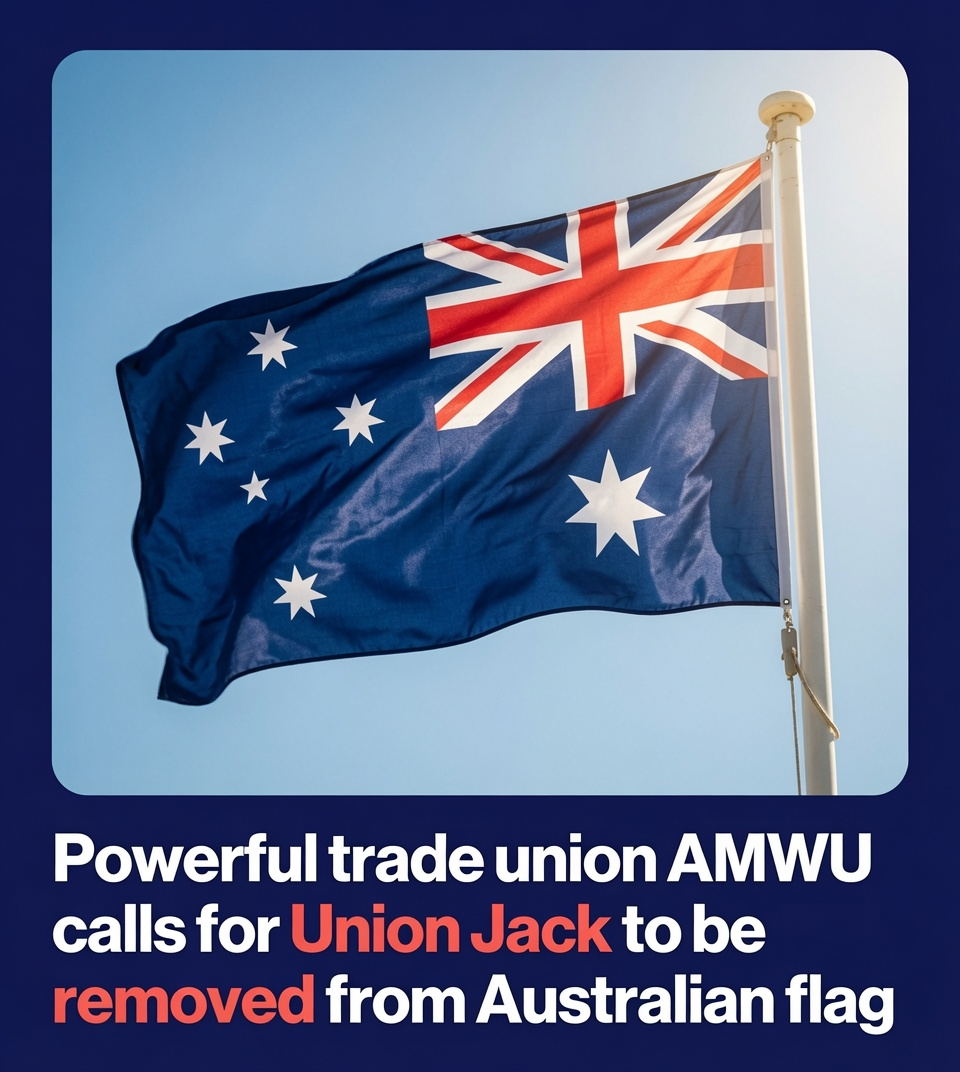
The Australian Manufacturing Workers’ Union (AMWU) unveiled the proposal in its Blueprint of Action, released ahead of the Australian Labor Party’s National Conference in Adelaide, where hundreds of delegates will debate policy priorities for the party’s future platform.
The document argues that Australia should remove what it describes as enduring symbols of colonial rule, identifying the Union Jack on the national flag as one of those symbols.
“We need to strip away the constant reminders of the old ruling class and colonial empire,” the blueprint states.
According to the AMWU, symbols associated with colonisation continue to represent historical oppression of Aboriginal and Torres Strait Islander peoples and should no longer occupy prominent positions in Australia’s public life.
The proposal forms part of a much broader policy agenda covering Indigenous recognition, taxation, public services and economic reform.
Among its recommendations, the union advocates introducing wealth taxes and inheritance taxes, expanding access to free education, increasing welfare payments and strengthening publicly funded essential services.
The blueprint also reiterates support for an Indigenous Voice to Parliament and argues Australia continues to grapple with the legacy of colonisation and its long-term social and economic consequences.
While the recommendations have attracted considerable public attention, they represent the policy position of the AMWU rather than official Australian Government policy.
The AMWU is one of Labor’s affiliated trade unions and participates in the party’s internal policy-making process through the National Conference.
Labor’s National Conference is the party’s highest governing forum, bringing together approximately 400 delegates representing affiliated unions, state branches and parliamentary representatives.
Delegates debate amendments to the party platform and vote on a wide range of proposals submitted by party organisations and affiliated unions. However, conference motions do not automatically become government policy or legislation.
This distinction has become particularly significant following widespread public discussion surrounding the union’s proposal.
After questions emerged about whether the Albanese Government might consider changing Australia’s national flag, the government issued a clear statement confirming it has no intention of doing so.
A government spokesperson stated that the Albanese Government would not change the Australian flag, effectively distancing the government from the AMWU proposal despite the longstanding relationship between Labor and Australia’s trade union movement.
The debate nevertheless illustrates the continuing influence affiliated unions can have in shaping discussion within the Labor Party.
Historically, unions have played a central role in Labor’s organisational structure, contributing delegates, policy proposals and organisational support at national conferences.
Affiliated unions regularly advance proposals covering industrial relations, taxation, climate policy, housing, social welfare and constitutional issues.
Some recommendations eventually become party policy, while others are amended, rejected or remain internal discussion documents.
The proposal concerning Australia’s national flag has generated particularly strong reactions because the flag remains one of the country’s most recognisable national symbols.
Australia adopted its current flag following Federation in 1901.
The design incorporates the Union Jack in the upper canton, reflecting Australia’s constitutional origins within the British Empire. Beneath it sits the Commonwealth Star representing Australia’s federation, while the Southern Cross constellation symbolises the country’s geographic location in the Southern Hemisphere.
Calls to redesign the flag are not new.
For decades, republic advocates, historians and some community organisations have argued that Australia’s national flag should better reflect the country’s independent identity and multicultural society rather than its colonial origins.
Supporters of removing the Union Jack argue Australia has evolved into a fully sovereign nation whose national symbols should reflect contemporary Australian identity.
Many also contend that the Union Jack carries painful historical associations for some Indigenous Australians because of colonisation and dispossession.
Opponents of changing the flag argue the existing design recognises Australia’s constitutional history, democratic institutions and the evolution of the nation’s legal and parliamentary systems.
They also point to the service of generations of Australian defence personnel who fought under the current flag during conflicts ranging from the First and Second World Wars to more recent peacekeeping and humanitarian operations.
Public opinion on changing the flag has historically remained divided, although most national surveys over recent decades have generally found stronger support for retaining the existing design than replacing it.
Beyond the debate over national symbols, the AMWU’s broader policy blueprint reflects a progressive economic agenda.
The union argues wealth inequality has increased over recent decades and proposes greater redistribution through tax reform alongside expanded government investment in education, social services and public infrastructure.
Advocates of wealth and inheritance taxes argue such measures can help reduce inequality and generate additional government revenue for public services.
Critics, however, contend that these taxes may discourage investment, complicate succession planning for family businesses and farms, and reduce Australia’s international competitiveness.
Similarly, proposals for universally free education and higher welfare payments have long generated debate over both their social benefits and their budgetary costs.
Supporters argue expanded public investment strengthens opportunity and reduces disadvantage, while opponents question how such programs would be financed without placing additional pressure on taxpayers or public debt.
These competing perspectives are expected to feature in broader policy discussions as Labor’s National Conference considers a wide range of economic and social priorities.
Senior ministers have consistently indicated the government’s immediate focus remains on practical issues affecting Australians, including housing affordability, cost-of-living pressures, Medicare, economic growth and productivity.
Political observers note that debates over national identity often attract significant media attention because they touch on history, culture and constitutional tradition as much as contemporary politics.
Whether or not the AMWU’s recommendations gain broader support among Labor delegates, the proposal has already succeeded in placing Australia’s national symbols back at the centre of public discussion.
For now, however, the government’s position remains unchanged.
While affiliated unions are free to advocate for constitutional and symbolic reforms within the Labor movement, the Albanese Government has made clear that removing the Union Jack from Australia’s national flag is not on its legislative agenda.






