Liberal MP Julian Leeser has delivered an emotional account to the Royal Commission into Antisemitism and Social Cohesion, describing how rising hostility towards Australia’s Jewish community has affected his own family and left his eight-year-old son questioning whether it is safe to attend Jewish events.
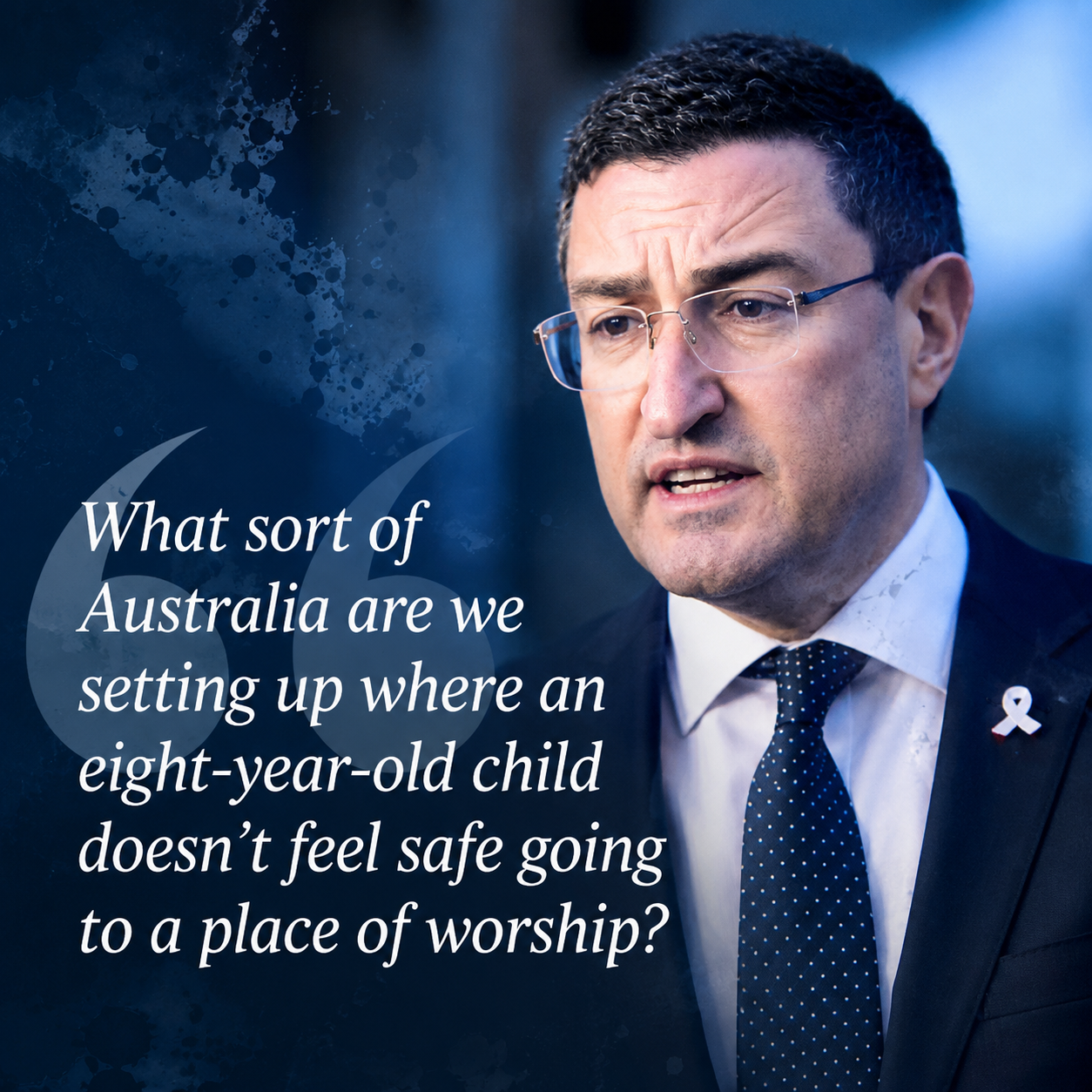
Appearing before the royal commission, Mr Leeser said the fears expressed by his son reflected a broader sense of anxiety now being experienced by many Jewish Australians following a series of high-profile incidents, including the fatal stabbing attack at Sydney’s Westfield Bondi Junction in April 2024.
While the Bondi attack was not officially determined to have been motivated by antisemitism, the tragedy, together with subsequent incidents targeting Jewish institutions and individuals, has heightened security concerns across many parts of the community.
Mr Leeser told the inquiry that one question from his young son has remained with him.
“Are we safe?”
He said the question highlighted how concerns once largely confined to adults are now affecting children attending schools, religious services and community gatherings.
The Berowra MP also described a series of disturbing incidents directed at his electorate office, including repeated graffiti featuring swastikas and other symbols associated with antisemitic hatred.
He said those experiences were confronting not only for himself but also for staff, volunteers and local community members who regularly visited the office.
Giving evidence to the commission, Mr Leeser recalled how such incidents had become increasingly frequent and contributed to a growing feeling that open expressions of antisemitism had become more visible in Australia.
The Royal Commission into Antisemitism and Social Cohesion was established to examine the rise in antisemitic behaviour, its impact on affected communities and the broader implications for social harmony across Australia.
The inquiry is hearing evidence from politicians, academics, faith leaders, law enforcement agencies, community organisations and individuals who have experienced antisemitic abuse firsthand.
Its task extends beyond documenting individual incidents.
The commission is examining whether existing legal protections, policing arrangements, educational programs and community responses remain adequate in addressing antisemitism while also strengthening social cohesion in an increasingly diverse Australia.
Mr Leeser has been one of Parliament’s most prominent Jewish voices and has frequently spoken publicly about the importance of combating antisemitism while protecting Australia’s tradition of religious freedom and multiculturalism.
His evidence combined personal experiences with broader observations about changes he believes have occurred within Australian society over recent years.
According to Mr Leeser, many Jewish Australians who once felt comfortable openly expressing their identity have become more cautious about displaying religious symbols or attending public community events.
Some families have reportedly reconsidered participating in cultural celebrations or religious gatherings because of concerns about security.
The Bondi Junction attack remains one of Australia’s most traumatic recent public tragedies.
Six people were killed and numerous others injured when a lone attacker carried out a stabbing rampage inside the busy shopping centre before being shot by a police officer.
The attack shocked communities across the country and prompted renewed discussion about public safety, emergency response capabilities and support for victims and witnesses.
Although investigators did not conclude the attack itself was driven by antisemitic ideology, the broader climate following the conflict in the Middle East has contributed to heightened concern among many Jewish Australians about personal security.
Since late 2023, police and community organisations have recorded increases in reports of antisemitic incidents, including graffiti, vandalism, online abuse, threats and intimidation directed at Jewish schools, synagogues, businesses and community facilities.
Governments at both federal and state level have responded by announcing additional funding for security infrastructure, protective measures around places of worship and initiatives designed to combat hate-motivated behaviour.
Mr Leeser told the commission that the effects extend well beyond physical damage caused by incidents such as graffiti.
He said repeated acts of intimidation create lasting psychological impacts, particularly when children begin questioning whether attending ordinary community activities places them at risk.
For parents, he suggested, those conversations represent one of the most painful consequences of rising social tension.
The commission is expected to continue hearing evidence from a wide range of witnesses as it examines both the causes of increasing antisemitism and potential policy responses aimed at strengthening community cohesion throughout Australia.
Community leaders appearing before the royal commission have consistently argued that antisemitism is not only a challenge for Australia’s Jewish population but also a broader test of the country’s commitment to tolerance, pluralism and mutual respect.
They contend that when hate directed at one community is allowed to grow unchecked, it ultimately weakens confidence across society and undermines the principles that have long supported Australia’s multicultural identity.
Mr Leeser’s evidence reflected that broader concern.
While recounting the personal experiences of his family, he emphasised that his testimony was intended to illustrate how acts of intimidation can alter the everyday lives of ordinary Australians who simply wish to participate in their community without fear.
He said the emotional impact extends well beyond individual incidents of vandalism or abuse, influencing how families make decisions about attending religious services, cultural celebrations and community events.
For many parents, he suggested, security considerations have become part of routine family planning in ways that would once have seemed unimaginable.
The royal commission is examining whether existing legal frameworks provide sufficient protection against antisemitic conduct while also considering how governments, educational institutions and community organisations can better respond to rising social tensions.
Witnesses have been asked to provide evidence on a wide range of issues, including hate speech, online radicalisation, discrimination, community education, policing practices and the effectiveness of current laws addressing religious vilification.
The inquiry is also exploring ways to strengthen social cohesion by encouraging respectful dialogue between different cultural and religious communities.
Experts appearing before the commission have noted that antisemitism can take many forms, ranging from abusive language and online harassment through to threats, vandalism and physical violence.
They argue that identifying concerning trends early is critical to preventing more serious incidents from occurring and maintaining public confidence in community safety.
At the same time, civil liberties advocates have emphasised the importance of ensuring any policy responses remain consistent with Australia’s long-standing protections for freedom of expression while distinguishing legitimate political debate from unlawful hate speech or intimidation.
Balancing those principles is expected to form an important part of the commission’s final recommendations.
The inquiry comes amid heightened international tensions following the conflict in the Middle East, which has generated strong public debate across Australia and prompted demonstrations by groups expressing differing political and humanitarian perspectives.
Political leaders from across the spectrum have repeatedly urged Australians to ensure overseas conflicts do not fuel hostility towards local communities or individuals based on their religion or ethnicity.
Successive governments have also stressed that every Australian should be able to practise their faith and participate in community life free from intimidation, discrimination or violence.
Mr Leeser’s testimony underscored the deeply personal consequences that can arise when those expectations are called into question.
Rather than focusing solely on political debate, his evidence centred on the experience of a father responding to the fears of a young child who no longer feels completely secure attending events connected with his own community.
That account provided the commission with a reminder that beyond statistics, police reports and policy discussions are families whose sense of belonging can be profoundly affected by acts of hatred.
As hearings continue, commissioners are expected to hear further evidence from victims, community representatives, academics and legal experts before preparing recommendations aimed at reducing antisemitism and strengthening social cohesion across Australia.
The commission’s final report is expected to inform future government policy on preventing hate-motivated behaviour, improving community safety and reinforcing Australia’s multicultural values while ensuring all Australians can participate confidently in public life regardless of their faith or background.