Victorian Premier Jacinta Allan is facing a fresh political fight over reports her government is considering a major overhaul of the state’s council rate cap, with critics warning the proposed changes could leave households exposed to larger annual rate increases.
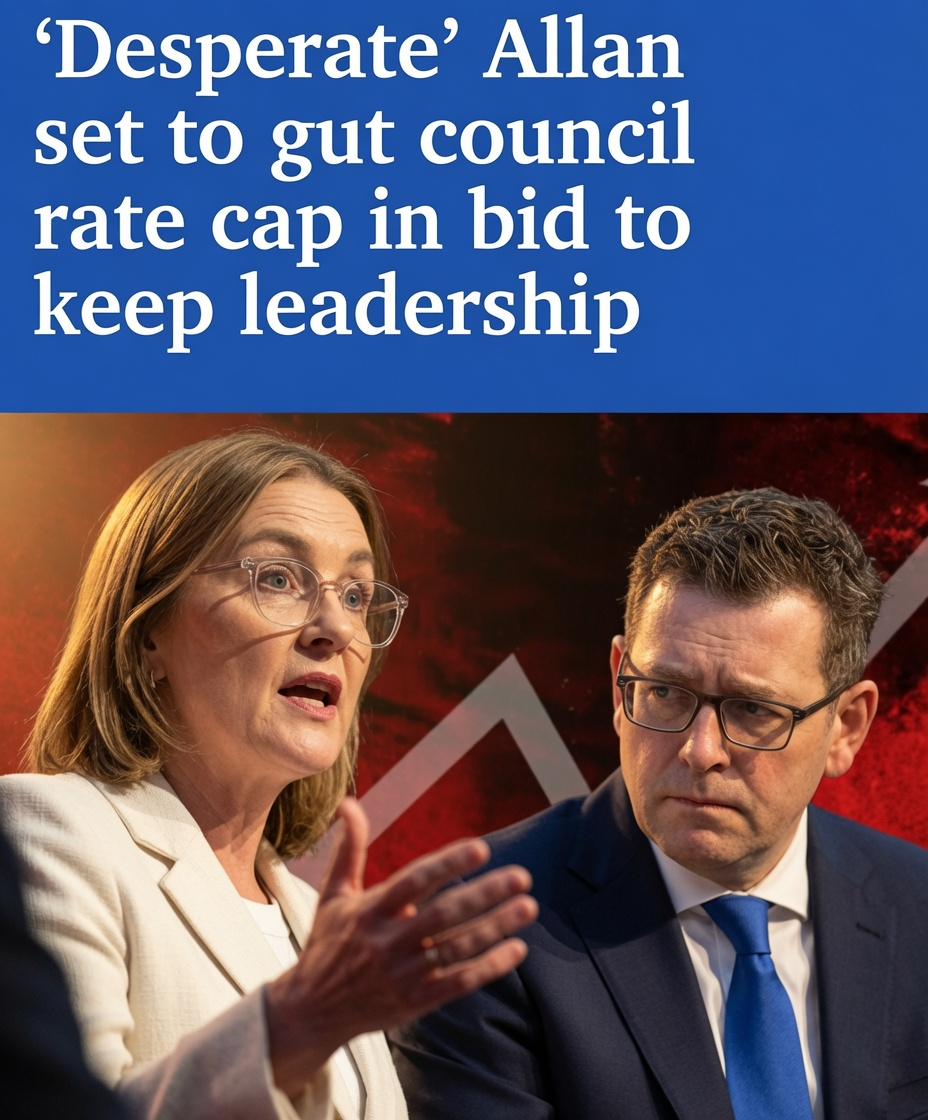
The reported proposal would potentially allow council wage costs to be treated separately from the existing cap, giving local governments greater scope to recover rising employee expenses from ratepayers.
No final policy has been announced, and the details remain subject to government consideration. However, the prospect of exempting a substantial part of council expenditure from the cap has already caused concern among ratepayer groups, political opponents and some figures within Victorian Labor.
The controversy is particularly sensitive because the Fair Go Rates system was introduced by a Labor government as a direct response to community anger over repeated council rate increases.
Since the framework began in the 2016–17 financial year, Victorian councils have generally been prevented from increasing their total rate revenue beyond a cap set annually by the Local Government Minister. The cap is informed by inflation forecasts and advice from the Essential Services Commission.
For the 2026–27 financial year, the statewide cap has been set at 2.75 per cent.
Councils that believe they cannot maintain services within the standard limit can apply to the Essential Services Commission for permission to impose a higher increase. That process requires a council to justify its financial need and demonstrate that it has consulted its community.
The system does not mean every individual property owner’s bill rises by exactly the headline percentage. Changes in property valuations, municipal charges and the distribution of rates across different property categories can produce different outcomes for individual households.
Nevertheless, the cap restricts the overall increase in general rate revenue collected by each council and has become an important source of certainty for Victorian homeowners.
The reported wage exemption could significantly alter that protection.
Employee expenses are among the largest costs carried by local governments. Councils employ staff across waste management, planning, engineering, libraries, maternal and child health, aged and disability services, parks, community facilities, administration and local law enforcement.
If wage increases were excluded from the cap, councils could potentially raise additional revenue to cover those costs without having to apply for a formal variation through the existing regulatory process.
Supporters of reform argue the present system has placed councils under growing financial strain. They say the cost of delivering local services has often risen faster than the inflation measure used to set the annual cap.
Councils have faced higher construction expenses, insurance premiums, fuel costs, technology bills, waste management charges and contractor fees. At the same time, many communities expect local government to maintain ageing infrastructure and provide an expanding range of services.
Population growth has placed further pressure on fast-developing municipalities, where councils must build and maintain roads, drainage systems, sporting facilities, libraries, community centres and public open space.
Regional councils face a different challenge. They often maintain extensive road networks and public assets across large geographic areas while collecting rates from relatively small populations.
Local government representatives have also repeatedly accused state and federal governments of cost shifting, arguing that councils are being asked to perform additional responsibilities without receiving enough funding to cover them.
From that perspective, changing the cap could give municipalities greater capacity to retain workers, negotiate wage agreements and protect essential services.
For ratepayers, however, the central question is whether those pressures should automatically be passed on through higher household bills.
The existing system already allows councils to seek a higher cap when they can demonstrate a genuine financial need. Critics therefore argue that creating a broad exemption for wage costs would weaken accountability and allow councils to increase revenue without facing the same level of independent scrutiny.
They also warn that excluding one major expense could create pressure for other costs to be removed from the cap in future, gradually hollowing out the policy while leaving its name intact.
That concern is likely to resonate with households already dealing with mortgage stress, rent increases, insurance premiums, energy bills, food prices and state government charges.
Council rates are unavoidable for property owners and are commonly reflected in rents paid by tenants. Even a modest increase can be difficult for pensioners, single-income families and residents whose incomes have not kept pace with living costs.
The political danger for the Allan Government is therefore clear. A policy promoted as a way to help councils and their workers could be interpreted by voters as another increase in the cost of owning or renting a home.
The debate has also become entangled with speculation about the Premier’s leadership.
Reports of unrest within Victorian Labor have intensified as the government confronts difficult polling, concern over its electoral prospects and continued scrutiny of major infrastructure spending and the construction industry.
Ms Allan has publicly rejected suggestions that she intends to step aside and has maintained that she is focused on governing Victoria. However, questions about her authority have persisted as some Labor MPs reportedly consider whether a leadership change would improve the party’s position before the state election.
Against that backdrop, opponents of the rate cap proposal have alleged that the change is designed partly to secure support from the Australian Services Union and Labor figures aligned with it.
The union represents many local government employees and has long argued that strict rate capping limits councils’ ability to fund fair wages and maintain public services.
There is no publicly confirmed evidence that a final decision has been made as part of any leadership arrangement. The government will need to explain the policy on its merits rather than allow claims about internal Labor politics to define the debate.
That explanation will require answers to several practical questions.
The government would need to specify which employment costs could be exempted, whether the exemption would cover all wage increases or only increases negotiated under formal enterprise agreements, and what safeguards would prevent councils from using the change to impose excessive rises.
It would also need to clarify whether councils would be required to demonstrate efficiency savings before passing higher wage costs to ratepayers.
Transparency would be another significant issue. Under the current variation process, councils seeking to exceed the cap must present a public case and obtain approval from the Essential Services Commission.
A wage exemption could reduce that independent oversight unless it was accompanied by new reporting, consultation and accountability requirements.
There is also a broader question about whether a statewide rule can fairly address the different financial circumstances of Victoria’s 79 councils.
Some municipalities have strong revenue bases, valuable commercial precincts and rapidly growing property markets. Others face declining populations, limited development and large infrastructure obligations.
A uniform wage exemption could provide necessary relief to financially stressed councils while also giving stronger councils permission to collect more revenue than they genuinely need.
One option available to the government would be to retain the existing cap while streamlining the process for councils seeking justified variations. Another would be to allow only part of an independently verified wage increase to sit outside the limit.
The government could also consider targeted financial assistance for councils facing exceptional pressures rather than shifting the entire burden to local ratepayers.
Any reform would have to balance three competing interests: the ability of councils to fund services, the right of workers to negotiate fair wages and the need to protect residents from uncontrolled increases.
That balance is difficult because local governments provide many services residents encounter every day.
Councils collect household rubbish, manage local roads, maintain parks and playgrounds, operate libraries, assess development applications, support community programs and look after public buildings and sporting grounds.
Cutting those services is rarely popular. Raising rates to preserve them is rarely popular either.
The rate cap was designed to force that trade-off into the open. Rather than allowing councils to increase revenue automatically, it required them to operate within a publicly announced limit or make a formal case for exceeding it.
Removing wage expenses from the calculation could make council budgeting easier, but it would also shift more financial risk from local governments to households.
The dispute comes at a time when the practical value of the variation system is already being tested. Glen Eira City Council received approval for a one-year increase above the standard 2026–27 cap after arguing it needed additional revenue to maintain services and infrastructure.
That decision demonstrated that the current framework is not an absolute freeze. Councils can exceed the statewide limit, but they must first establish why the increase is necessary.
Critics of the Allan Government’s reported proposal are likely to argue that this mechanism should remain the primary avenue for councils seeking additional money.
Those advocating change will respond that repeatedly applying for special approval is slow, uncertain and poorly suited to routine wage pressures faced by the entire sector.
The eventual decision will reveal whether the government believes the problem lies with individual council budgets or with the design of the rate cap itself.
It will also test the credibility of Labor’s cost-of-living message.
In December 2025, the Allan Government presented the 2.75 per cent cap for 2026–27 as a measure intended to keep pressure off household budgets. A major exemption announced months later would invite accusations that the government was retreating from that commitment.
Ministers would therefore need to explain why the circumstances have changed and how ratepayers would remain protected under a revised system.
The Opposition is likely to frame any weakening of the cap as evidence that Labor is prioritising internal political relationships over household finances. Councils and unions, meanwhile, will argue that a cap which does not reflect the real cost of delivering services cannot remain sustainable indefinitely.
Both arguments contain legitimate concerns, but the impact on residents will depend on the final details rather than the political language surrounding them.
A tightly controlled exemption with independent oversight could have a limited effect. A broad removal of wage costs from the cap could substantially increase the amount councils are permitted to collect.
Until the government releases a formal proposal, Victorian households cannot know how much their bills could change or which councils would use the new flexibility.
What is already apparent is that the rate cap has moved from a technical local government issue to a serious political test for the Premier.
Ms Allan must now decide whether to proceed with a reform sought by parts of the council sector and organised labour, modify it to preserve stronger ratepayer protections or abandon it in the face of political opposition.
For Victorian residents, the issue is less about internal Labor manoeuvring than the amount they may ultimately be required to pay.
Any government seeking to change a landmark household protection will need to prove that the reform is necessary, transparent and fair. Without those assurances, a policy intended to stabilise council finances risks becoming another source of financial anxiety for ratepayers across the state.






