Indian Prime Minister Narendra Modi’s appearance before tens of thousands of supporters in Melbourne has generated renewed debate over one of Australia’s most politically sensitive public customs after he opened his speech with an Acknowledgement of Country.
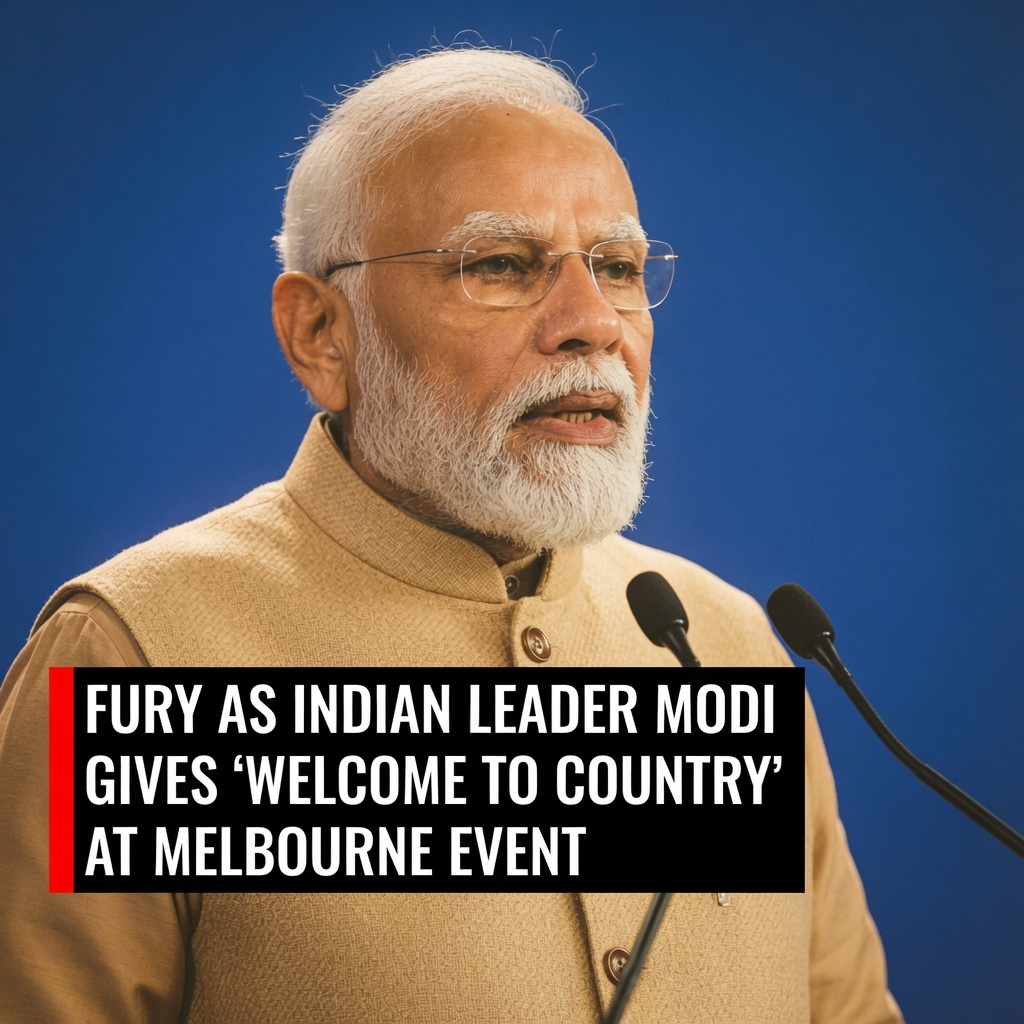
The event, held at Melbourne’s Marvel Stadium and attended by Australian Prime Minister Anthony Albanese and Victorian Premier Jacinta Allan, attracted an audience estimated at around 30,000 people. It was designed as a celebration of the growing relationship between Australia and India and the contribution of the Indian-Australian community.
At the beginning of his address, Mr Modi followed a format now commonly seen at major public events across Australia.
“I would like to begin by acknowledging the traditional owners of the land on which we meet,” he said.
“And I pay my respects to their Elders past, present and emerging.”
While similar acknowledgements are routinely delivered by Australian politicians, business leaders, universities and community organisations, Mr Modi’s remarks quickly became the focus of political discussion online.
Some commentators questioned whether a visiting foreign leader should perform an acknowledgement traditionally associated with Australian civic events. Others argued the remarks simply reflected established Australian protocol and diplomatic courtesy.
The differing reactions highlighted broader disagreements that have continued since the 2023 Indigenous Voice referendum, which intensified national debate over Indigenous recognition, constitutional reform and public symbolism.
Outside the stadium, several groups staged separate demonstrations during the event. Protesters included Sikh activists critical of Mr Modi’s government, human rights campaigners and smaller groups expressing opposition to Australia’s immigration policies.
Although their motivations differed significantly, the protests underscored the complex political environment surrounding one of the largest public appearances by the Indian Prime Minister during his Australian visit.
Critics of Mr Modi’s opening remarks argued that an Acknowledgement of Country carries symbolic implications extending beyond simple respect for Indigenous Australians.
Some claimed that such acknowledgements reinforce particular interpretations of Australia’s history and sovereignty that remain politically contested.
Those views have circulated widely across social media in recent years, particularly among groups opposed to mandatory acknowledgements at government events and institutions.
Supporters, however, argued that the criticism misunderstands the purpose of the practice.
An Acknowledgement of Country differs from a Welcome to Country. A Welcome to Country is a ceremonial welcome performed by a Traditional Owner or authorised Indigenous representative whose Country is being visited.
An Acknowledgement of Country, by contrast, may be delivered by anyone attending or hosting an event. It is intended as a statement recognising the Traditional Custodians of the land rather than a ceremonial welcome.
The distinction has become increasingly important as both practices have become common across Australian governments, universities, sporting events and corporate functions.
For supporters, acknowledgements represent an expression of respect towards Aboriginal and Torres Strait Islander peoples without creating any legal consequences regarding land ownership or sovereignty.
For critics, however, their increasing use reflects what they see as an unnecessary politicisation of public life.
The issue has become one of Australia’s most polarising cultural debates, particularly following the unsuccessful Voice referendum, with many organisations reassessing how frequently acknowledgements are used.
Mr Modi’s remarks therefore occurred within an already contentious domestic conversation rather than creating an entirely new controversy.
The Melbourne gathering itself was intended to celebrate expanding Australia-India relations, which have strengthened considerably over the past decade.
India has become one of Australia’s most significant strategic partners across trade, education, defence cooperation and regional security.
The Indian-born population in Australia has also grown rapidly over recent years, making it one of the country’s largest migrant communities.
Successive Australian governments from both major political parties have promoted closer engagement with India, viewing the relationship as increasingly important to Australia’s economic and geopolitical interests in the Indo-Pacific region.
During the Melbourne event, Prime Minister Albanese praised the contribution of Indian Australians and described the bilateral relationship as stronger than ever.
The visit also included discussions on cultural cooperation, education, investment and the return of certain cultural artefacts and human remains held in museums in both countries.
Those agreements attracted considerably less public attention than the debate surrounding Mr Modi’s opening acknowledgement.
The controversy illustrates how symbolic gestures can rapidly become politically charged in Australia, particularly when they intersect with broader debates over immigration, national identity and Indigenous recognition.
While critics viewed the acknowledgement as inappropriate for a visiting foreign leader, others argued that refusing to follow standard Australian event protocol could itself have attracted criticism.
Diplomatic visits frequently involve observing local customs and ceremonial conventions, particularly during official community events attended by senior political leaders.
Whether the incident has any lasting political impact remains unclear.
However, the reaction demonstrates that discussions surrounding Indigenous recognition continue to resonate well beyond government policy, extending into diplomacy, public ceremonies and international events held on Australian soil.
As Australia continues debating questions of national identity and reconciliation, even brief ceremonial remarks can become focal points for wider political disagreement, particularly when delivered on high-profile stages before large audiences.






