Prime Minister Anthony Albanese is set to face a fresh political challenge in his long-held Sydney electorate after commentator, podcaster and Cheek Media co-founder Hannah Ferguson confirmed she will contest the seat of Grayndler as an independent at the next federal election.
Ferguson, who has built a substantial online following through political commentary and social media analysis, announced her decision after weeks of speculation that she was preparing to enter federal politics. Rather than pursuing the Senate as she had previously indicated, the 28-year-old said she had decided to focus on Grayndler following months of discussions with local residents and supporters.
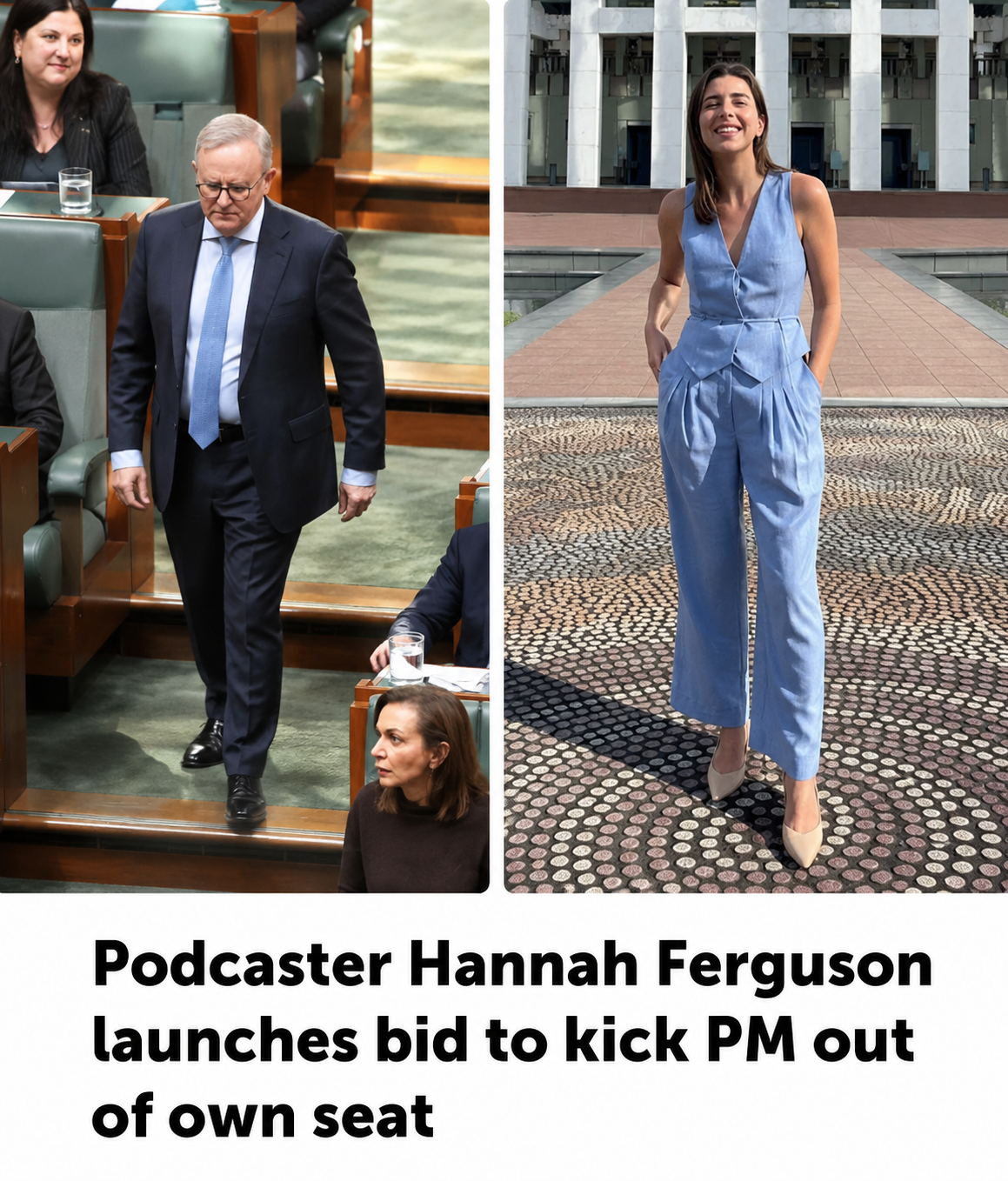
Her decision immediately places one of Australia’s most recognisable online political commentators in direct competition with a sitting Prime Minister who has represented the electorate since 1996 and remains one of Labor’s most prominent figures.
Announcing her campaign on Instagram, Ferguson argued Australia’s political system no longer reflects the interests of ordinary voters, saying both major parties have become increasingly disconnected from the communities they were elected to represent.
“The political system is broken,” she wrote.
She claimed Australia’s major political parties were answering to vested interests instead of local communities and argued many voters felt increasingly frustrated despite Labor holding one of the largest parliamentary majorities in recent history.
“The Albanese government currently holds a historic 94-seat super majority in the House of Representatives — yet all I hear from voters is disappointment and frustration,” Ferguson said.
Rather than presenting herself as a traditional politician, Ferguson framed her campaign around community engagement, promising to continue holding local forums, listening sessions and neighbourhood events before finalising a comprehensive policy platform.
She said her objective was to develop evidence-based policies informed directly by residents rather than party strategists or factional negotiations.
“I’m not here to play politics,” she said, adding that she intended to keep listening and learning from the community throughout the campaign.
Ferguson also took aim at the Prime Minister personally, arguing the people of Grayndler deserved stronger local representation than they currently receive.
She accused Albanese of prioritising the interests of the gambling industry, fossil fuel companies and political donors over those of local constituents, positioning her campaign as an alternative to what she described as an increasingly entrenched political establishment.
Those criticisms come as Labor continues facing pressure from crossbench MPs and advocacy groups over several contentious policy areas.
One of the most prominent concerns involves gambling reform.
A Senate inquiry is currently examining the government’s proposed advertising restrictions, which would ban gambling advertisements during live sport broadcasts on television and radio while introducing tighter rules for online platforms after users opt in.
However, the Greens and a number of independent MPs argue the package falls well short of the comprehensive reforms recommended by earlier parliamentary inquiries, including calls for a near-total ban on gambling advertising across multiple media platforms.
Energy policy has also become another point of political debate.
Labor has resisted growing calls from some economists, Greens MPs and progressive campaigners to introduce a tax on gas exports, with supporters claiming such a measure could generate billions of dollars for programs including Medicare dental coverage or expanded university funding.
The Albanese government has rejected those proposals, arguing major changes to Australia’s gas export framework could undermine investment certainty and complicate relationships with important international trading partners.
The Prime Minister has instead defended his government’s approach as balancing economic stability with energy security while continuing broader cost-of-living measures.
Ferguson’s announcement also follows renewed scrutiny of political fundraising after Albanese defended attending a private dinner hosted by the 25-year-old son of a billionaire accused of facilitating donations linked to China.
Speaking on ABC’s Insiders, Albanese dismissed suggestions there was anything unusual about attending such events.
He said political leaders regularly attend community and fundraising functions and emphasised that all political donations made to Labor are disclosed in accordance with Australian electoral laws.
“We declare all of our donations in accordance with the rules. We’re transparent about it,” Albanese said.
The fundraising issue has nevertheless added to broader debates surrounding transparency, political donations and the influence of wealthy supporters—issues that independent candidates across Australia have increasingly used as campaign themes in recent election cycles.
Ferguson’s decision to target Grayndler reflects that broader movement.
Over the past several federal elections, independent candidates have transformed Australia’s political landscape, particularly in metropolitan electorates where voters have become increasingly willing to support community-backed challengers instead of the traditional major parties.
While many of the so-called “teal independents” focused their campaigns on climate policy, political integrity and stronger accountability, Ferguson appears likely to build her campaign around democratic reform, community representation, gambling policy and political transparency.
Grayndler itself has long been regarded as one of Labor’s safest inner-city seats.
Anthony Albanese first won the electorate in 1996 and has comfortably retained it through multiple elections before becoming Prime Minister following Labor’s 2022 federal victory.
The electorate covers Sydney’s inner west, including communities such as Marrickville, Newtown, Leichhardt, Dulwich Hill, Summer Hill, Stanmore and Petersham—areas known for high levels of political engagement and relatively strong support for progressive candidates.
Although Grayndler has consistently returned Labor representatives for decades, the electorate has also witnessed growing support for Greens candidates and independents in recent elections, making it fertile ground for campaigns centred on political reform and local representation.
Despite that history, challenging a sitting Prime Minister on home turf carries obvious political symbolism regardless of the eventual result.
Successful campaigns against incumbent prime ministers are exceptionally rare in Australian federal politics, particularly in electorates that have developed a long-standing connection with their local member.
However, Ferguson’s campaign is likely to attract national attention because it reflects a broader shift in Australian politics, where independent candidates increasingly view even traditionally safe seats as contestable if voters become dissatisfied with the major parties.
Her profile may also distinguish her from conventional first-time candidates.
As co-founder and executive of Cheek Media, Ferguson has built a substantial audience discussing politics, social issues and current affairs through digital media rather than traditional news organisations.
She was also among a small group of online creators invited by the Albanese government to attend last year’s federal Budget lock-up, an event historically reserved almost exclusively for journalists from established media outlets.
That invitation illustrated how political parties have increasingly sought to engage audiences through digital creators whose platforms reach younger Australians who consume little traditional news.
Now, Ferguson is attempting to move from political commentator to political candidate, a transition that presents both opportunities and challenges.
While her online following provides immediate name recognition and direct access to thousands of potential supporters, campaigning for public office requires convincing voters that commentary can translate into practical policy and effective representation.
Recognising that challenge, Ferguson said she intends to spend the coming months continuing to meet residents, hold community events and refine her policy positions before formally launching a full-scale campaign.
She also confirmed she plans to step away from her operational role at Cheek Media during the election campaign to avoid conflicts between journalism, commentary and politics.
Until then, she said opinion content she produces for the platform will continue carrying clear disclaimers acknowledging her candidacy.
The decision reflects growing expectations around transparency for media personalities entering politics, particularly as digital publishers increasingly influence public debate alongside traditional broadcasters and newspapers.
Whether Ferguson can convert online popularity into electoral support remains one of the biggest unanswered questions surrounding her campaign.
Australia’s electoral history contains numerous examples of high-profile media figures attracting substantial publicity without translating that attention into votes on election day.
At the same time, recent federal elections have demonstrated that well-organised community independents can dramatically outperform expectations when they establish strong local volunteer networks and build campaigns focused on electorate-specific concerns rather than national party politics.
For Ferguson, much will depend on whether voters see her as more than an online commentator.
Her campaign message places heavy emphasis on listening to residents before finalising policy positions, presenting herself as someone seeking to represent community priorities instead of advancing a predetermined party agenda.
That approach mirrors strategies adopted by several successful independent MPs who have argued that local consultation should play a larger role in federal decision-making.
For Anthony Albanese, the challenge comes at a time when his government continues navigating debates over housing affordability, inflation, energy prices, gambling reform, political donations and broader concerns about trust in government.
Although Labor maintains a commanding parliamentary majority, opinion polling in recent months has suggested many voters remain frustrated by the pace of reform on several high-profile issues.
Even so, Grayndler has consistently delivered comfortable victories for Albanese throughout nearly three decades in Parliament, and Labor remains the overwhelming favourite to retain the electorate based on its electoral history.
The Prime Minister has not publicly responded to Ferguson’s announcement, and his office has so far declined to comment on her candidacy.
Attention is therefore likely to focus on how Ferguson develops her campaign over the coming year and whether she can build the volunteer base, fundraising network and local policy platform needed to mount a credible challenge against one of Australia’s most experienced political leaders.
Regardless of the eventual outcome, her decision to contest Grayndler underscores the continuing evolution of Australian politics, where independent candidates, digital media personalities and community campaigns are playing an increasingly prominent role in shaping the national conversation.
As campaigning intensifies ahead of the next federal election, Ferguson’s bid will be closely watched not only as a test of Anthony Albanese’s enduring popularity in his own electorate, but also as another measure of whether Australia’s political system is entering a new era in which independent challengers are willing to contest even the safest seats once considered beyond reach.