Australian mining billionaire Gina Rinehart has seen an estimated paper profit of around A$700 million evaporate after SpaceX shares fell below their initial public offering (IPO) price for the first time, marking a dramatic reversal for one of the most closely watched listings in modern market history.
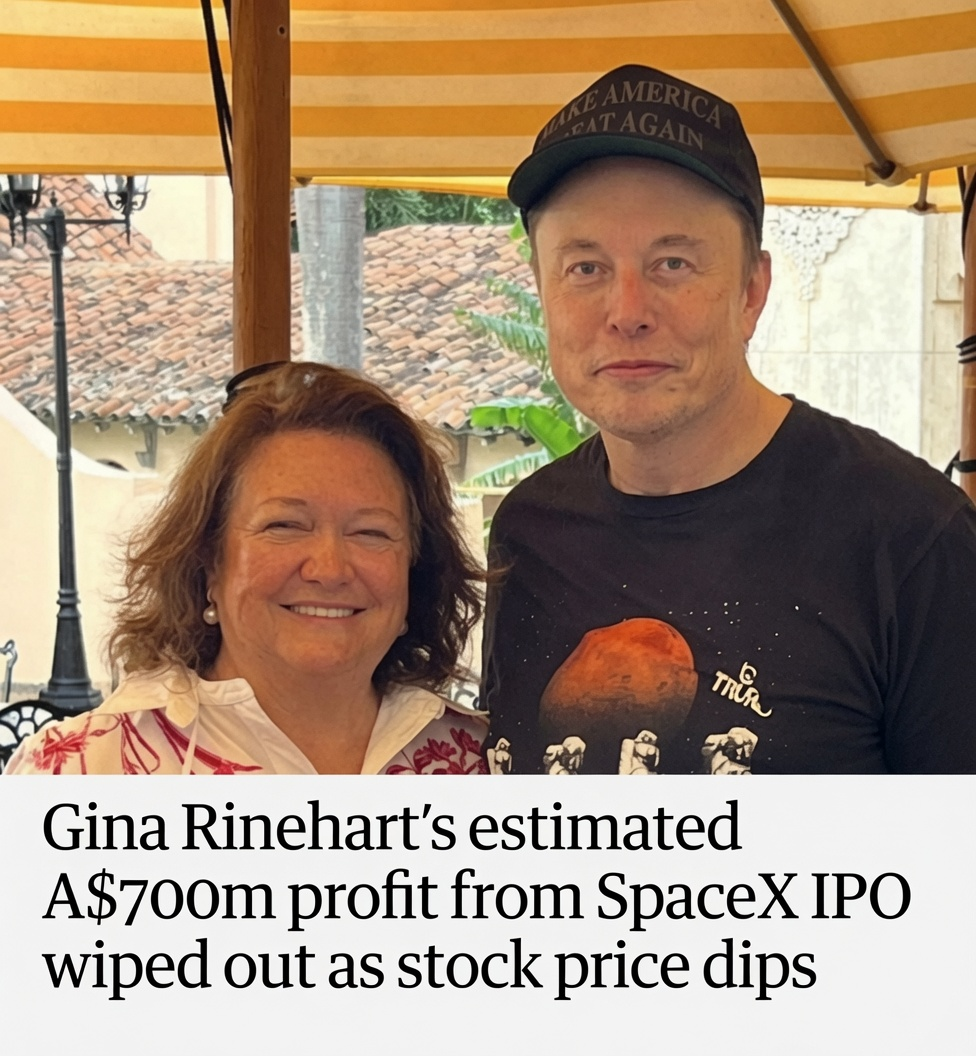
The decline has also affected thousands of Australian retail investors who bought into Elon Musk’s aerospace and technology company during its blockbuster public debut in June, although market analysts argue the recent weakness is unlikely to alter the long-term investment thesis that attracted many shareholders in the first place.
SpaceX shares finished Thursday’s trading session at US$131.11, slipping below their IPO price of US$135 per share for the first time since listing.
The milestone represented another setback for the company after an extraordinary debut that briefly propelled its market capitalisation beyond US$2.6 trillion and made founder Elon Musk the world’s first trillionaire on paper.
Since then, however, investor enthusiasm has cooled considerably.
SpaceX’s valuation has retreated to approximately US$1.72 trillion, erasing hundreds of billions of dollars in market value as traders reassessed the company’s lofty valuation following its explosive first weeks on the stock market.
Among the most prominent investors affected is Hancock Prospecting, the privately owned mining company controlled by Gina Rinehart.
Hancock Prospecting participated in the historic IPO by acquiring a substantial stake in SpaceX, reinforcing Rinehart’s growing interest in technology investments alongside her traditional resources empire.
Although the company has not publicly disclosed the precise size of its holding, Hancock Prospecting has previously republished media reports stating it invested more than US$1 billion during the IPO.
Based on those reports and subsequent movements in SpaceX’s share price, analysts estimate that Rinehart briefly accumulated an unrealised—or paper—gain of roughly US$500 million, equivalent to about A$700 million, during the stock’s early surge.
That gain has now effectively disappeared as the share price slipped below its original listing level.
Thursday’s close, approximately 3 per cent below the IPO price, also implies an additional unrealised decline of around US$30 million compared with the initial investment value.
Importantly, these figures represent paper gains and losses rather than realised profits.
Unless shares are actually sold, changes in market value remain unrealised and can reverse as prices fluctuate.
Neither Gina Rinehart nor Hancock Prospecting has indicated that any portion of the investment has been sold.
When approached for comment, Hancock Prospecting declined to disclose the current value of its SpaceX investment or whether it had increased or reduced its holding since the company listed.
That silence has fuelled speculation that Rinehart continues to view the investment as a long-term strategic position rather than a short-term trading opportunity.
According to Tony Sycamore, market analyst at IG Australia, the recent share-price weakness is unlikely to concern experienced investors such as Rinehart.
“You’re looking to invest in SpaceX for the long term, you’re backing the man,” Sycamore said.
“She knows Elon personally.”
The observation reflects Rinehart’s own comments when Hancock Prospecting announced the investment in June.
At the time, Australia’s richest woman praised Elon Musk’s leadership and entrepreneurial record, saying he “excels in every regard”.
She added that Hancock Prospecting prefers investing in businesses led by “sensible, hard-working, patriotic and exceptional people.”
The relationship between the two billionaires extends beyond financial investment.
Shortly after announcing Hancock’s investment, Rinehart publicly suggested that Australia should consider offering Musk access to islands off Queensland’s coast to support satellite launches and future aerospace projects.
The proposal illustrated her broader enthusiasm for expanding Australia’s participation in the global space industry and highlighted her confidence in Musk’s long-term ambitions.
SpaceX’s market debut attracted unprecedented interest among Australian investors.
CommSec, Australia’s largest retail share broker, reported that approximately 28,000 Australians submitted applications to participate in the IPO.
That figure represented the largest level of retail interest the broker had ever recorded for a public offering.
However, overwhelming global demand meant many applicants were unsuccessful.
According to CommSec, worldwide applications exceeded the number of shares available by roughly three to one, meaning only a portion of Australian applicants ultimately received allocations.
Some institutional investors reportedly took advantage of SpaceX’s initial rally by selling part or all of their holdings to lock in substantial profits.
Others, including Rinehart, have given no indication that they intend to exit.
Sycamore believes the differing approaches simply reflect different investment objectives.
“These types of investors, the mums and dads who supported it so willingly and so enthusiastically… obviously they would prefer to see it still trading at a profit,” he said.
“But it is the new frontier of tech stocks.”
“It is something that is not going to pay off in a month or a year. You’re looking to be involved in this stock for a decade.”
The recent decline has been driven by several factors.
Following an explosive opening, many investors naturally began taking profits after the initial surge. Momentum stocks frequently experience increased volatility after listing as early investors, institutions and hedge funds rebalance their positions.
SpaceX has now fallen in seven of its past eight trading sessions, reflecting a significant cooling of the enthusiasm that characterised its first days as a publicly listed company.
The company’s largest single-day decline occurred on 22 June after management announced plans to raise billions of dollars through a new bond issue.
While issuing debt is a common corporate financing strategy, the announcement prompted some investors to question whether the company was moving aggressively to fund expansion at a time when expectations were already exceptionally high.
At the same time, Bloomberg has reported that investors who bet against SpaceX through short-selling strategies have collectively generated profits approaching US$3.9 billion during the stock’s recent decline.
The episode demonstrates how quickly market sentiment can reverse following high-profile IPOs, particularly in the technology sector where valuations often depend heavily on expectations for future growth rather than current earnings.
Despite the recent weakness, analysts generally caution against drawing broad conclusions from only a few weeks of trading.
SpaceX remains one of the world’s most influential aerospace companies, operating the Falcon rocket family, the Starlink satellite internet constellation and an expanding portfolio of commercial, government and defence launch contracts.
The company also maintains close relationships with NASA, the US Department of Defense and international commercial customers, giving it multiple long-term revenue streams beyond its traditional launch business.
Investors also continue to monitor developments surrounding Starship, the company’s next-generation heavy-lift rocket designed for missions to the Moon and eventually Mars.
Successful commercial deployment of Starship could significantly expand SpaceX’s future revenue opportunities, although the program remains subject to ongoing testing and regulatory approvals.
For long-term shareholders such as Hancock Prospecting, those strategic opportunities are likely to remain more important than short-term movements in the share price.
Large institutional investors often expect technology investments to experience substantial volatility during their early years on public markets, particularly when valuations reflect ambitious expectations for innovation and future market dominance.
Whether SpaceX ultimately returns above its IPO price will depend on a combination of financial performance, execution of major aerospace projects, broader technology-sector sentiment and investor confidence in Elon Musk’s leadership.
For now, however, one of the biggest winners from the company’s spectacular market debut has seen an estimated paper windfall disappear almost as quickly as it appeared—a reminder that even the world’s most closely watched growth companies remain subject to the realities of public markets.






