Australia’s highest court is set to hear one of the country’s most significant constitutional cases in recent years after the Free Speech Union of Australia (FSU) sought permission to intervene in a legal challenge against the federal government’s controversial prohibited hate group laws.
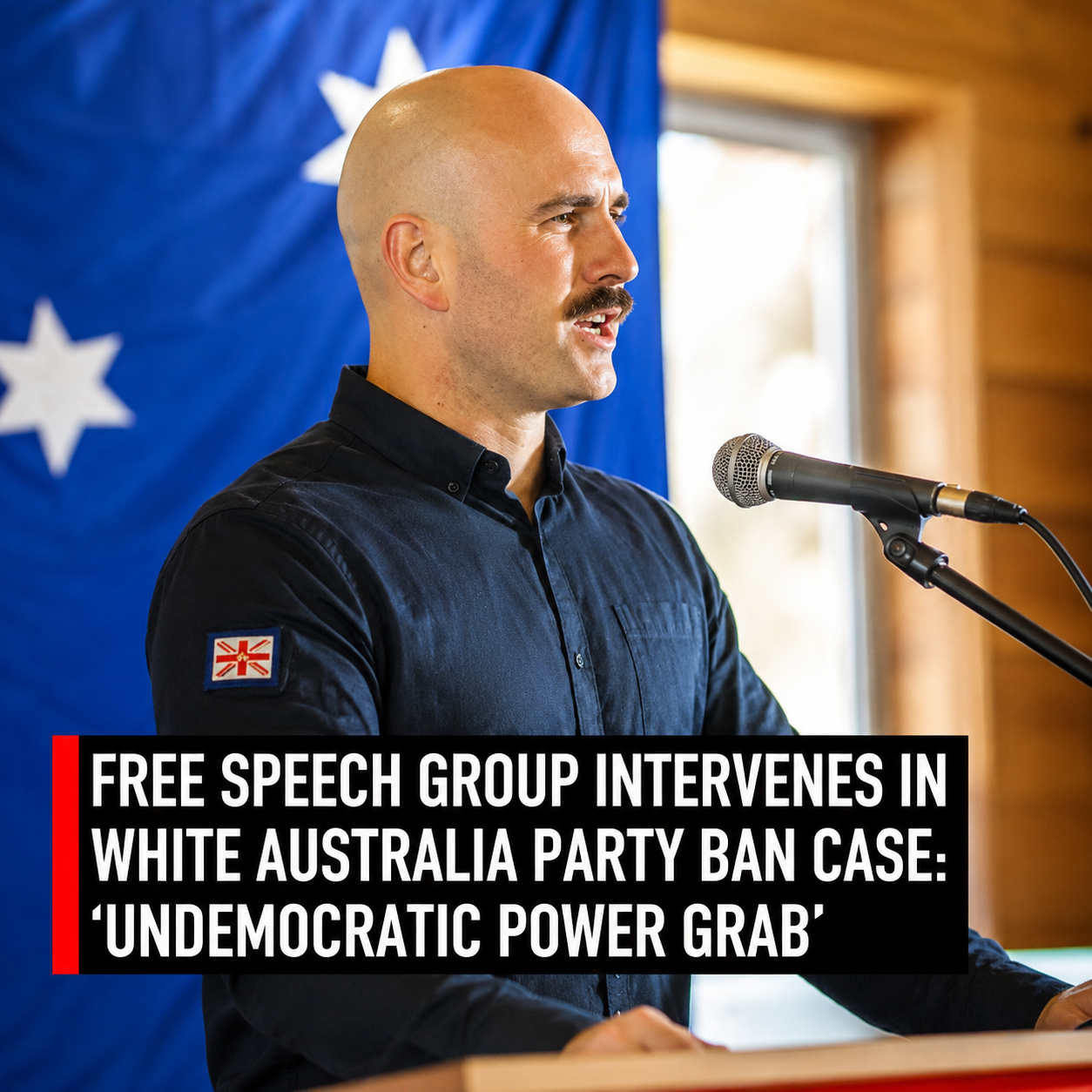
The case, scheduled to be heard by the High Court on September 8 and 9, will examine whether legislation introduced earlier this year gives the Commonwealth constitutional authority to prohibit political organisations by executive action.
Although the proceedings arise from the federal government’s decision to list the White Australia Party as a prohibited hate group, the Free Speech Union says its application is not about defending the organisation’s ideology. Instead, it argues the litigation raises broader constitutional questions about political freedom, executive power and democratic participation that could affect every Australian.
The FSU has applied to appear before the High Court as amicus curiae, commonly described as a “friend of the court”. In Australian courts, an amicus is not a party to the dispute but may be permitted to make submissions where broader legal or constitutional issues are involved.
FSU Director Dr Reuben Kirkham said the organisation was focused on protecting constitutional principles rather than supporting the views of any particular political movement.
“What concerns us is the constitutional principle. Governments change. Political fashions change. The constitutional powers we create today won’t always be exercised by governments we agree with,” Dr Kirkham said.
He argued that constitutional safeguards exist precisely because governments should not possess unchecked powers over political participation.
“If today’s government can prohibit one political organisation with relatively little constitutional scrutiny, what prevents tomorrow’s government banning One Nation? Or an environmental activist group? Or a militant union? Or another organisation whose views have fallen out of favour?” he said.
The organisation maintains that constitutional protections should apply equally regardless of whether the political views involved are popular or widely condemned.
The High Court challenge centres on legislation introduced following the Bondi terrorist attack earlier this year. Parliament passed a package of reforms establishing a new prohibited hate group framework under the Criminal Code, allowing organisations to be formally listed where statutory requirements are satisfied.
On 15 May 2026, the Australian Government formally listed White Australia, formerly known as the National Socialist Network and the European Australia Movement, as a prohibited hate group. The listing took effect the following day after the government said it was supported by classified and unclassified intelligence assessments.
Under the legislation, offences now exist for directing, joining, recruiting for, training with, funding or providing support to a listed prohibited hate group. Maximum penalties for some offences reach 15 years’ imprisonment.
White Australia Party and its national president Thomas Sewell subsequently launched constitutional proceedings against the Commonwealth, arguing that the legislation unlawfully burdens Australia’s implied freedom of political communication and improperly allows the executive government to effectively outlaw a political organisation.
Court documents filed in the High Court indicate the plaintiffs also contend that the legislation conflicts with constitutional principles established in the historic 1951 Communist Party Case, in which the High Court invalidated legislation seeking to dissolve the Australian Communist Party.
The High Court has already declined requests to temporarily suspend the listing while the constitutional challenge proceeds, but allowed the substantive constitutional case to continue. The full hearing is now listed for September.
The Free Speech Union argues that the significance of the case extends well beyond the White Australia Party itself.
According to Dr Kirkham, the constitutional rules ultimately developed by the High Court could determine how much protection political communication receives in future disputes involving entirely different organisations.
“Whatever the outcome of these proceedings, the legal rules developed by the High Court will apply equally to every future government and every future political movement,” he said.
The organisation also intends to argue that where legislation imposes substantial restrictions on political communication, governments should be required to demonstrate correspondingly stronger constitutional justification.
Dr Kirkham warned that constitutional rights are designed to protect unpopular speech as well as popular speech.
“This case is about ensuring that constitutional protections remain strong enough to safeguard democratic participation for all Australians – not just those whose views happen to be popular.”
He added that while many Australians strongly oppose neo-Nazi ideology, expanding executive powers may create precedents that later governments could apply more broadly.
“At the minute they are doing it to Nazis, but the next censored views might be yours instead.”
The FSU has also launched a public campaign opposing the legislation, describing the prohibited hate group framework as an “undemocratic power grab” and encouraging supporters to contribute to its legal efforts.
The constitutional challenge has generated wider discussion among lawyers, constitutional scholars and civil liberties advocates regarding the balance between protecting public safety and preserving Australia’s implied constitutional freedom of political communication.
Unlike some democracies, Australia does not have a comprehensive constitutional bill of rights. Instead, the implied freedom of political communication has been recognised by the High Court through interpretation of Australia’s system of representative and responsible government established under the Constitution.
That implied freedom does not create an individual right to unrestricted speech. Rather, it limits legislative and executive action that places an unjustified burden on political communication necessary for Australia’s democratic system.
The upcoming proceedings are therefore expected to examine whether Parliament’s objective of preventing hate-based extremism is constitutionally compatible with restrictions placed on political organisations through the prohibited hate group regime.
The Commonwealth has consistently argued that the legislation is designed to protect Australians from organisations involved in hate crimes, violent extremism and activities capable of causing social, psychological and physical harm. Government material states that the listing framework is intended to prevent prohibited groups from recruiting members, raising funds and continuing organised activities.
The White Australia Party rejects the government’s position and argues the legislation effectively criminalises political association before judicial findings about the organisation itself have been made.
The constitutional dispute is likely to become an important test of the limits of executive authority in Australia and may clarify how future governments can regulate extremist organisations while remaining within constitutional boundaries.
The High Court’s eventual judgment is expected to provide guidance not only on the prohibited hate group framework introduced in 2026 but also on the scope of Australia’s implied constitutional freedom of political communication for years to come.






