A Melbourne-based National Disability Insurance Scheme (NDIS) consultant has admitted defrauding Australia’s disability support program of almost $230,000, with a court hearing that much of the offending occurred while he was living in the Philippines.
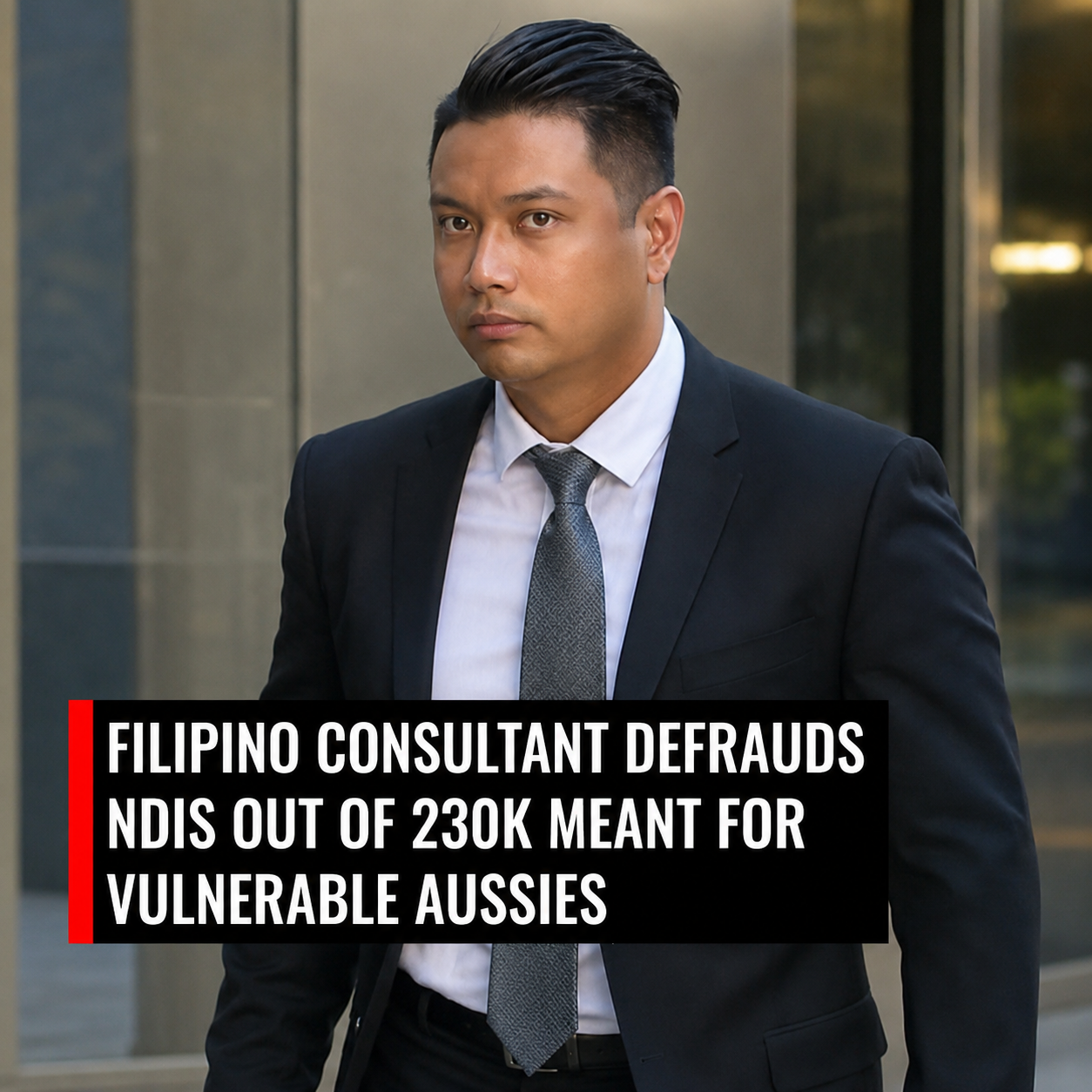
Ryogie Tumandao, 30, from Weir Views in Melbourne’s west, pleaded guilty in the County Court of Victoria to multiple offences arising from a scheme that diverted taxpayer-funded disability payments intended for vulnerable Australians into his own bank accounts.
He admitted three counts of dishonestly obtaining a financial advantage by deception, one count of causing a loss to a Commonwealth entity and one count of dealing with proceeds of crime.
Although Judge Michael Cahill indicated a custodial sentence was the likely outcome, Tumandao was granted continued bail before sentencing. The judge accepted requests allowing him to accompany his wife to a medical appointment and to undergo a psychiatric assessment before he returns to court later this year.
The offending occurred between 2019 and 2020 while Tumandao worked for two private businesses registered to provide services under the National Disability Insurance Scheme.
According to the prosecution, Tumandao exploited his authorised access to the NDIS online payment portal by altering banking details linked to the service providers. Once the account information had been changed, government payments intended to reimburse legitimate disability support services were instead transferred into accounts under his control.
The fraudulent claims related to services that were never delivered to NDIS participants.
Prosecutors told the court Tumandao dishonestly obtained $228,931 through the scheme. Investigators also identified a further $9,708 deposited into his accounts, although authorities were unable to conclusively establish who had submitted those additional claims.
The court heard that the majority of the fraudulent activity occurred while Tumandao was residing in the Philippines rather than Australia, highlighting the challenges investigators can face when financial crime crosses international borders.
While the offending involved sophisticated manipulation of payment systems rather than direct contact with participants, prosecutors argued the consequences extended well beyond the financial losses.
One NDIS participant whose identity was used during the fraud provided a victim impact statement describing the personal distress caused by discovering services had been claimed in his name.
The participant, who has lived with the effects of polio for many years, told the court that the claimed support had never been provided.
“I’ve been affected with polio disability which I’ve been suffering with for many years. That person never provided service to me,” the victim said.
The statement illustrated one of the most damaging aspects of NDIS fraud: beyond the direct financial loss, fraudulent claims can create uncertainty for genuine participants who depend on the scheme for essential daily support.
During the hearing, the court was told the offending also disrupted legitimate disability service providers whose identities and payment arrangements had been manipulated during the fraud.
Businesses operating within the NDIS rely on the integrity of the payment system to fund the support they deliver. Fraudulent redirection of payments not only deprives providers of legitimate revenue but can also interfere with participant care and administrative operations.
The National Disability Insurance Agency (NDIA), which administers the scheme, responded by reiterating its uncompromising stance on fraud.
In a statement presented to the court, an agency spokesperson said the NDIA maintained a “zero tolerance” approach toward anyone attempting to exploit funding intended for Australians living with disability.
“We’re making the NDIS stronger every day, to stop exploitation of individuals and to make sure every NDIS dollar goes to help participants,” the spokesperson said.
The case comes as governments and regulators continue efforts to restore confidence in the multi-billion-dollar disability support program following years of increasing concern about organised fraud, false billing and misuse of participant funding.
The NDIS was introduced in 2013 to provide lifetime funding for Australians with permanent and significant disabilities, allowing eligible participants greater choice and control over the services they receive.
As the scheme expanded rapidly, annual expenditure grew into one of the Commonwealth’s largest social spending programs, supporting hundreds of thousands of Australians through funding for personal care, therapy, equipment, transport and community participation.
That rapid growth has also increased opportunities for criminal exploitation.
Authorities have identified numerous forms of NDIS fraud in recent years, including false invoicing, identity misuse, phantom service claims, forged documentation and the diversion of participant funds by dishonest providers or consultants.
In response, the Commonwealth has strengthened compliance measures through enhanced auditing, improved data analytics, expanded investigative powers and closer cooperation between the NDIA, law enforcement agencies and financial crime investigators.
Officials say detecting suspicious claiming patterns early has become a major priority as governments seek to preserve public confidence in one of Australia’s most significant social welfare programs.
Cases involving insider access are regarded as particularly serious because they often involve trusted individuals using legitimate system permissions to bypass safeguards.
Rather than exploiting technical vulnerabilities, these offences frequently rely on authorised access combined with deliberate manipulation of payment records, making them difficult to detect until significant losses have already occurred.
Legal experts have previously noted that courts generally regard offences involving public funds and breaches of trust as requiring strong deterrent sentences, particularly where vulnerable members of the community are indirectly affected.
Judge Cahill did not impose sentence on Friday, instead ordering Tumandao to return after completing a psychiatric assessment.
The assessment is expected to assist the court in considering any personal circumstances that may be relevant before determining an appropriate penalty.
Despite allowing bail to continue, the judge indicated imprisonment remained the likely outcome given the seriousness of the offending, the amount of money involved and the deliberate nature of the fraud.
Tumandao is scheduled to return to the County Court in October for further proceedings, when the court is expected to determine his final sentence.
The outcome will be closely watched as governments continue efforts to demonstrate that fraud against Australia’s disability support system will attract significant legal consequences.






