The state funeral of veteran broadcaster, journalist and former senator Derryn Hinch has become the centre of a fresh cultural debate after a Welcome to Country ceremony was included in the service despite Hinch having publicly criticised the practice during his lifetime.
More than 350 mourners gathered at The Timber Yard in Port Melbourne on Monday to farewell one of Australia’s most recognisable media personalities. Family members, close friends, former colleagues, politicians and leading figures from Australia’s media industry attended the Victorian Government-organised state funeral to celebrate Hinch’s life and career.
While much of the service focused on Hinch’s decades-long contribution to journalism, broadcasting and public life, the opening Welcome to Country ceremony quickly became a talking point both inside the venue and across social media.
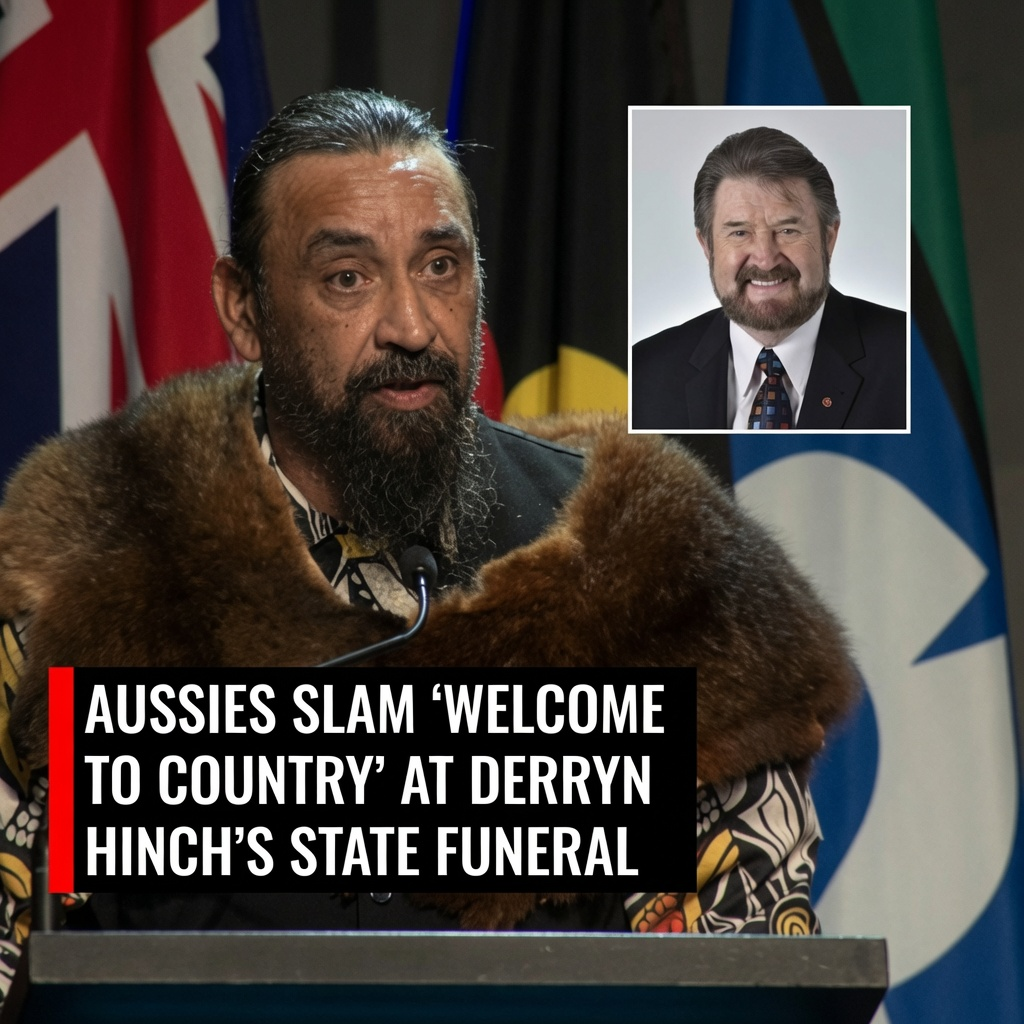
The ceremony was delivered by Aboriginal elder and activist Mark Brown, who welcomed attendees before acknowledging that such ceremonies are not commonly performed as part of funeral services.
“A Welcome to Country is usually offered at the beginning of something, but today we offer it as part of a farewell,” Brown told mourners.
He continued by welcoming those gathered while saying that ancestors would receive the spirit of the late broadcaster.
The inclusion of the ceremony immediately attracted attention because Hinch himself had repeatedly expressed opposition to the growing use of Welcome to Country ceremonies at public events.
Following controversy surrounding Anzac Day commemorations earlier this year, Hinch wrote on social media that while booing was disrespectful, he also believed a Welcome to Country should not have formed part of those services.
“Booing was disrespectful on Anzac Day but Welcome should not have been there, Diggers fought and died for all Australians,” he wrote.
Hinch had also opposed the Albanese Government’s proposed Indigenous Voice to Parliament during the 2023 referendum campaign, placing him among prominent public figures who argued against the constitutional change.
That background led many observers to question whether including the ceremony reflected Hinch’s own wishes.
Veteran broadcaster Ray Martin appeared to acknowledge that point during his eulogy.
Speaking warmly about his long-time colleague and friend, Martin remarked that Hinch “wouldn’t have much cared for the Welcome to Country,” drawing attention to the broadcaster’s well-known views before moving on to celebrate his remarkable career.
Reaction online was swift and sharply divided.
Some commentators argued that a state funeral organised by the Victorian Government would ordinarily include a Welcome to Country, regardless of the personal views of the deceased.
Others contended that ceremonies intended to honour an individual’s life should reflect that person’s publicly expressed beliefs wherever practical.
The debate spread rapidly across social media, where supporters and critics of the ceremony offered contrasting interpretations.
Some users described the inclusion as inconsistent with Hinch’s own positions, while others argued that Welcome to Country has become standard protocol at many government events in Victoria and should not overshadow the purpose of the funeral.
The differing reactions mirrored the broader national discussion that has surrounded Welcome to Country ceremonies in recent years.
Originally performed by Traditional Owners to formally welcome visitors onto Country, the practice has become increasingly common at government functions, sporting events, major conferences, citizenship ceremonies and state occasions across Australia.
Supporters argue the ceremonies recognise Aboriginal and Torres Strait Islander peoples as the Traditional Custodians of the land and acknowledge thousands of years of continuous cultural history.
Critics, however, have questioned both the frequency of the ceremonies and whether they remain appropriate at every public event, particularly when attendees or those being honoured held different personal views.
The issue has become one of Australia’s most visible culture-war debates, intensifying after the unsuccessful 2023 Voice referendum and recurring during several major national commemorations.
Despite the discussion surrounding the ceremony, the funeral itself largely focused on celebrating Hinch’s extraordinary and often controversial career.
Friends and colleagues remembered him as fearless, relentless and impossible to ignore.
Ray Martin described Hinch as one of the finest tabloid journalists he had ever known, recalling both his booming personality and unwavering commitment to pursuing stories others would avoid.
Tributes also reflected on Hinch’s career spanning newspapers, radio, television and federal politics.
Nicknamed the “Human Headline”, he became one of Australia’s most recognisable media figures through his direct interviewing style, outspoken opinions and willingness to challenge authority.
His journalism took him around the world, covering major international events including the funeral of Martin Luther King Jr., the assassination of Robert F. Kennedy and numerous historic political developments.
Later in life he entered politics by founding Derryn Hinch’s Justice Party before winning election to the Senate in 2016.
Throughout his political career he remained best known for campaigning on victims’ rights, criminal justice reform and stronger protections against serious sexual offenders.
His determination to publicly identify convicted offenders led to multiple convictions for breaching suppression orders, including a 50-day prison sentence that he often described as a consequence of standing by his principles.
Friends speaking at the funeral remembered not only his public persona but also the man behind the headlines.
Former wife Jacki Weaver delivered a recorded tribute describing their enduring friendship long after their marriage ended, while family members recalled his lifelong passion for radio, storytelling and words.
The service also featured musical performances and concluded with mourners giving Hinch a standing ovation after Ray Martin invited those present to honour a man who had spent decades fighting for causes he believed in.
Hinch died peacefully in his sleep on July 10 at the age of 82 following years of declining health, having previously battled liver cancer and undergone a liver transplant.
The Victorian Government granted him a state funeral in recognition of his long contribution to Australian journalism, broadcasting and public life. The ceremony was streamed nationally, allowing Australians around the country to pay their respects.
Although debate over the Welcome to Country ceremony dominated much of the public conversation following the service, the funeral ultimately served as a reminder of Hinch’s enduring influence on Australian public life.
Admired by supporters for his willingness to confront difficult issues and criticised by others for his uncompromising style, Hinch built a career that rarely avoided controversy.
In that respect, the discussion that followed his farewell reflected a pattern that defined much of his life: even in death, Derryn Hinch remained at the centre of Australia’s national conversation.






