Olympic swimming legend Dawn Fraser has launched a blistering attack on Prime Minister Anthony Albanese, accusing him of remaining silent while the ABC faces mounting backlash and legal action over a controversial television segment depicting graphic violence against mining executive Gina Rinehart.
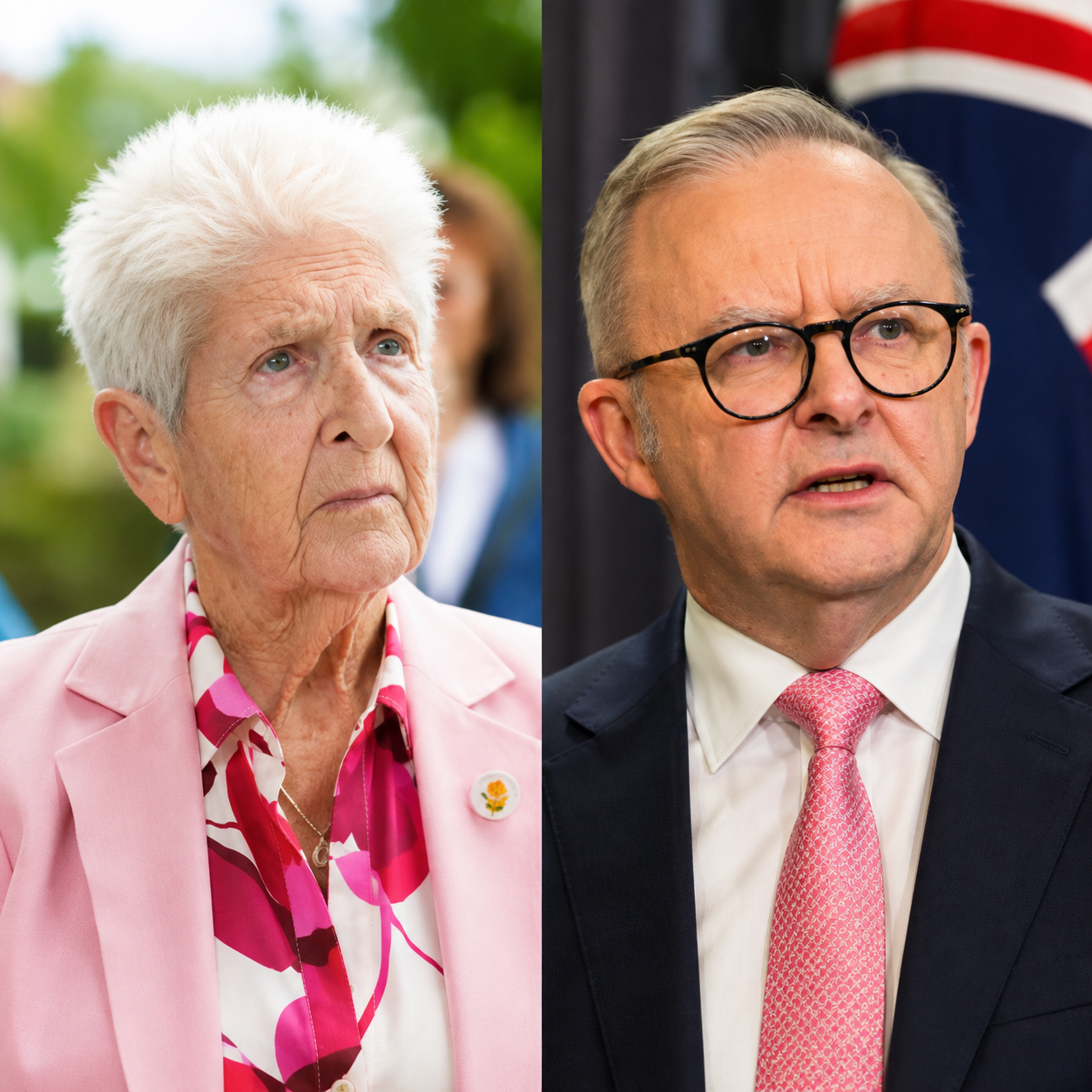
The four-time Olympic gold medallist said she was “sick to my stomach” that Australia’s national broadcaster aired the segment and criticised the Prime Minister for failing to publicly condemn it.
The comments have added another high-profile voice to an increasingly heated national debate over editorial standards, political accountability and freedom of expression following the ABC’s decision to leave the controversial material online despite widespread complaints.
In a Facebook post that has attracted more than 10,000 reactions, Fraser accused Mr Albanese of failing to stand up against content she believes crossed an unacceptable line.
“I am sick to my stomach to think we have a government funded network ABC showing vile pieces to air about one of Australia’s greatest supporters Gina Rinehart and our vile Prime Minister has not come out and condemned the content,” Fraser wrote.
She went on to describe the Prime Minister as a “spineless imbecile” and accused him of allowing the material to go unchallenged despite the broadcaster being publicly funded.
The controversy centres on a segment broadcast during the ABC program Race Around the World on 12 July. The satirical film, created by filmmaker Kate McGuinness, concluded with an extended graphic monologue describing violent acts against Ms Rinehart while encouraging viewers to imagine “when the revolution comes”. The remarks quickly triggered public outrage, complaints to the broadcaster and criticism from politicians, industry groups and prominent Australians.
Hancock Prospecting, chaired by Ms Rinehart, initially wrote to the ABC Board demanding the segment be removed immediately, a public apology be issued and an investigation launched into how the material had been commissioned and approved.
After receiving no substantive response, the company escalated the matter by sending detailed legal correspondence to ABC Chair Kim Williams, Deputy Chair Lisa Caffery and Managing Director Hugh Marks, alleging serious breaches of Australian criminal and civil laws arising from both the publication and continued availability of the segment.
The ABC has confirmed it received correspondence from lawyers acting for Ms Rinehart and says it will respond in due course. It has also referred audience complaints to the ABC Ombudsman, an independent internal office that reports directly to the ABC Board.
While the broadcaster has defended the segment as editorially justifiable satire, it acknowledged that the Ombudsman would independently assess complaints about the episode. The controversial video has remained available on ABC platforms while that process continues.
Kate McGuinness later apologised to “anyone I’ve offended”, saying the work was intended as farcical political satire rather than a literal encouragement of violence. Nevertheless, the apology has done little to ease criticism from those arguing the segment normalised violent rhetoric directed at a prominent Australian woman.
Fraser’s intervention is particularly significant because of her longstanding support for Australian swimming and her public admiration for Ms Rinehart’s financial backing of elite athletes.
The Olympic legend said she was “disgusted and embarrassed” that someone who had donated extensively to Australian sport had become the subject of such treatment.
“I’m disgusted and embarrassed to think that anyone that chooses to support our athletes can be ridiculed, denigrated and shown no respect to a person that has nothing and asked for nothing while all she does is help our sporting teams,” Fraser wrote.
She also praised Ms Rinehart’s longstanding contribution to Australian athletes, saying swimmers, rowers, synchronised swimmers and volleyball players had all benefited from her generosity.
Fraser added that had Ms Rinehart been supporting Australian swimming during her own competitive career, she would have been “absolutely unbelievably grateful”.
Her comments came only days after Hancock Prospecting distributed more than $1.2 million in performance bonuses to Australian swimmers and para-swimmers following the Commonwealth Games, continuing the company’s longstanding investment in high-performance sport.
Despite the growing controversy, Prime Minister Albanese has not publicly commented on the segment itself.
Senior members of the government have instead emphasised the ABC’s editorial independence while acknowledging that the content described publicly was unacceptable.
Communications Minister Anika Wells said the material was “unacceptable” but stressed that editorial decisions ultimately belonged to the independent national broadcaster.
Acting Prime Minister Richard Marles adopted a similar position, saying that although he had not personally viewed the footage, the descriptions he had heard suggested it sounded “completely unacceptable”.
However, neither minister publicly called for the ABC to apologise to Ms Rinehart or remove the material from its platforms.
Mr Marles instead described the ABC’s decision to refer complaints to its Ombudsman as an appropriate next step, again pointing to the broadcaster’s editorial independence.
The distinction has become central to the political debate.
Critics argue that publicly funded institutions should be held to higher editorial standards when broadcasting material that depicts graphic violence against identifiable individuals.
Supporters of the ABC’s approach contend that editorial independence exists specifically to protect broadcasters from political interference, even when controversial content generates significant public backlash.
The dispute has also drawn attention to Australia’s complaints framework for the national broadcaster.
Unlike commercial television networks, complaints regarding ABC editorial content are first reviewed internally through the ABC Ombudsman before any potential involvement by the Australian Communications and Media Authority. ACMA has indicated it will await the outcome of the ABC’s internal complaints process before considering whether any further regulatory action is warranted.
For Hancock Prospecting, however, the issue has moved well beyond editorial complaints.
The company’s legal correspondence argues that the broadcaster’s continued publication of the segment exposes both the ABC and senior executives to potential legal consequences.
In a public statement, Hancock said one week had passed after its initial request without any substantive response or removal of the material, despite what it described as widespread public condemnation.
Those legal proceedings now place additional pressure on the broadcaster while the Ombudsman’s review continues.
The controversy has become one of the most politically charged disputes involving the ABC in recent years because it sits at the intersection of satire, freedom of expression, editorial responsibility and public funding.
It has also generated broader discussion about where the line should be drawn between political satire and language that critics believe risks encouraging or normalising violence.
For Fraser, the issue extends beyond broadcasting standards.
Her criticism reflects what she sees as a failure by Australia’s political leadership to defend someone she regards as one of the country’s most significant supporters of elite sport.
Whether the legal action ultimately succeeds remains to be determined, but the dispute has already intensified scrutiny of the ABC’s editorial decision-making, the government’s response and the limits of acceptable political satire in publicly funded broadcasting.






