Australia’s Climate Change and Energy Minister Chris Bowen is facing renewed political scrutiny after official expense records revealed more than $345,000 in taxpayer-funded international travel over the past financial year, prompting questions about the value of the trips and the government’s evolving public messaging around its flagship climate agenda.
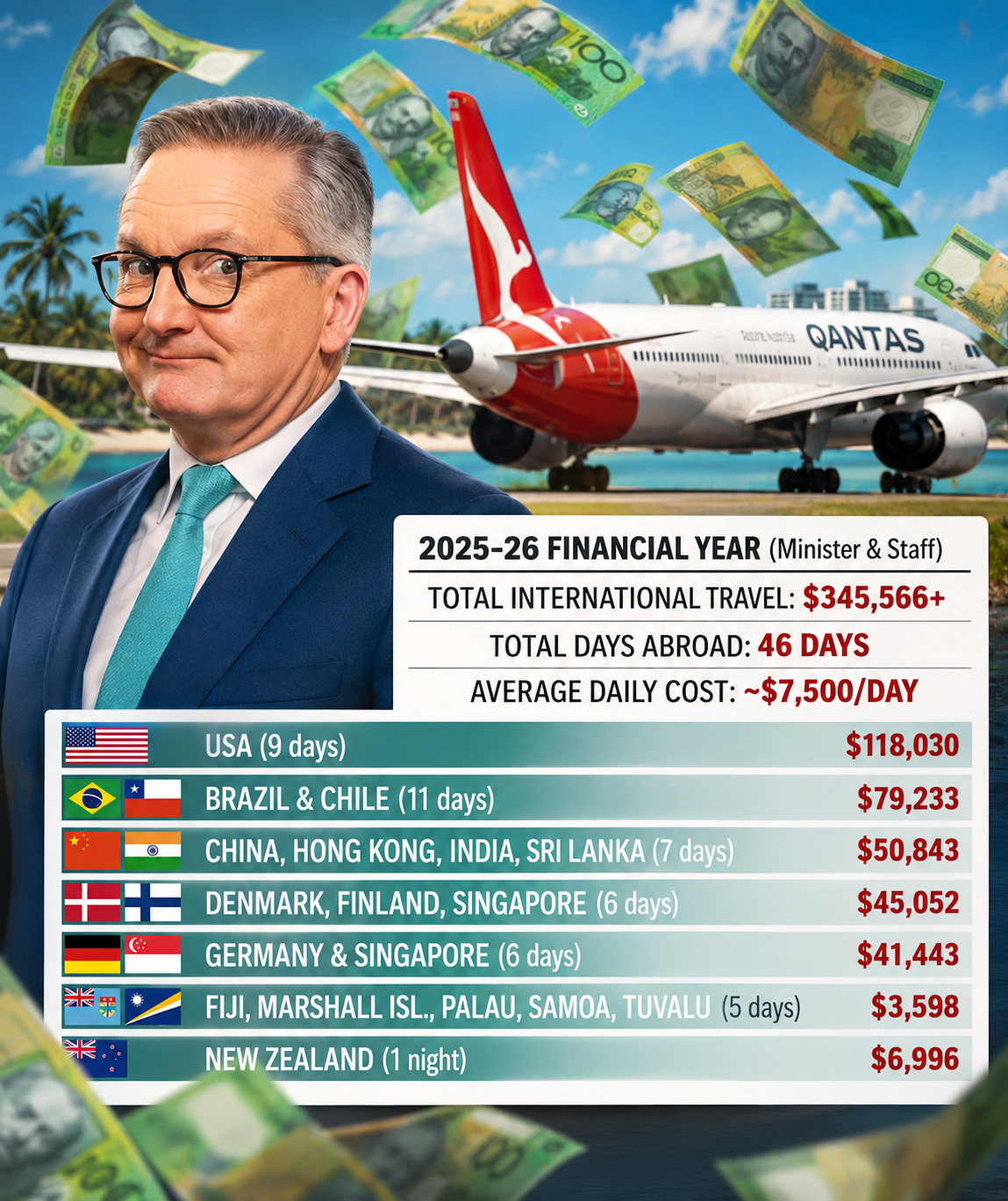
The expenditure, disclosed through reports released by the Independent Parliamentary Expenses Authority (IPEA), shows Bowen and accompanying staff undertook an extensive schedule of overseas travel across multiple continents while representing Australia at climate negotiations, diplomatic meetings and international clean-energy forums.
According to the published records, the minister spent a total of 46 days overseas during the 2025–26 financial year, travelling an estimated 167,800 kilometres—equivalent to more than four trips around the Earth.
The itinerary included visits to Germany, Singapore, Denmark, Finland, New Zealand, Brazil, Chile, the United States, China, Hong Kong, India, Sri Lanka, Fiji, the Marshall Islands, Palau, Samoa and Tuvalu. Individual trips ranged from just over $3,500 to more than $118,000 for a single nine-day visit to the United States.
The travel has attracted attention not simply because of its overall cost, but because critics argue it sits awkwardly alongside the government’s emphasis on reducing emissions while encouraging Australians to lower their own carbon footprint.
Adding to the political debate was Bowen’s recent address to the National Press Club, where observers noted he did not explicitly use the phrase net zero, despite the policy remaining central to Australia’s legislated climate strategy.
Instead, the minister focused his remarks on reducing household power bills, strengthening energy security, increasing renewable generation and expanding rooftop solar across commercial and industrial buildings.
Bowen argued Australia’s transition towards cleaner energy represented an economic opportunity rather than simply an environmental obligation, highlighting billions of dollars in potential investment and future employment linked to renewable industries.
The omission of the words “net zero” quickly became a political talking point.
Institute of Public Affairs research fellow Saxon Davidson claimed the government appeared increasingly reluctant to publicly emphasise terminology that had become politically contentious following years of debate over energy prices, reliability and the pace of Australia’s decarbonisation policies.
Davidson argued the absence of the phrase reflected growing political sensitivity surrounding Labor’s climate messaging rather than any change in official policy.
Government ministers, however, have not indicated any retreat from Australia’s legislated emissions reduction targets or its commitment to achieving net zero emissions by 2050.
Australia’s climate framework continues to include the legally binding target of reducing greenhouse gas emissions by 43 per cent below 2005 levels by 2030 while pursuing economy-wide net zero emissions by mid-century. Those commitments remain embedded in the Climate Change Act passed during the Albanese Government’s first term.
Bowen has consistently argued that international engagement forms a necessary part of achieving those objectives.
As Australia’s Minister for Climate Change and Energy, and previously serving as President of Negotiations for Australia’s proposed COP31 climate summit bid, Bowen has represented Australia in multilateral negotiations involving governments, investors, technology companies and international organisations.
His office maintains that many of these meetings cannot be effectively conducted through videoconferencing because they involve complex diplomatic negotiations, investor engagement and ministerial-level discussions requiring face-to-face participation.
A spokesperson for the minister said international engagement is intended to position Australia as a future renewable energy superpower capable of attracting a greater share of the trillions of dollars expected to flow into global clean-energy investment over coming decades.
Opposition figures remain unconvinced.
Shadow Energy Minister Dan Tehan questioned whether taxpayers had received value for money from the extensive overseas travel program, arguing Bowen should demonstrate how the expenditure has translated into lower electricity prices or measurable benefits for Australian households.
Tehan also suggested some international meetings could potentially have been conducted through secure videoconferencing technology, reducing both taxpayer costs and emissions associated with long-haul international flights.
Those criticisms have become part of a broader political argument over Australia’s energy transition, with the Coalition continuing to attack Labor’s renewable energy strategy while advocating greater reliance on alternative approaches, including nuclear power proposals.
The debate intensified further after details emerged surrounding Bowen’s September 2025 visit to New York during Australia’s ultimately unsuccessful campaign to secure hosting rights for the COP31 United Nations climate conference.
Expense records show that trip alone cost taxpayers approximately $118,000. Although Bowen met numerous international leaders, investors and foreign representatives while lobbying support for Australia’s bid, Turkey ultimately secured the hosting rights following a compromise reached during COP30 negotiations in Brazil.
Bowen’s office rejects suggestions that the international travel was excessive or unnecessary, arguing the minister’s overseas engagements form part of Australia’s broader diplomatic and economic strategy as global investment in renewable energy accelerates.
A spokesperson for the minister said international engagement is critical to attracting investment into Australian clean energy projects, strengthening relationships with Pacific neighbours and positioning Australia to benefit from the worldwide transition toward lower-emissions technologies.
“Australia is strengthening our multilateral relationships through international engagement that positions Australia as a renewable energy superpower that will deliver economic opportunities,” the spokesperson said, noting that global investment in clean energy projects is forecast to exceed US$2 trillion annually in coming years.
The minister’s office also rejected criticism that meetings could simply have been conducted online, saying Bowen already uses videoconferencing regularly and international travel is approved only when officials determine face-to-face engagement is necessary to advance Australia’s diplomatic and economic interests.
The political controversy comes at a time when Australia’s energy transition remains one of the most fiercely contested issues in federal politics.
The Albanese Government continues to argue that expanding renewable generation, battery storage, transmission infrastructure and electrification will ultimately reduce wholesale electricity costs while helping Australia meet its legislated emissions targets.
The Coalition, however, has maintained that Labor’s renewable energy strategy is contributing to higher household power bills and greater uncertainty across the electricity market. Opposition figures have increasingly promoted nuclear energy as part of Australia’s future generation mix while criticising what they describe as excessive spending on overseas climate diplomacy.
Against that backdrop, Bowen’s overseas travel has become a symbolic issue extending well beyond the dollar value of individual flights and accommodation.
Critics argue taxpayers expect ministers to demonstrate clear, measurable outcomes when significant public funds are spent on international representation. Supporters counter that Australia cannot expect to attract global investment, influence international climate negotiations or strengthen strategic partnerships without ministers participating directly in major international forums.
The debate also coincides with heightened public concern over government expenditure more broadly. Recent expense disclosures have prompted scrutiny of travel claims across both major political parties, including family travel during parliamentary sitting weeks and ministerial overseas delegations. While all such expenses are subject to rules administered by the Independent Parliamentary Expenses Authority, political opponents frequently question whether individual trips represent value for taxpayers.
One of the most expensive journeys undertaken by Bowen during the reporting period was his September 2025 visit to New York, where Australia was seeking international backing for its bid to jointly host the COP31 United Nations Climate Change Conference with Pacific nations. Expense records show the nine-day visit cost taxpayers more than $118,000.
During the trip, Bowen met with government representatives, investors and technology leaders, while also participating in New York Climate Week and holding discussions with officials from countries including Indonesia, the United Kingdom, Turkey, the United Arab Emirates and members of the European Union. He also signed an energy transition agreement with Palau and attended investor events hosted alongside Prime Minister Anthony Albanese.
Despite those efforts, Australia’s campaign to host COP31 ultimately ended unsuccessfully after Turkey secured the conference through a compromise reached during COP30 negotiations in Brazil. Opposition Energy spokesman Dan Tehan described the outcome as evidence that taxpayers had funded an expensive overseas campaign without achieving its primary objective.
Beyond the travel expenses themselves, the renewed focus on Bowen’s National Press Club address has generated debate about Labor’s political messaging on climate policy.
While the minister spoke extensively about reducing emissions, improving energy security, lowering electricity bills and expanding rooftop solar installations for commercial and industrial buildings, commentators noted the phrase net zero was absent from the speech. That omission prompted critics to argue the government may be attempting to soften language around a policy that continues to divide voters as cost-of-living pressures remain elevated.
However, there has been no indication that the government has altered its official policy. Australia’s commitment to achieving net zero emissions by 2050 remains legislated under the Climate Change Act, alongside the target of reducing national greenhouse gas emissions by 43 per cent below 2005 levels by 2030. The Department of Climate Change, Energy, the Environment and Water continues to publish policy documents outlining the government’s pathway towards those objectives.
Whether the political focus remains on Bowen’s travel costs or shifts back towards Australia’s long-term energy strategy is likely to depend on broader economic conditions, including electricity prices, investment outcomes and public confidence in the pace of the clean-energy transition.
For now, the expense disclosures have provided fresh ammunition in an already heated political contest over climate policy. Supporters view the overseas engagements as part of Australia’s responsibility to participate in international climate diplomacy and compete for investment. Critics see an expensive travel schedule that has yet to demonstrate tangible benefits for households facing persistent cost-of-living pressures.
As Parliament prepares for further debate over energy policy and government spending, Bowen’s travel bill is likely to remain part of the broader argument over how Australia balances international climate leadership with domestic economic priorities. While the figures themselves are not disputed, their significance—and whether taxpayers ultimately received value for money—remains firmly at the centre of Australia’s ongoing political debate.