OPINION: If Canberra wanted to design a program that perfectly captured why so many Australians believe the political class now inhabits a different universe, it would be difficult to improve on Chris Bowen’s COP31 travel grants.
At a time when households are still staring at power bills, businesses are counting every increase in operating costs and regional Australians continue to navigate roads and telecommunications that would embarrass a wealthier developing nation, the federal government is offering grants of up to $20,000 to help selected Australians travel to a United Nations climate conference in Antalya, Türkiye.
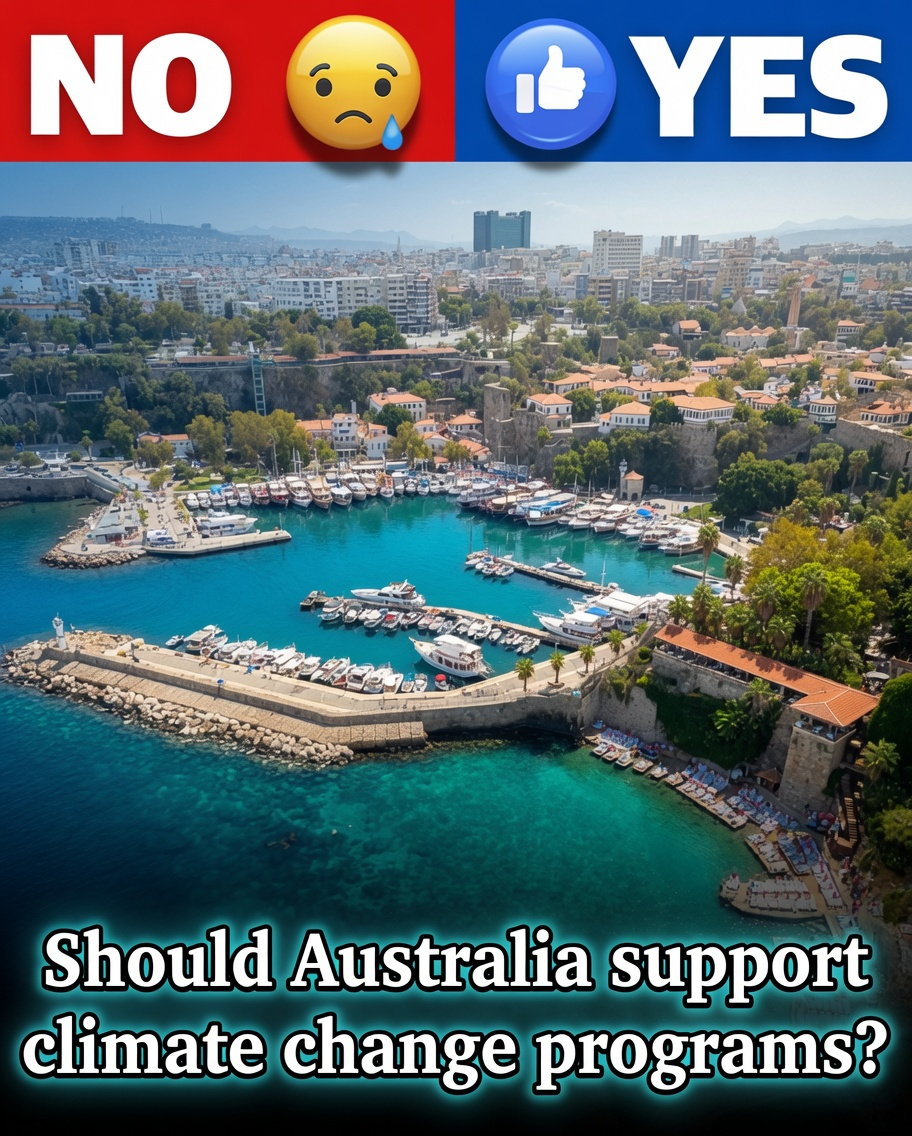
The COP31 Climate Conference Travel Support Program is real.
It is open now. Applications close on July 27.
According to the Australian government’s own grant material, the program covers eligible travel, accommodation and participation costs for people attending COP31 from November 9 to 20.
The grants are worth up to $20,000 each.
And the stated objective is to support individuals from “diverse and underrepresented groups”, primarily First Nations Australians and young people, to participate in Australia’s climate engagement.
The government’s broader COP31 material also specifically mentions Australians from regional communities as among those often less represented in the COP process.
So, no, this is not technically a sign on the door saying white blokes need not apply.
That would be an easy caricature.
The real problem is almost worse: the government appears genuinely surprised that taxpayers might look at the entire exercise and ask what on earth Canberra is doing.
Bowen and his department will argue that international climate negotiations need voices beyond ministers, bureaucrats and corporate executives.
There is a legitimate argument there.
First Nations communities have direct experience of land management and environmental change. Pacific nations face climate risks that are central to Australia’s regional diplomacy. Young Australians will live longest with the consequences of decisions being negotiated today.
If Australia is participating in a global conference, broadening representation is not inherently absurd.
But politics is not conducted in a seminar room.
Governments do not get to design programs in isolation from the economic circumstances of the people paying for them.
And right now, the optics are atrocious.
Imagine explaining the program to a household that has spent the past year cutting back on groceries to keep ahead of its electricity account.
The government will provide up to $20,000 for an eligible participant’s flights, accommodation and costs to attend a climate conference in Antalya.
Antalya, for those unfamiliar with it, is not an industrial wasteland requiring participants to sleep in a shipping container.
It is Türkiye’s Mediterranean tourism capital, famous for beaches, resorts, Roman ruins and a coastline marketed to millions of international visitors every year.
The conference may involve serious work.
The destination remains Antalya.
Now explain it to a small business owner whose energy costs have risen.
Explain it to a farmer driving a road that becomes unusable after heavy rain.
Explain it to a regional family that loses mobile coverage a few kilometres outside town.
Explain why their tax dollars should subsidise another person’s international travel to “contribute to Australia’s inclusive climate engagement”.
Perhaps there is a persuasive answer.
If so, Bowen should make it in language ordinary Australians recognise.
Instead, the government’s communications read like they were assembled by a committee whose members receive a small electric shock every time they use a noun without placing “inclusive”, “diverse”, “engagement” or “participation” in front of it.
The official objective is to “enhance inclusion and diversity of Australian participation at COP31”.
The intended participants come from “diverse and underrepresented groups”.
Australia is pursuing “inclusive climate engagement”.
This is the language of modern government administration.
It may be perfectly intelligible inside the Department of Climate Change, Energy, the Environment and Water.
Outside Canberra, it sounds like a grant application has swallowed a human being.
That language matters because it reveals how the government thinks about the people it is trying to reach.
Canberra’s political class increasingly appears convinced that public scepticism is a communications failure.
If Australians object to climate spending, they have not understood the transition.
If they complain about power prices, they are being misled.
If they question the cost of an international conference, they fail to appreciate Australia’s diplomatic role.
If they are suspicious of grants targeted at particular categories of people, they need another lecture on inclusion.
At almost no point does the political establishment consider the possibility that voters understand perfectly well what they are being told and simply do not share the government’s priorities.
That is the arrogance at the centre of the COP31 travel grant controversy.
It is not the $20,000 alone.
The broader program has been reported as providing up to $650,000 for travel support. Against a federal budget measured in hundreds of billions of dollars, that amount will not bankrupt the Commonwealth.
Canberra wastes more money before morning tea.
But taxpayers do not experience government spending as an economist examining percentages of GDP.
They experience it as a statement of priority.
Every government expenditure answers a simple question: we thought this was worth paying for.
And the Albanese government has decided it is worth paying up to $20,000 a participant to broaden Australian representation at COP31.
That is a political choice.
Australians are entitled to judge it.
The criticism becomes sharper when placed against the extraordinary machinery now surrounding COP31.
Australia will not host the conference.
Türkiye will host COP31 and the World Leaders Summit in Antalya.
But Australia secured a highly unusual arrangement after its campaign to host the event with the Pacific failed to produce the expected result.
Under the agreement announced last November, Australia became President of Negotiations and received “exclusive authority in relation to the negotiations” through COP31.
Bowen fills that role.
Australia and the Pacific will also lead a special Pre-COP process, with events in Fiji and an important segment in Tuvalu.
From the government’s perspective, this is a diplomatic achievement.
Climate change is an existential issue for Pacific nations. Australia’s relationship with those countries has strategic consequences extending beyond environmental policy. China is actively competing for influence across the region.
Being at the centre of international climate negotiations gives Australia an opportunity to demonstrate that it takes Pacific concerns seriously.
That is the strongest argument for Bowen’s role.
It is also precisely why taxpayers deserve much greater clarity about the cost.
Reports have put Australia’s broader COP31-related commitments and machinery at close to $150 million in direct allocations, while critics have used much larger figures when combining wider commitments associated with the COP arrangement and Pacific climate support.
The distinction matters.
It is misleading to describe every climate-related dollar as the cost of Bowen attending a conference in Türkiye.
But it is equally ridiculous for the government to behave as though scrutiny of COP spending is evidence of climate denial.
How many officials will ultimately travel?
How many external participants will receive taxpayer support?
What will the average travel cost be?
What class of airfare will be approved?
What accommodation limits apply?
Who selects successful grant recipients?
What constitutes a meaningful “contribution” to COP31?
What must recipients produce after returning to Australia?
And how will taxpayers determine whether the program achieved anything?
These are not anti-climate questions.
They are questions asked by people who provide the money.
The eligibility criteria deserve particular attention.
The government’s official grant page says eligible Australian organisations can seek funding to support individuals from diverse and underrepresented groups.
First Nations Australians and youth aged over 18 are specifically highlighted.
Separate COP31 guidance says applications are welcomed from a broad cross-section of the Australian community and also identifies Australians from regional communities as people who can be less represented in the COP process.
This is more nuanced than the claim that the program is exclusively reserved for a narrow ideological “DEI brigade”.
But there remains an obvious problem.
The purpose of the program is not to assemble a representative sample of Australian opinion on climate policy.
It is to increase participation by people who “contribute to Australian climate action”.
That wording naturally raises the question of whether sceptics of the government’s climate policy, critics of net zero or representatives of industries facing major disruption would receive equal consideration.
Would a coal worker from the Hunter who believes the transition is destroying his community qualify as an underrepresented regional voice?
Would a small manufacturer who says energy policy is making Australian production uncompetitive be considered somebody contributing to the climate debate?
Would a farmer who opposes transmission lines across productive land be welcomed as part of Australia’s diverse COP31 participation?
Or does “diversity” stop at the point where diversity of political opinion becomes inconvenient?
The government should answer that clearly.
Because demographic diversity combined with ideological uniformity is not broad representation.
It is a photo opportunity.
Bowen has repeatedly described Australia’s COP31 approach as transparent, inclusive and collaborative.
At the Copenhagen Climate Ministerial in May, he said Australia and Türkiye wanted a COP focused on implementation and acceleration.
More recently, he has stressed the importance of elevating Pacific voices and has acknowledged that COP31 is unlikely to produce some miraculous “massive breakthrough”.
That last point is revealing.
Even the man presiding over negotiations is managing expectations.
Perhaps that is sensible diplomacy.
Climate negotiations involving almost every country on Earth are difficult. China, India, the United States, Russia, Europe and developing nations have radically different energy systems, economic interests and political constraints.
No Australian minister can fly to Antalya and order the world to decarbonise.
But if COP31 is fundamentally about incremental negotiation and implementation, the burden on Bowen to justify every layer of taxpayer-funded participation becomes greater, not smaller.
What does an additional Australian grant recipient achieve?
What negotiating influence do they possess?
What knowledge are they bringing that cannot be submitted remotely, represented through an existing organisation or incorporated into Australia’s negotiating position before the conference?
The government may have good answers.
The grant material does not make them obvious to a sceptical taxpayer.
This is where the view from regional Australia becomes impossible to ignore.
Drive through western Queensland and the contrast with Canberra’s policy language is brutal.
There are communities where mobile reception disappears almost immediately outside town.
There are roads where two vehicles meeting on narrow sealed sections require one driver to leave the bitumen.
Rain can turn unsealed routes into impassable mud.
Residents routinely travel enormous distances for health care, specialist services and basic commercial needs that metropolitan Australians assume are nearby.
These communities are not museum exhibits from an Australia that no longer exists.
They produce food, energy and export income.
Many are directly affected by the policies negotiated and promoted under the banner of the energy transition.
Yet Canberra’s political conversation often treats them as stakeholders to be “engaged” rather than citizens whose judgement might alter policy.
A consultation is held.
A regional roundtable is announced.
A minister visits.
A departmental report records that community concerns were heard.
Then the policy continues in substantially the same direction.
That is why a $20,000 COP31 travel grant carries political significance far beyond its budget line.
It reinforces the suspicion that government can always find money for the activities it considers virtuous while ordinary infrastructure problems are placed in a queue.
Of course, federal spending does not work like a household jar of cash.
Cancelling the COP31 Travel Support Program would not automatically repair a Queensland road or build a mobile tower.
That familiar defence misses the point.
Politics is the art of choosing what receives urgency, money and institutional attention.
Bowen’s department has designed a grant program.
It has established eligibility requirements.
It has opened applications.
It will assess organisations.
It will distribute money.
Successful recipients will travel to Türkiye.
All of that requires administrative energy.
Somewhere in government, public servants have spent working hours determining how to increase diverse Australian participation at a UN climate conference on the Mediterranean.
Meanwhile, Australians trying to connect a business to reliable energy, obtain mobile coverage or navigate a degraded regional road are repeatedly told that complex problems take time.
The public notices these contrasts.
Political leaders seem not to.
That is the broader danger for Labor.
The Albanese government increasingly faces a voter revolt that cannot be explained simply through left and right.
It is a revolt against institutions that appear to speak a private language, spend money according to priorities ordinary people do not recognise and then express bewilderment when challenged.
The answer is not to abandon international climate diplomacy.
Australia has legitimate interests at COP31, particularly because of the Pacific and its negotiating presidency.
Nor is the answer to declare that First Nations people or young Australians should never receive support to participate in international forums.
The answer is much simpler.
Stop treating taxpayer scepticism as ignorance.
Publish the full costs in a form normal people can understand.
Explain why physical attendance is necessary.
Show how recipients are selected.
Demonstrate that diversity includes people with uncomfortable views about the energy transition.
Require measurable outcomes.
And when Australians ask whether $20,000 travel grants to Antalya represent the best use of public money, answer the question without implying they are too backward to understand climate policy.
Chris Bowen wants COP31 to be remembered as a conference of implementation.
He may first need to implement something closer to home: political common sense.
Because the problem with Canberra is no longer that Australians do not understand what the political class is doing.
Increasingly, they understand it perfectly well — and they do not like what it says about the people setting the priorities.






