Australia’s swimming team has publicly acknowledged billionaire Gina Rinehart for her financial backing following the conclusion of the Glasgow 2026 Commonwealth Games, ending a period during which athletes had been discouraged from thanking her publicly because Hancock Prospecting was not an official partner of the Australian Commonwealth Games team.
The shift in tone came after Commonwealth Games Australia (CGA) previously reminded swimmers that Mrs Rinehart and her companies were not official team sponsors and that athletes should avoid publicly promoting non-partner organisations during the Games. The guidance was understood to be aimed at protecting the commercial rights of official sponsors rather than preventing athletes from expressing personal opinions once competition had finished. Recent reporting confirmed athletes had been advised not to publicly thank Rinehart during the event itself.
Now, with competition complete, several of Australia’s biggest swimming stars have openly praised the mining magnate for a funding program that delivered more than $1.27 million in performance bonuses following the Dolphins’ record-breaking campaign in Glasgow.
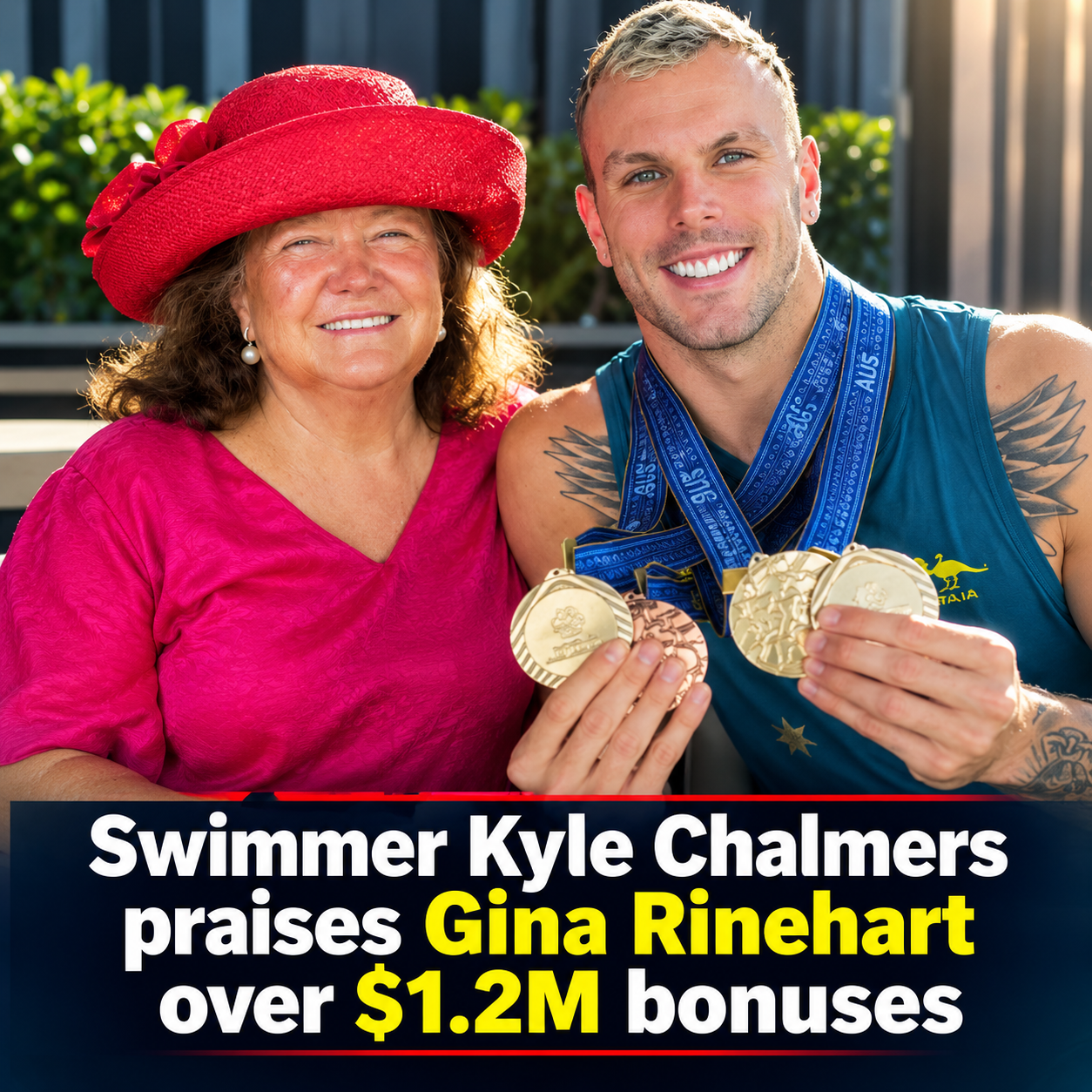
Olympic champion Kyle Chalmers was among the first to publicly express his appreciation, posting photographs alongside Rinehart and describing her contribution as extending well beyond financial rewards.
Writing on social media, Chalmers said some people changed lives without ever standing on a podium themselves, describing Rinehart as someone who continued to invest in Australian athletes and Australian sport in meaningful ways.
He said the incentive payments recognised the years of sacrifice required to compete at the highest level and provided genuine support for elite swimmers trying to balance demanding training with family life and financial realities.
For Chalmers, who is now a husband and father while continuing his elite swimming career, the funding represented more than prize money.
He said the support allowed him to continue pursuing the sport to which he had dedicated his life, adding that he would never take that backing for granted.
The post quickly attracted attention across the Australian swimming community.
Fellow Dolphins swimmer Sam Short commented that Rinehart had been instrumental in helping place the national swimming team in its strongest position in years, reflecting the view held by a number of athletes who have benefited from private funding programs.
Olympic medallist Elijah Winnington also published a separate message thanking both Rinehart and Hancock Prospecting for what he described as years of consistent backing.
Winnington wrote that she had changed the lives of countless Australian swimmers through ongoing financial support and said he was personally grateful for her commitment to the sport.
The public endorsements came only days after Australia completed one of the most dominant swimming campaigns in Commonwealth Games history.
The Dolphins finished the Glasgow meet with a record haul that included 37 gold medals while sweeping every relay event and producing a new generation of international contenders ahead of the 2027 World Championships and the 2028 Los Angeles Olympic Games.
Before the Games began, Rinehart announced an incentive scheme offering swimmers substantial cash bonuses for podium finishes and world records.
Individual athletes were eligible to receive $20,000 for a gold medal, $15,000 for silver and $10,000 for bronze, while additional payments were available for relay medals and world records.
Following Australia’s exceptional results in Glasgow, the total value of bonus payments exceeded $1.27 million.
Some athletes reportedly received tens of thousands of dollars through the scheme, with distance star Lani Pallister among those earning one of the largest bonus payouts after an outstanding Games.
The payments have highlighted the increasingly important role private benefactors play in supporting elite Australian athletes.
Although Australia’s swimming program enjoys stronger financial support than many Olympic sports, a number of athletes have previously spoken about the challenge of balancing full-time training with employment, study and family commitments.
Ahead of the Games, Chalmers acknowledged that reality, saying swimmers were fortunate to receive support but that financial pressures remained significant, particularly for experienced athletes continuing their careers beyond a single Olympic cycle.
Commonwealth Games Australia has consistently maintained that its position was based on sponsorship obligations rather than politics.
The organisation noted that official commercial partners invest millions of dollars in supporting the entire Australian team across every sport and that those contractual relationships must be respected during official Games activities.
The guidance did not prevent athletes from receiving privately funded bonuses or maintaining existing relationships outside official competition, but it did limit references to non-official sponsors during the event itself.
Rinehart has become one of the most significant private financial supporters of Australian swimming over the past decade.
Beyond one-off medal incentives, Hancock Prospecting has funded development programs, athlete scholarships and high-performance initiatives through partnerships with several swimming organisations.
Supporters argue that the investment has strengthened Australia’s position as one of the world’s leading swimming nations and helped retain experienced athletes who might otherwise struggle with the financial demands of elite competition.
However, Rinehart’s involvement in Australian sport has frequently attracted controversy.
In 2022, Hancock Prospecting withdrew its sponsorship from the Australian Diamonds netball team after Indigenous player Donnell Wallam expressed concern about wearing the company’s logo because of historical comments made by Gina Rinehart’s father, Lang Hancock.
Those comments, made decades earlier, prompted wider debate within Australian sport about corporate sponsorship, historical legacies and athlete activism.
Rinehart herself has also remained a polarising public figure because of her business interests, political donations and outspoken views on a range of national issues.
More recently, attention has also focused on Hancock Prospecting’s support for Pauline Hanson’s One Nation party, ensuring Rinehart continues to attract both strong supporters and vocal critics across Australian public life.
The latest praise from leading swimmers therefore extends beyond a simple thank-you message.
It has reopened discussion about how Australian elite sport should be funded and whether governments, sporting bodies or private philanthropists should bear greater responsibility for supporting athletes throughout Olympic and Commonwealth Games cycles.
Many competitors in less commercially successful sports have long argued that elite athletes often rely on outside employment, family assistance or private sponsorship simply to continue competing internationally.
The debate has become increasingly prominent as international competition intensifies and professional sporting careers become longer and more expensive to sustain.
For Australia’s swimmers, however, the immediate focus remains on building on the momentum created in Glasgow.
With the Commonwealth Games now complete, many members of the Dolphins squad are preparing for upcoming international meets before attention turns towards the 2027 World Championships and ultimately the Los Angeles Olympics in 2028.
Whether viewed as generous philanthropy or as another example of the growing influence of wealthy private backers in elite sport, Rinehart’s financial support has clearly left a significant impression on many of Australia’s leading swimmers.
Their willingness to publicly acknowledge that support once the Games concluded has ensured the discussion surrounding athlete funding, sponsorship rules and private investment in Australian sport is likely to continue well beyond the medals won in Glasgow.






