A fed-up Sydney resident says he confronted a man after watching him leave several large bags of rubbish on somebody else’s front lawn, refusing to let the matter go until the waste was picked up and taken away.
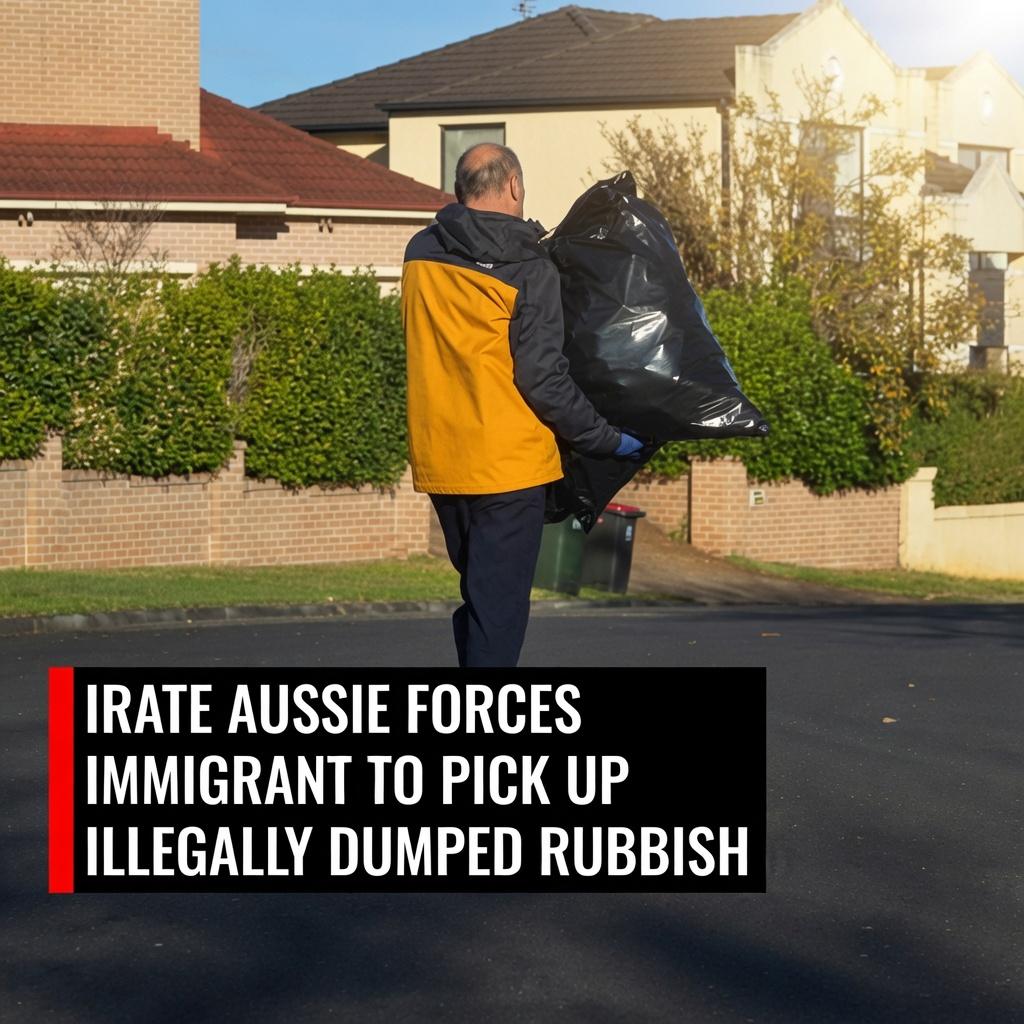
The incident reportedly unfolded in Castle Hill, in Sydney’s north-west, on Tuesday morning.
A local man identified as Ryan said he saw another man leave multiple bags of rubbish on a residential property and walk away.
Ryan told Noticer News he was stunned by what he believed was a blatant act of illegal dumping and decided to confront the man.
“I was honestly just gobsmacked, he was so brazen about it,” Ryan said.
According to Ryan, the man initially continued walking after being challenged.
Ryan said he drove around, returned and confronted him again.
“He first walked off after I told him off, and only came back to grab it when I came back around and yelled again,” he said.
“He only picked it up because I called him out on it.”
Photos supplied with the account appear to show a man collecting large bags from a grassed area beside a suburban street while Ryan watches from his vehicle.
There is no public indication that the man has been identified, charged or fined, and the circumstances described by Ryan have not been the subject of a publicly announced council or police investigation.
Ryan said he believed the man was Chinese and claimed the pair were unable to communicate in English.
However, the man’s nationality, citizenship and immigration status have not been independently established.
The central issue in the reported confrontation is the alleged disposal of waste on another person’s property.
For residents of Castle Hill, illegal dumping is not merely a question of whether discarded bags, furniture or household waste look unsightly.
The Hills Shire Council defines illegal dumping as the unlawful transporting or dumping of waste, or land filling, without council consent.
The council warns that dumped rubbish can harm wildlife and the local environment, encourage vermin, introduce weeds and contaminate land or waterways.
It can also create health risks and fire hazards.
Penalties of up to $8,000 may apply for illegal dumping in The Hills Shire, according to council information.
The Castle Hill confrontation reflects a frustration familiar to councils and residents across Australia: one person leaves waste behind, while somebody else — a homeowner, council or land manager — is left to deal with it.
In this case, according to Ryan’s account, the rubbish did not remain on the lawn long enough to become a council clean-up problem.
He says the man responsible returned and collected it after being challenged a second time.
The confrontation may have produced an immediate result, but authorities generally encourage residents to report illegal dumping through official channels rather than placing themselves in a potentially dangerous dispute with an unknown person.
The Hills Shire Council provides separate reporting options depending on whether a suspected dumper can be identified.
For rubbish dumped on public land where the person responsible can be identified, residents can submit a dumped rubbish report for investigation.
Where the dumper cannot be identified, residents can report litter or rubbish for collection.
The council has also previously encouraged residents to report illegal dumping through the Regional Illegal Dumping Squad system.
Photographs, vehicle details, registration numbers, dates, times and precise locations can all potentially assist an investigation.
That evidence can matter because illegal dumping cases are not always as straightforward as finding a pile of rubbish and determining who left it there.
Investigators may need to establish who transported the waste, where it came from and whether a person or business was paid to dispose of it lawfully.
In some cases, the person whose documents or belongings are found among dumped rubbish may not be the person who physically dumped the waste.
NSW authorities have repeatedly warned households and businesses to be cautious when paying people to remove unwanted material.
A cheap rubbish removal service can become an expensive environmental problem if the operator collects waste, takes payment and then abandons the load on public or private land.
The NSW Environment Protection Authority says illegal dumping commonly includes household furniture, soil, construction and demolition rubble, mattresses, skips and tyres.
Those categories illustrate the scale of the problem.
Illegal dumping can range from a small quantity of household waste abandoned in an open place to truckloads of construction material or contaminated waste deliberately disposed of to avoid lawful treatment and landfill costs.
The penalties therefore vary according to the seriousness of the conduct.
For small-scale illegal dumping, NSW EPA guidance says an individual can receive a $1,000 on-the-spot fine for waste dumped on other public land or open private places.
Where dumping occurs in or on a sensitive place, the on-the-spot fine for an individual can be $2,500.
Corporations face higher penalty notice amounts.
At the most serious end of the system, NSW significantly increased maximum penalties for illegal dumping offences in April 2024.
The NSW EPA said in February 2026 that maximum penalties for the most serious illegal dumping offences had risen to $500,000 for an individual and $2 million for a corporation.
Even higher penalties can apply to offences involving asbestos waste.
Since those laws were strengthened, the EPA said it had issued 26 penalty notices for illegal dumping totalling $446,750.
It had also successfully prosecuted 11 illegal dumping cases in the Land and Environment Court, with total court-imposed fines of more than $2 million.
The figures show why authorities treat dumped waste as an environmental enforcement issue rather than simply bad manners.
There is, however, some positive movement in the NSW data.
The EPA said illegal dumping reports fell by 12 per cent in the 2024–25 financial year compared with the previous year.
Reports dropped from 19,610 to 17,271.
The agency attributed the improvement to increased surveillance, stronger enforcement, tougher penalties and prevention programs.
But more than 17,000 reports in a single year still represent a substantial burden for councils, land managers and communities.
The EPA has continued funding targeted action.
In May 2026, it announced that 19 projects across NSW would share $1.2 million under an Illegal Dumping Prevention Program aimed at identifying offenders and stopping waste from being abandoned on public and private land.
Projects supported by the program can use surveillance, data analysis, community education and other targeted measures in known dumping areas.
The NSW Government says prevention programs have helped councils and public land managers identify patterns and focus resources on locations where dumping repeatedly occurs.
That approach is increasingly important because the cost of illegal dumping does not disappear when the offender leaves the scene.
Someone still has to inspect the waste.
Potentially dangerous material may need to be identified.
The rubbish may need to be loaded, transported and disposed of at an authorised facility.
If asbestos, chemicals or other hazardous substances are present, the clean-up can become significantly more complicated and expensive.
Even ordinary household rubbish can create problems when bags are torn open by animals or exposed to rain.
Waste can enter drains and waterways, while food scraps can attract pests.
Large dumped items can obstruct paths or roadsides and create hazards for pedestrians and motorists.
In residential streets, dumped rubbish can also create confusion about council clean-up collections.
The Hills Shire Council operates a booked clean-up collection service for residents.
That is different from simply leaving waste on another person’s lawn or placing unwanted material in a public area without authorisation.
Residents are expected to follow the council’s collection requirements and arrange lawful disposal for waste that cannot be accepted through normal household services.
The distinction matters because illegally dumped material can quickly encourage further dumping.
Once one pile appears, other people may assume the location is an unofficial collection point and add their own rubbish.
Councils across Australia have long described that pattern as a major challenge in known dumping hotspots.
The Castle Hill incident also sits within a broader wave of videos and photographs showing residents confronting alleged dumpers.
Similar clips have circulated from Australia, New Zealand and Canada, often showing household waste, furniture or boxes being returned to vehicles after local residents intervene.
Those videos regularly attract strong public reactions because they offer something official illegal-dumping investigations often cannot provide immediately: a visible consequence at the moment the rubbish is abandoned.
In Ryan’s account, the alleged dumper was told to return and remove the bags.
He did.
But viral confrontations can also carry risks.
A resident cannot know whether a stranger will respond calmly, become aggressive or be carrying a weapon.
There may also be uncertainty about what actually occurred before filming began.
For that reason, collecting useful information from a safe position and reporting suspected dumping can be more valuable than escalating a face-to-face confrontation.
NSW EPA and council reporting systems rely on evidence that can connect a person or vehicle to the disposal of waste.
A clear registration plate, description of a vehicle, time and location can give investigators a starting point.
Photos of the waste may also help authorities determine the nature and scale of the dumping.
Ryan’s decision to confront the man was his own response to what he says he witnessed in Castle Hill.
His account suggests the language barrier made the confrontation difficult, with Ryan saying the man did not speak English.
But the photographs and Ryan’s description indicate the message was ultimately understood: the bags were collected and removed.
The man’s background remains unverified.
While Ryan said he believed the man was Chinese, there is no publicly available evidence establishing that fact or confirming that he was an immigrant.
Describing the incident as an “immigrant dumping rubbish” case would therefore go beyond what has been independently established.
What can be said is that a Castle Hill resident says he witnessed a man leave several large rubbish bags on somebody else’s lawn, challenged him twice and watched him return to collect the waste.
The reported incident is small when compared with major industrial dumping cases involving tonnes of waste.
Yet it captures the everyday version of the problem that residents are most likely to encounter.
A bag is left on a verge.
A mattress appears beside a road.
Furniture is unloaded in a reserve.
Boxes are placed outside a home that does not belong to the person getting rid of them.
Each individual incident may seem minor, but collectively they create thousands of reports and significant clean-up work.
NSW authorities say enforcement is becoming tougher, and the latest figures suggest reported dumping has fallen.
At the same time, the state is still funding new prevention projects and issuing substantial penalties because the problem remains far from solved.
For Castle Hill residents, The Hills Shire Council makes its position clear: unlawfully transporting or dumping waste without consent is illegal, and the environmental consequences can extend well beyond an untidy street.
Ryan chose an immediate solution when he says he saw rubbish being abandoned in front of him.
He called the man out.
When the man walked away, Ryan returned and called him out again.
According to Ryan, the bags were finally picked up.
For councils dealing with thousands of dumping complaints, preventing the rubbish from being left behind in the first place remains the far bigger challenge.






