Australia’s political landscape could be heading towards one of its most dramatic realignments in decades after a new nationwide seat projection suggested Pauline Hanson’s One Nation is no longer simply a protest party, but a genuine contender to play a decisive role in forming the next federal government.
The latest Multilevel Regression with Poststratification (MRP) model produced by DemosAU for Capital Brief projects a parliament in which neither Labor nor the Coalition would be capable of governing alone, with One Nation emerging as the biggest winner from growing voter dissatisfaction with Australia’s traditional major parties.
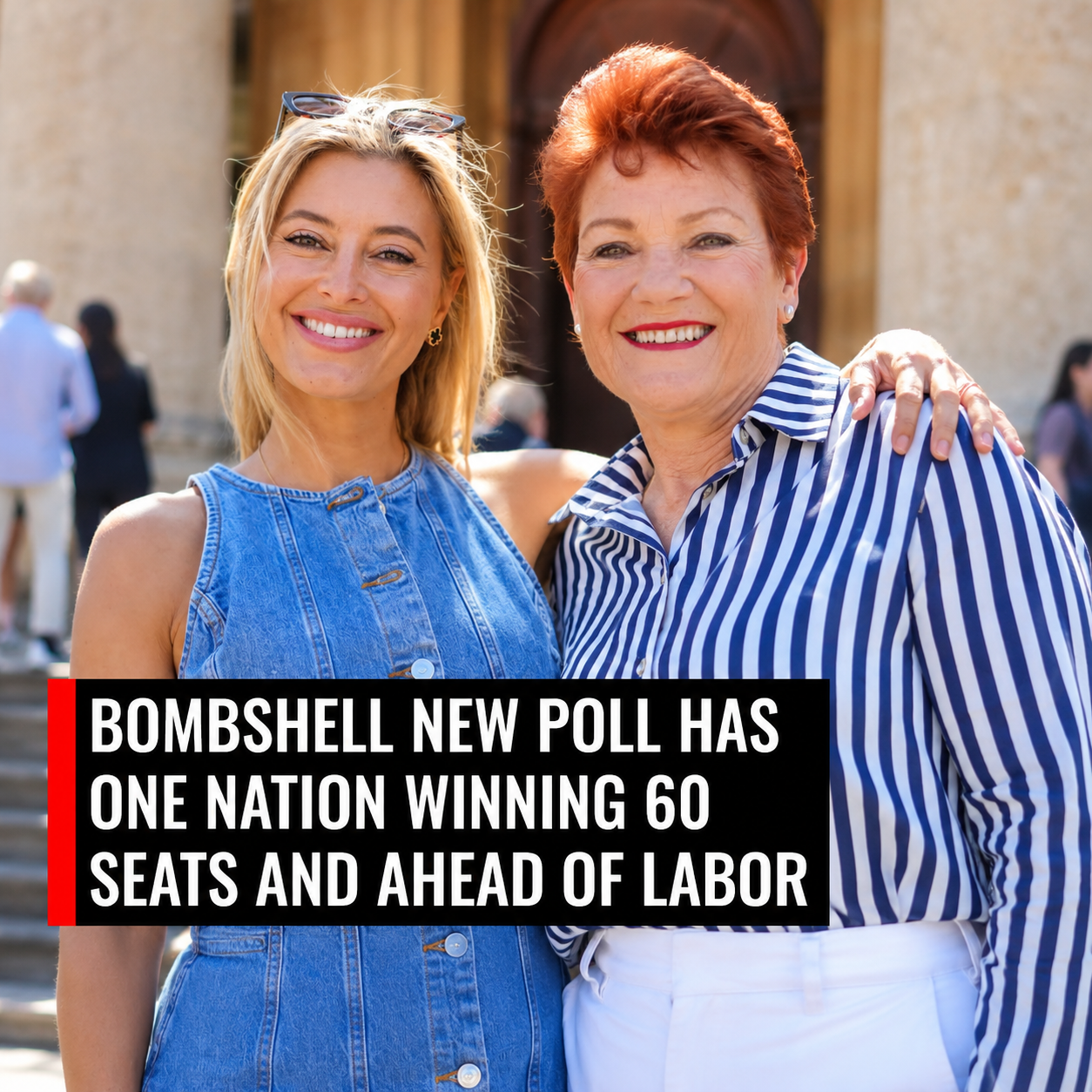
According to the modelling, Labor would secure an estimated 68 seats in the 150-member House of Representatives if an election were held now—well below the 76 seats required for majority government. One Nation is projected to win 60 seats, while the Coalition would be reduced to just 13. The Greens would hold three seats and other candidates six.
Although the figures are projections rather than election results, they represent one of the strongest performances ever recorded for One Nation in national seat modelling and suggest Australia’s next election could produce a parliament unlike any seen in recent decades.
For Pauline Hanson, whose party has traditionally occupied the political fringe while exerting influence primarily through the Senate, the numbers indicate something entirely different. Instead of acting as a minor crossbench force, One Nation would become the dominant conservative party in terms of House representation, leaving the Coalition facing its weakest parliamentary position in generations.
The implications extend well beyond headline seat totals.
If the projected numbers were replicated at an actual election, Labor would lose its outright majority despite remaining the single largest party. Combined, One Nation and the Coalition would hold 73 seats, placing them closer to government than Labor and potentially opening the door to negotiations involving independents or other crossbench MPs.
While no single party would automatically gain the right to govern, the balance of power could shift dramatically depending on post-election negotiations.
In Australia’s Westminster system, the Governor-General commissions the person most likely to command the confidence of the House of Representatives. That does not necessarily mean the leader of the party winning the most seats. It means whichever leader can demonstrate sufficient parliamentary support to survive confidence votes and pass supply legislation.
That constitutional reality explains why the DemosAU projections have generated such intense discussion despite Labor remaining ahead of every other individual party in seat numbers.
One Nation’s pathway to government would not depend solely on winning an outright majority. Instead, it would rely on assembling enough parliamentary support to command confidence on the floor of the House.
The MRP model estimates Labor’s likely outcome somewhere between 60 and 72 seats, while One Nation’s projected range stretches from 53 to 66 seats. The Coalition is projected to finish between 11 and 22 seats, demonstrating that relatively modest changes in voter behaviour could still reshape the final parliamentary arithmetic.
Unlike conventional opinion polls, MRP polling does not simply ask which party voters currently support before calculating national percentages.
Instead, it combines thousands of survey responses with demographic, geographic and historical voting data to estimate the likely outcome in every individual electorate across Australia.
This approach has become increasingly popular internationally because elections are ultimately decided seat by seat rather than by nationwide vote share.
The latest DemosAU model was built using responses collected between May 27 and July 11 from 9,343 participants—a considerably larger sample than traditional weekly polling.
Its national primary vote estimates place One Nation on 30 per cent, ahead of Labor on 26 per cent, followed by the Coalition on 21 per cent, the Greens on 13 per cent and all other parties collectively on 10 per cent.
Those figures represent a significant shift from earlier modelling conducted between January and March, when Labor maintained a stronger parliamentary position and One Nation’s projected representation was considerably lower.
The movement reflects a broader trend that has emerged throughout 2026 as cost-of-living pressures, housing affordability, energy prices and dissatisfaction with major-party politics continue influencing voter sentiment across much of the country.
Support for One Nation appears to have expanded well beyond its traditional regional Queensland heartland.
Recent polling indicates the party has been making gains across outer metropolitan suburbs, regional communities and several electorates where voters have become increasingly frustrated with both Labor and the Coalition.
Political analysts have noted that many Australians are no longer viewing elections as contests exclusively between the two traditional governing parties.
Instead, dissatisfaction with the political establishment has encouraged greater willingness among voters to consider alternatives, particularly where economic concerns dominate household priorities.
The projected collapse of Coalition representation is equally striking.
Historically, the Liberal and National parties have formed the principal alternative government whenever Labor has held office. Under this projection, however, conservative support would become fragmented, with One Nation attracting a larger share of primary votes and vastly outperforming the Coalition in projected House seats.
Such an outcome would fundamentally reshape Australia’s conservative movement.
Rather than negotiating with Labor from the position of a traditional opposition, Coalition MPs could instead find themselves deciding whether to support a government led or heavily influenced by Pauline Hanson.
That possibility remains hypothetical, but it illustrates just how dramatically the political conversation has changed over the past year.
Even so, polling experts caution against interpreting any single survey as a prediction of election day.
MRP modelling is designed to estimate likely outcomes based on current voting patterns, not forecast how Australians will necessarily vote months into the future after election campaigns, leadership debates and policy announcements.
The lengthy fieldwork period also means the survey captures public opinion over several weeks rather than measuring sudden changes in political momentum.
That distinction becomes particularly important when compared with more traditional opinion polling.
A separate Roy Morgan survey conducted between July 13 and July 19 painted a considerably different picture of One Nation’s immediate support.
Rather than recording the party on 30 per cent of the primary vote, the Morgan poll placed One Nation on 22.5 per cent after a sharp 5.5-point decline from the previous survey.
Labor remained on 27.5 per cent, while the Coalition improved to 23 per cent, highlighting the volatility that has characterised national polling throughout recent months.
Under respondent preference flows, Labor continued leading One Nation by 55–45, suggesting that although One Nation’s primary support has strengthened considerably, preference distributions remain a major challenge in converting votes into parliamentary seats.
Roy Morgan’s polling has fluctuated significantly throughout winter, with One Nation climbing to more than 31 per cent in mid-June before falling sharply, recovering, then slipping once again.
Those movements illustrate why political strategists generally focus on longer-term trends rather than individual weekly surveys when assessing electoral prospects.
The contrasting results between the DemosAU modelling and the Roy Morgan survey also highlight an important feature of Australian polling that is often overlooked outside political circles.
Traditional opinion polls generally provide a snapshot of national voting intention over a relatively short period. MRP models, by contrast, use larger datasets and demographic modelling to estimate outcomes in every electorate, making them better suited to projecting seat distributions than identifying week-to-week momentum.
For that reason, the DemosAU projection should not be interpreted as saying One Nation is guaranteed to win 60 seats. Instead, it suggests that if current voting patterns remained broadly consistent across the country, the party could realistically emerge as one of the largest parliamentary forces after the next federal election.
The distinction matters because Australia’s electoral system is not determined solely by national vote share.
Each of the 150 House of Representatives seats is decided individually using full preferential voting, meaning local candidates, preference flows and electorate-specific issues frequently produce results that differ significantly from the national vote.
It is also possible for a party to win a higher primary vote nationally but secure fewer seats than expected if support is concentrated in electorates it already dominates while remaining uncompetitive elsewhere.
Conversely, efficiently distributed support can produce disproportionately strong parliamentary representation.
One Nation’s growing support therefore raises important questions not only about how many Australians are backing the party, but also where those voters are located geographically.
The modelling suggests the party is expanding beyond its traditional rural and regional base into suburban electorates that have historically alternated between Labor and the Coalition.
Should that trend continue during an election campaign, a significant number of marginal seats could become genuine three-way contests for the first time.
Another factor likely to influence the next election is the completion of federal electoral redistributions across South Australia, Tasmania and the Australian Capital Territory.
Redistributions occur periodically to ensure electorates contain roughly equal populations as demographic patterns change.
Although boundary adjustments rarely dominate election coverage, they can influence close contests by moving thousands of voters between neighbouring electorates.
In South Australia, electoral analyst Antony Green described the changes as relatively modest, affecting all ten House divisions without fundamentally altering their political complexion.
The ACT also experienced only minor boundary adjustments across its three electorates. However, even small changes may prove significant in closely contested seats.
Bean, won by Labor by just 50.3 per cent to 49.7 per cent at the 2025 election, is now estimated to become marginally tighter following the redistribution.
Tasmania experienced more substantial boundary changes affecting three of its five federal divisions.
Despite those alterations, Antony Green concluded the overall balance between Labor and the Liberals changes only marginally, with Lyons becoming slightly safer for Labor after the redistribution.
Queensland will also undergo redistribution before Australians next head to the polls, affecting all 30 federal electorates in the state.
Given Queensland has historically been one of One Nation’s strongest regions, any changes to electorate boundaries will be closely monitored by campaign strategists from every major party.
The broader political picture also extends beyond federal polling.
New South Wales polling released alongside the national surveys suggests support for One Nation is strengthening at state level as well.
A Resolve survey conducted for The Sydney Morning Herald recorded Labor on 29 per cent of the primary vote, One Nation on 25 per cent and the Coalition on 23 per cent.
Although Labor retained a comfortable advantage after preferences, both major parties recorded historically weak primary vote figures.
For the Coalition, it represented a record low since Resolve began conducting state polling in 2021.
For Labor, it equalled its lowest result over the same period.
Political analyst Kevin Bonham noted that Labor would still likely prevail under New South Wales’ optional preferential voting system because conservative support remains divided between the Coalition and One Nation.
That split reduces the ability of either conservative party to overtake Labor in two-candidate contests, even when their combined vote is substantial.
The New South Wales survey also found Premier Chris Minns maintaining a commanding lead over Opposition Leader Kellie Sloane as preferred premier, suggesting state leadership perceptions remain more favourable than the underlying party vote might indicate.
Meanwhile, separate polling in the Australian Capital Territory suggests One Nation is beginning to establish a measurable presence in a jurisdiction where it previously had little electoral impact.
The DemosAU and Premier National survey recorded Labor on 32 per cent, the Liberals on 21 per cent, independents on 19 per cent, One Nation on 14 per cent and the Greens on 11 per cent.
While the ACT elects its Legislative Assembly using proportional representation rather than the federal preferential system, the results indicate that dissatisfaction with the traditional major parties is not confined to regional Australia.
Taken together, the national and state polling points towards an increasingly fragmented political environment.
Australian elections have long been dominated by Labor and the Liberal-National Coalition, but support for independents and smaller parties has steadily increased over the past decade.
The latest DemosAU modelling suggests that trend may be accelerating rather than slowing.
Whether One Nation can ultimately translate growing support into parliamentary representation remains uncertain and will depend on candidate selection, campaign performance, preference flows and local electorate dynamics.
Nevertheless, the survey reinforces a political reality that would have seemed improbable only a few election cycles ago.
Instead of asking whether One Nation can influence the next parliament, political observers are increasingly debating how large its influence could become if current trends continue.
With the next federal election still ahead, polling will undoubtedly continue to shift as parties unveil new policies, campaign across marginal electorates and respond to changing economic conditions.
However, the latest modelling serves as another reminder that Australia’s political landscape is becoming more competitive, more fragmented and considerably less predictable than the traditional two-party contests that defined federal elections for much of the past half-century.
If the projections ultimately prove even partially accurate, the next parliament may be shaped less by outright victories and more by negotiations, alliances and confidence agreements—placing smaller parties, particularly One Nation, at the centre of decisions that determine who governs Australia.






