Australia’s record-breaking swimming team will receive more than medals and national acclaim following its extraordinary Glasgow Commonwealth Games campaign, with mining executive Gina Rinehart confirming a $1.272 million bonus pool for swimmers and para swimmers who stood on the podium.
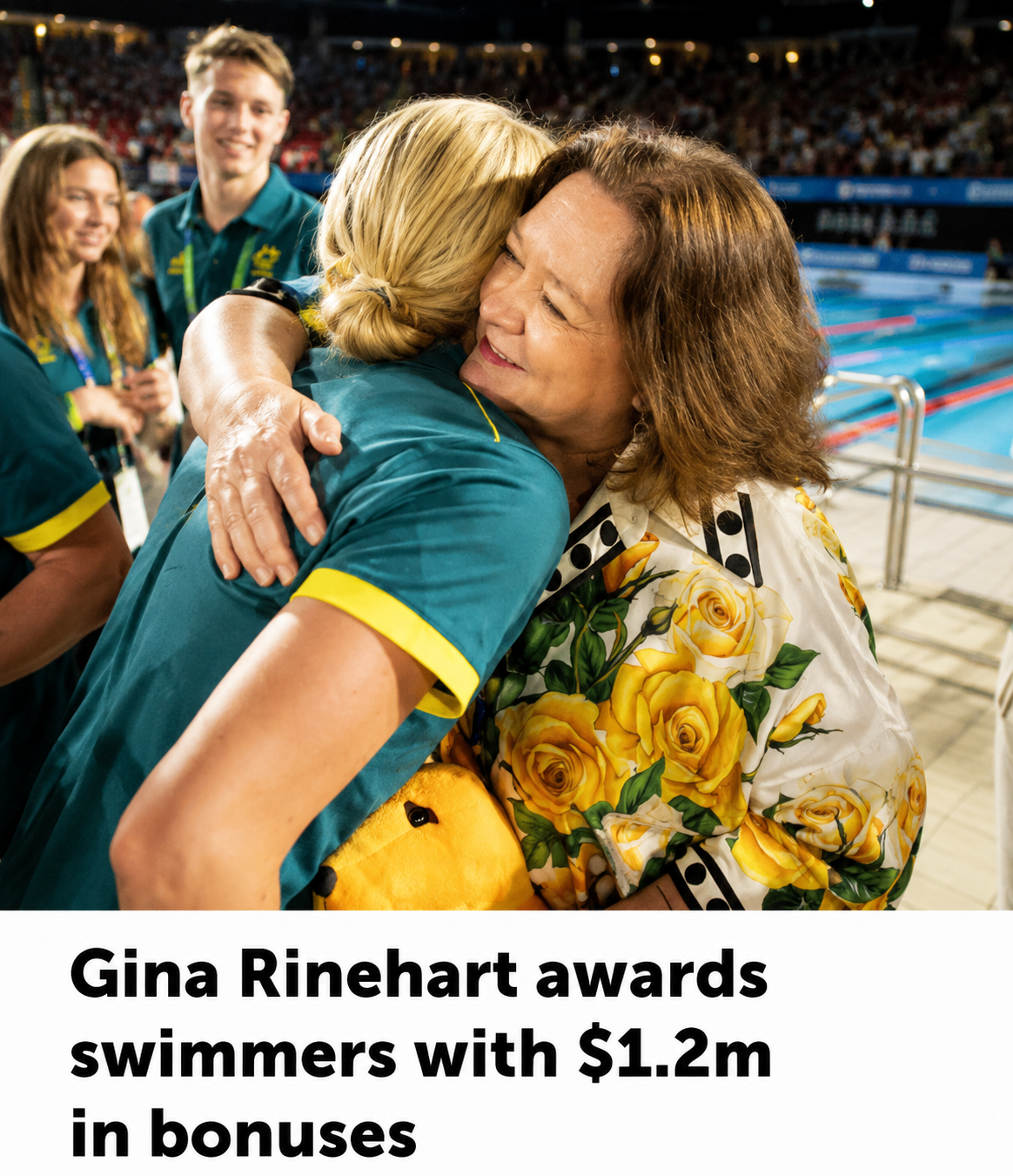
The privately funded rewards, provided through Hancock Prospecting, recognise one of the greatest international performances in Australian swimming history after the Dolphins dominated competition throughout the Games. The team finished with an unprecedented 37 gold medals, while also collecting 16 silver and 23 bronze medals, reinforcing Australia’s reputation as one of the world’s premier swimming nations.
Athletes will receive bonus payments for every medal they earned during the Games, with the money expected to arrive in competitors’ bank accounts within two weeks of the closing ceremony. The initiative continues a long-standing tradition of financial support from Rinehart, who has invested heavily in Australian high-performance sport for more than a decade.
Under the bonus structure, swimmers who captured an individual gold medal will receive $20,000 for each victory. Members of gold medal-winning relay teams will each receive $5,000. Individual silver medallists are entitled to $15,000, while relay silver medallists will receive $3,750 each. Individual bronze medal winners will collect $10,000, with relay bronze payments distributed across team members.
The structure rewards consistency as much as individual brilliance, meaning athletes who repeatedly reached the podium during the week-long competition will receive significant financial recognition.
One of the biggest beneficiaries is sprint star Meg Harris, who produced one of the standout performances of the Games. Harris won six gold medals—two individual titles and four relay victories—earning a total bonus of approximately $60,000 under the incentive program.
Several other Australian swimmers are also expected to receive sizeable payments after collecting multiple medals across individual and relay events, highlighting the remarkable depth that Australia displayed throughout the competition.
Announcing the bonus program, Rinehart said the payments were intended to recognise not only sporting excellence but also the commitment and sacrifice required to compete at the highest level.
“I’m pleased to be able once again to provide financial rewards to our medal winners in the sports where I’m Patron,” Rinehart said.
“It’s a way of saying thank you and showing appreciation for their dedication and achievements, the pride they make Australians feel, right across our country, and for being the inspiring young ambassadors that they truly are.”
Her comments reflect a philosophy she has repeated across multiple Olympic and Commonwealth Games cycles—that Australia’s elite athletes deserve recognition extending beyond medals themselves, particularly in sports where professional earning opportunities remain relatively limited.
Unlike athletes competing in Australia’s major professional football codes, most elite swimmers rely on a combination of sponsorships, grants, institute scholarships and private support while training full-time. Even Olympic champions often spend years balancing intensive training schedules with education or part-time work before securing major commercial endorsements.
Private incentive programs such as Hancock Prospecting’s therefore provide an important additional source of financial support, allowing athletes to continue investing in coaching, recovery, travel and preparation between major international competitions.
Rinehart has become one of Australia’s most influential private supporters of elite sport over recent years. Through Hancock Prospecting, she has provided financial backing across numerous disciplines including swimming, para swimming, rowing, artistic swimming, volleyball and athletics.
Her investment extends well beyond one-off bonus payments. Hancock Prospecting has supported national training programs, athlete development initiatives and high-performance pathways designed to help Australian competitors remain internationally competitive.
The company’s involvement has frequently been praised by sporting organisations, which face increasing financial pressure as the cost of preparing athletes for Olympic and Commonwealth competition continues to rise.
The Glasgow bonus announcement follows similar reward programs introduced during previous Olympic Games, World Championships and Commonwealth Games campaigns.
Earlier this year, Rinehart also pledged additional bonuses for Australian swimmers capable of breaking world records during the Glasgow meet, further demonstrating her commitment to rewarding exceptional achievement rather than participation alone.
Australia’s performance justified that confidence.
From the opening night until the final session, the Dolphins controlled the medal table through a combination of established Olympic champions and emerging young talent. Relay teams proved particularly dominant, continuing Australia’s long-standing strength in team events while a new generation of swimmers announced themselves on the international stage.
The campaign was especially significant because several experienced stars were unavailable through injury, retirement or carefully managed competition schedules. Rather than weakening Australia’s chances, the absences created opportunities for younger swimmers to establish themselves before the next Olympic cycle.
Coaches have repeatedly highlighted Australia’s growing depth as one of the team’s greatest competitive advantages. Rather than relying on a handful of superstars, Australia now possesses multiple internationally competitive athletes across freestyle, backstroke, butterfly, breaststroke and medley events.
That depth has been developed through decades of investment by Swimming Australia, state institutes of sport, local clubs and private partners including Hancock Prospecting.
The results in Glasgow demonstrated that pipeline remains exceptionally strong heading towards future World Championships and the Los Angeles Olympic Games.
Australia’s para swimming team also contributed significantly to the nation’s success, with several athletes producing personal-best performances while reinforcing the country’s status as a global powerhouse across both Olympic and Paralympic aquatic competition.
The inclusion of para swimmers within the Hancock Prospecting bonus program has become an important feature of Rinehart’s support for Australian sport, recognising achievements equally regardless of whether medals are won in Olympic or Paralympic disciplines.
The overall distribution of bonus payments reflects the breadth of Australia’s success throughout the Games.
- Gold medals: 37 medals – $802,500 in bonus payments.
- Silver medals: 16 medals – $240,000 in bonus payments.
- Bronze medals: 23 medals – $230,000 in bonus payments.
- Total bonus pool: $1,272,500.
Because payments are calculated according to each medal earned, athletes who featured in multiple relay teams in addition to individual events will receive significantly larger bonuses than competitors who reached the podium once.
For many swimmers, however, the financial reward represents more than its monetary value. Elite swimming demands years of early mornings, thousands of kilometres in the pool and countless hours in the gym, often with no guarantee of international success. Recognition from private supporters therefore carries considerable symbolic importance alongside the financial assistance itself.
Swimming Australia has repeatedly emphasised that maintaining the nation’s position at the top of world swimming requires collaboration between government agencies, sporting bodies, commercial sponsors and private benefactors. Programs such as Hancock Prospecting’s bonus initiative have become an increasingly visible part of that broader ecosystem.
Australia’s extraordinary Glasgow campaign will ultimately be remembered for the records broken, the relay victories and the emergence of future champions. Yet for the athletes returning home after one of the country’s greatest Commonwealth Games performances, another reward now awaits.
Within weeks, more than $1.27 million in privately funded bonus payments will begin reaching medal winners across Australia’s swimming and para swimming teams—a tangible acknowledgement of performances that thrilled supporters across the nation and reinforced Australia’s enduring dominance in the pool.
Beyond the financial rewards, Australia’s remarkable showing in Glasgow has strengthened confidence that the nation’s swimming program is well positioned for the remainder of the decade. Coaches have consistently argued that the country’s greatest competitive advantage is no longer simply producing world-class champions, but developing enough depth that international finals are routinely filled with Australian athletes.
That depth was evident throughout the Commonwealth Games. In several events, Australia qualified multiple swimmers for medal races, while relay teams demonstrated exceptional consistency across every leg. The ability to rotate athletes without sacrificing performance has become one of the defining characteristics of the Dolphins program.
Sports analysts have noted that this depth provides Australia with a significant edge at major international championships. Injuries, illness and changing competition schedules inevitably affect elite sport, but Australia’s growing talent pool allows selectors to maintain world-class standards even when established stars are unavailable.
The Glasgow campaign illustrated that point perfectly. While several experienced names were absent from the competition, younger swimmers seized their opportunities, collecting medals and gaining invaluable international experience that is expected to benefit Australia at future World Championships and Olympic Games.
For Swimming Australia, that emerging generation is perhaps one of the most encouraging outcomes from Glasgow. Medal tables reflect current success, but long-term competitiveness depends on continually developing athletes capable of replacing retiring champions. The performances delivered throughout the Games suggest that transition is already well underway.
The Commonwealth Games have traditionally played an important role in that development pathway. Although the Olympics remain the pinnacle of international competition, the Games provide athletes with experience competing under pressure while representing Australia in a multi-sport environment. Many of the nation’s greatest Olympic swimmers first established themselves on the Commonwealth stage before progressing to global success.
The financial recognition announced by Hancock Prospecting is also viewed as helping athletes bridge the gap between major international events. Elite swimmers often face significant expenses associated with training, nutrition, sports science support, interstate travel and overseas competition, with many relying on multiple funding sources throughout their careers.
While Australia’s high-performance sporting system receives government assistance through the Australian Institute of Sport and other programs, private investment has become increasingly important as competition intensifies internationally. Nations around the world continue expanding investment in elite sport, making partnerships with corporate sponsors and private benefactors increasingly valuable.
Rinehart has repeatedly argued that rewarding excellence encourages athletes to remain committed throughout lengthy Olympic cycles. Unlike professional leagues where contracts provide guaranteed income, swimmers typically spend years preparing for competitions that may ultimately last only a matter of minutes.
That reality makes performance incentives particularly meaningful. Beyond recognising success after the fact, they also provide practical assistance that can be reinvested into future preparation, helping athletes access better coaching, recovery equipment, overseas training camps and sports science services.
Swimming Australia’s sustained international success has also delivered broader benefits beyond the pool. High-profile victories inspire increased participation among young Australians, strengthen local swimming clubs and reinforce swimming’s position as one of the country’s most successful Olympic sports.
Grassroots participation has historically surged following major international events, with children often inspired by watching Australian champions compete on the world stage. Those participation increases help strengthen the pipeline that eventually produces future elite athletes.
The Glasgow medal haul therefore represents more than a collection of podium finishes. It reflects years of investment by coaches, clubs, sporting organisations, families and supporters who contribute to Australia’s high-performance swimming system.
For Hancock Prospecting, the latest bonus program continues a relationship with Australian swimming that has expanded steadily over recent years. The company has positioned itself as one of the nation’s most significant private sporting supporters, extending assistance across Olympic, Paralympic and Commonwealth pathways.
Industry observers note that such partnerships have become increasingly valuable as sporting organisations seek stable long-term funding rather than relying solely on government grants or commercial sponsorship agreements tied to broadcast exposure.
Australia’s swimmers now return home having delivered one of the country’s finest Commonwealth Games campaigns, setting new benchmarks for success while demonstrating the remarkable strength of the national program.
The achievements of athletes such as Meg Harris, together with the dominance displayed by Australia’s relay teams and para swimmers, have reinforced expectations that the Dolphins will remain among the world’s leading swimming nations throughout the next Olympic cycle.
For the medal winners themselves, however, the celebrations are not quite over. Alongside the memories, medals and national recognition, more than $1.27 million in bonus payments will soon begin arriving in their bank accounts—a gesture of appreciation from Gina Rinehart and Hancock Prospecting recognising the dedication, discipline and excellence that produced another golden chapter in Australian sporting history.






