Australia has capped one of the greatest swimming campaigns in Commonwealth Games history, finishing the Glasgow 2026 program with a record-breaking 37 gold medals as the Dolphins overwhelmed the rest of the competition and rewrote the nation’s record books.
The final day in the pool delivered another extraordinary haul of nine gold medals, lifting Australia’s swimming tally to an astonishing 76 medals overall – 37 gold, 16 silver and 23 bronze – comfortably eclipsing the previous national record of 28 swimming gold medals set at the Gold Coast Games in 2018.
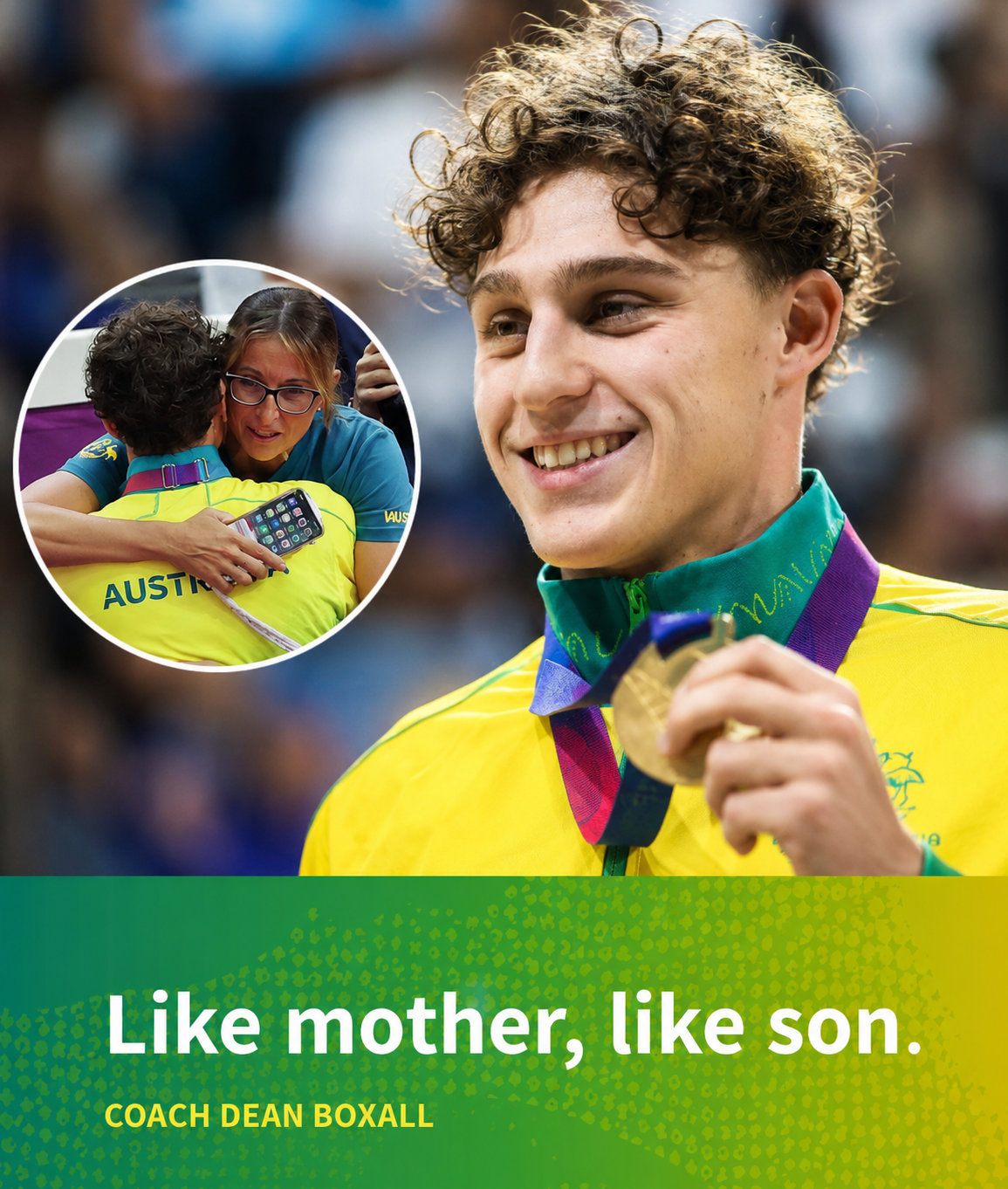
While Australia’s dominance had been evident throughout the week, the defining image of the final morning belonged to Kai Taylor, whose remarkable victory in the men’s 200 metres freestyle completed a remarkable full-circle story spanning more than three decades of Australian swimming history.
The Queensland swimmer, son of Australian swimming icon Hayley Lewis, stunned the field by winning from lane one – traditionally one of the least favourable lanes in championship racing – recreating almost exactly what his mother achieved 36 years earlier when she became world champion after launching her race from an outside lane.
Television cameras immediately turned towards Hayley Lewis after her son’s victory, capturing an emotional celebration that quickly became one of the most memorable moments of the Games.
Her reaction reflected far more than parental pride.
It was the culmination of a sporting journey that linked two generations of Australian champions through one extraordinary race.
Taylor attacked the race from the opening metres, refusing to allow his outside lane assignment to dictate his tactics.
Rather than attempting to conserve energy and chase the leaders over the closing stages, he established an early advantage and maintained his composure as swimmers in the centre lanes gradually closed the gap.
Despite enormous pressure over the final 50 metres, Taylor held on to secure gold in what many observers described as one of the finest individual swims of the championships.
His victory represented more than another Australian medal.
It confirmed the emergence of one of the next generation’s leading freestyle swimmers and demonstrated that Taylor has now established his own identity after years of inevitably being compared with one of Australia’s greatest female swimmers.
Until recently, many of Taylor’s biggest international achievements had come in relay events.
His Commonwealth Games triumph now stands as the biggest individual title of his career and reinforces Australia’s remarkable depth in middle-distance freestyle swimming heading towards future World Championships and the Los Angeles 2028 Olympic Games.
Adding to the emotion surrounding the victory was the reaction of celebrated Australian coach Dean Boxall.
Known internationally for his energetic celebrations whenever his swimmers achieve major success, Boxall again became one of the stars of the television broadcast as he erupted beside the pool following Taylor’s victory.
His passionate response perfectly reflected the atmosphere within the Australian team, which had spent the previous six days producing one outstanding performance after another.
Taylor’s gold was only one chapter in what became another remarkable morning for the Dolphins.
Australian swimmers repeatedly climbed to the top of the podium across the final session, underlining the enormous gap that separated them from the rest of the Commonwealth field.
The team ultimately completed the swimming program with 37 gold medals, a figure unmatched in Australian Commonwealth Games history.
The achievement comfortably surpassed the previous benchmark of 28 gold medals and further reinforced Australia’s reputation as the dominant swimming nation within the Commonwealth.
Across the six-day program, Australia’s success was built not around one or two superstars but an extraordinary spread of medal winners.
Established champions continued to deliver, while an emerging generation demonstrated they are ready to carry Australian swimming into its next era.
Distance specialists Sam Short and Lani Pallister enjoyed outstanding campaigns, collecting multiple gold medals throughout the meet.
Flynn Southam continued his rapid development as one of Australia’s brightest sprint freestyle talents, while athletes including Iona Anderson, Sienna Toohey and Kai Taylor announced themselves as future leaders of the Dolphins program.
The relay teams also maintained Australia’s long tradition of excellence.
Throughout the championships, Australian quartets repeatedly converted qualifying performances into gold medals, showcasing both remarkable depth and exceptional consistency across every freestyle and medley discipline.
That relay dominance has long been one of Australia’s defining strengths at major international competitions and again proved decisive in building the nation’s overwhelming medal tally.
One of the most impressive aspects of the campaign was achieved despite several high-profile absences.
Australia competed without some of the country’s biggest recent swimming stars, including Ariarne Titmus, Mollie O’Callaghan and Kaylee McKeown, yet still produced the most successful Commonwealth Games swimming campaign in national history.
That outcome has strengthened confidence that Australian swimming possesses exceptional depth as preparations continue for future Olympic and world championship competition.
Although the Commonwealth Games do not feature the full global strength seen at the Olympic Games or World Championships, the performances in Glasgow nevertheless provided valuable evidence of Australia’s extraordinary talent pipeline.
Young swimmers were repeatedly entrusted with leading roles and consistently delivered under pressure, suggesting the transition between generations is already well underway.
For Swimming Australia, that may prove one of the most encouraging outcomes of the entire competition.
The emergence of athletes capable of winning major championships before reaching their athletic peak provides confidence that Australia’s success can continue well beyond this Commonwealth Games cycle.
The Glasgow campaign also demonstrated the effectiveness of Australia’s high-performance training environment.
Many medal winners emerged from nationally recognised programs that place equal emphasis on technical excellence, sports science, race strategy and mental preparation.
Those systems have helped Australia consistently produce elite swimmers across multiple events rather than relying on isolated individual stars.
As the swimming competition concluded, Australia had not simply topped the medal table.
The Dolphins had outperformed every expectation, setting new Games records, dominating relay competition and repeatedly filling podium positions across freestyle, backstroke, butterfly, breaststroke and para-swimming events.
The statistics alone tell a remarkable story, but the emotional images from the final day may ultimately become the enduring memory.
Hayley Lewis cheering as her son recreated a defining chapter of her own sporting career symbolised both Australia’s proud swimming history and its bright future.
Few sporting families ever experience such a moment, and even fewer do so on one of international sport’s biggest stages.
For Kai Taylor, the gold medal represented the fulfilment of years of work and the opportunity to step permanently out of the shadow of one of Australia’s greatest swimmers.
For Hayley Lewis, it was a chance to witness history repeat itself in the most personal way imaginable.
For Australia, meanwhile, it was the perfect conclusion to a swimming campaign that will be remembered as one of the finest ever produced by the Dolphins at a Commonwealth Games.
With 37 gold medals, 76 total medals and a new generation of champions announcing themselves to the sporting world, Glasgow 2026 may ultimately be remembered not only for Australia’s dominance, but for signalling the beginning of another golden era in Australian swimming.






