Australia has formally cleared the way for uranium exports to India under a new administrative agreement signed by Prime Minister Anthony Albanese and Indian Prime Minister Narendra Modi, marking another significant step in the growing strategic partnership between the two Indo-Pacific nations.
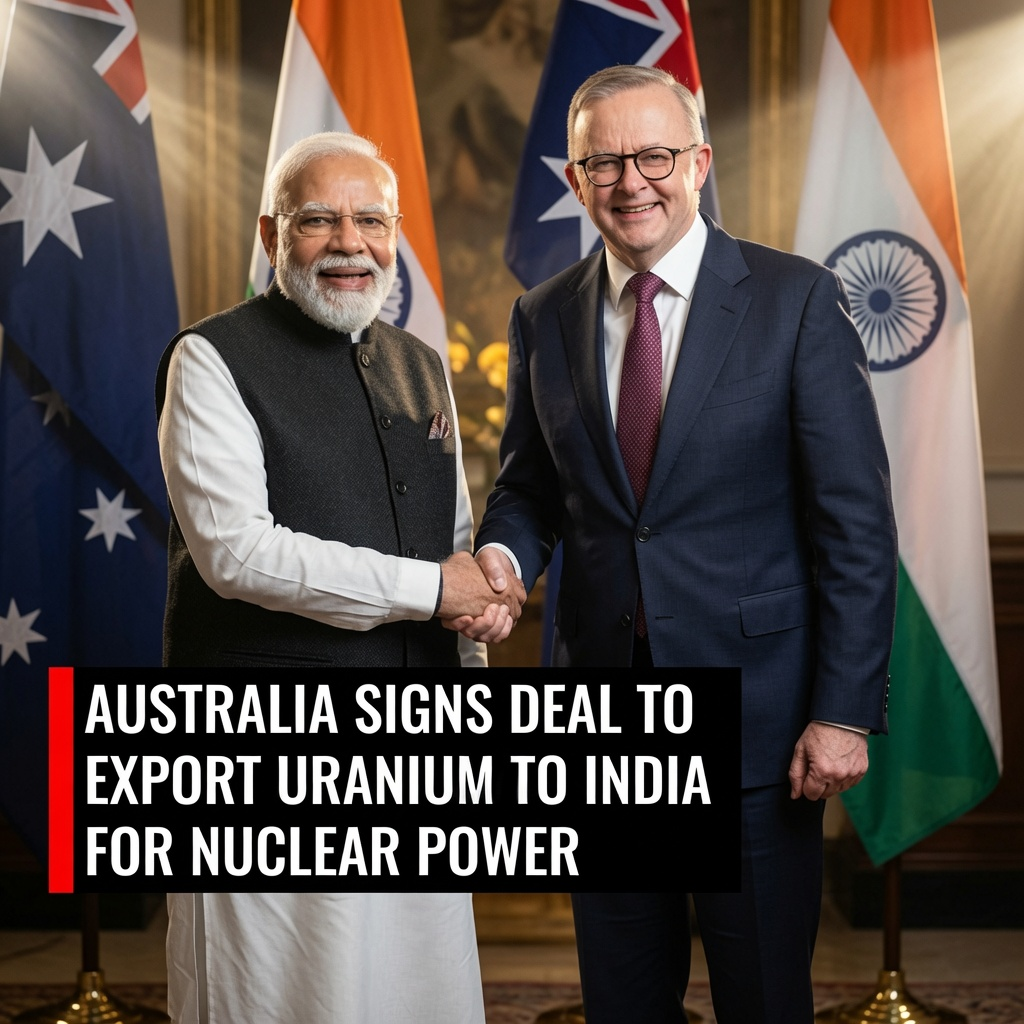
The agreement was announced during the Third Australia–India Annual Summit in Melbourne, where the two leaders reaffirmed cooperation across a wide range of areas including critical minerals, energy security, supply chain resilience, education and closer people-to-people connections.
Among the summit’s most significant outcomes was the signing of the Administrative Arrangement that enables Australian uranium exports to India under the Australia–India Nuclear Cooperation Agreement, originally signed in 2015.
Prime Minister Albanese described the arrangement as an important milestone in bilateral cooperation.
“Today, we can confirm the signing of the arrangement to enable uranium exports to India for peaceful purposes under the 2015 Australia-India Nuclear Cooperation Agreement,” Mr Albanese said.
He said the agreement would allow Australian uranium producers to access another major international market while supporting India’s efforts to expand low-emissions electricity generation.
“The arrangement facilitates Australian uranium exports to India to help increase the share of non-fossil fuel power capacity, providing an additional market for the Australian resources sector.”
Prime Minister Modi also welcomed the agreement, describing it as a major boost for India’s clean energy ambitions.
“This will pave the way for uranium supplies from Australia to India and give our clean energy objectives fresh momentum,” Mr Modi said.
The announcement reinforces the rapid expansion of strategic ties between Canberra and New Delhi at a time when both governments are seeking to strengthen economic cooperation while reducing reliance on increasingly fragile global supply chains.
Energy has become one of the most important pillars of that relationship.
India is pursuing one of the world’s most ambitious nuclear expansion programs as electricity demand continues to grow alongside industrialisation and population growth.
The country currently operates 23 nuclear reactors, with another eight under construction, and has outlined plans to increase installed nuclear generating capacity to around 100 gigawatts by 2047.
Achieving that target will require reliable long-term uranium supplies, making Australia an attractive partner given its enormous natural reserves.
According to international estimates, Australia possesses roughly 28 per cent of the world’s known recoverable uranium resources, making it one of the largest uranium-holding nations globally.
Although Australia mines uranium, virtually all production is exported because nuclear electricity generation remains prohibited domestically under existing federal legislation.
The latest agreement therefore highlights a longstanding contradiction within Australia’s energy policy.
Successive governments have supported uranium mining and exports under strict international safeguards while maintaining restrictions on domestic nuclear power generation.
Australia exports uranium to several countries operating civilian nuclear energy programs, provided those nations meet international non-proliferation obligations and use the fuel exclusively for peaceful purposes.
The safeguards framework governing exports to India stems from the bilateral Nuclear Cooperation Agreement signed in 2015 after years of diplomatic negotiations.
India is not a signatory to the Nuclear Non-Proliferation Treaty, a factor that previously complicated uranium trade with Australia.
However, Australia ultimately agreed to exports after India accepted a range of International Atomic Energy Agency safeguards covering its civilian nuclear facilities.
The newly signed administrative arrangement provides the practical framework needed to implement those exports.
Beyond uranium, the Melbourne summit also focused heavily on critical minerals.
Australia is one of the world’s leading suppliers of lithium, rare earth elements and other minerals essential for batteries, renewable energy technologies and advanced manufacturing.
India is seeking secure access to those resources as it expands domestic manufacturing and reduces dependence on overseas suppliers.
The two governments also discussed strengthening supply chain resilience across strategic industries, an increasingly important objective as geopolitical tensions reshape global trade patterns.
Education, research partnerships and investment were also identified as priorities for future cooperation.
Trade between Australia and India has grown substantially over recent years, supported by the Australia–India Economic Cooperation and Trade Agreement, which has lowered tariffs across numerous sectors and encouraged greater business engagement.
The uranium agreement is likely to be viewed as another indication that the bilateral relationship is moving well beyond traditional trade into broader strategic cooperation.
However, the announcement is also likely to reignite debate over Australia’s own energy policy.
The Albanese Government continues to oppose domestic nuclear power generation, arguing that renewable energy backed by storage and modern electricity networks represents the fastest and least expensive pathway towards achieving Australia’s emissions targets.
Labor has consistently maintained that renewable technologies, combined with batteries, pumped hydro and transmission investment, offer a more practical long-term solution than building a domestic nuclear industry.
The Greens likewise remain firmly opposed to nuclear generation, citing concerns over construction costs, lengthy development timelines, radioactive waste management and financial risks.
Opposition parties and supporters of nuclear power argue Australia should reconsider that position, particularly given its abundant uranium resources and growing electricity reliability challenges.
They contend that exporting uranium while prohibiting its domestic use creates an inconsistency in national energy policy.
The issue has become increasingly prominent in Australian politics as energy prices, emissions reduction targets and electricity reliability continue to dominate public debate.
The summit also included a large public appearance by the two prime ministers at the sold-out Melbourne Meets Modi event held at Marvel Stadium.
The event attracted thousands of supporters celebrating the growing relationship between Australia and India’s extensive diaspora community.
Outside the venue, however, a separate protest highlighted concerns held by some Australians regarding immigration levels and national sovereignty.
Organiser Hugo Lennon argued Australia’s emphasis on expanding “people-to-people links” had contributed to sustained high migration from India and warned that immigration policy should better reflect Australia’s national interests.
The protest reflected broader domestic debates surrounding migration, housing affordability, infrastructure pressures and population growth that have become increasingly prominent across Australian politics.
Despite those concerns, both governments continue to describe Australia–India relations as one of the defining strategic partnerships in the Indo-Pacific region.
For Canberra, closer ties with India provide opportunities to diversify export markets, strengthen regional security partnerships and deepen economic engagement with one of the world’s fastest-growing major economies.
For New Delhi, Australia represents a stable democratic partner with abundant natural resources, advanced education institutions and strategic alignment across many regional security issues.
The uranium export arrangement is therefore more than a commercial agreement.
It reflects the continuing evolution of Australia–India relations into a comprehensive strategic partnership encompassing energy, defence, trade, technology and regional cooperation.
Whether it also prompts renewed discussion about Australia’s own nuclear future remains to be seen, but the agreement undoubtedly places nuclear energy back at the centre of Australia’s political conversation while strengthening one of the country’s most important international relationships.






