An interview on ABC News about a SpaceX rocket expected to collide with the Moon has sparked widespread discussion after an Australian astronomer described the Moon as part of “Indigenous sky country” and argued that it should not be viewed simply as an object for human exploration.
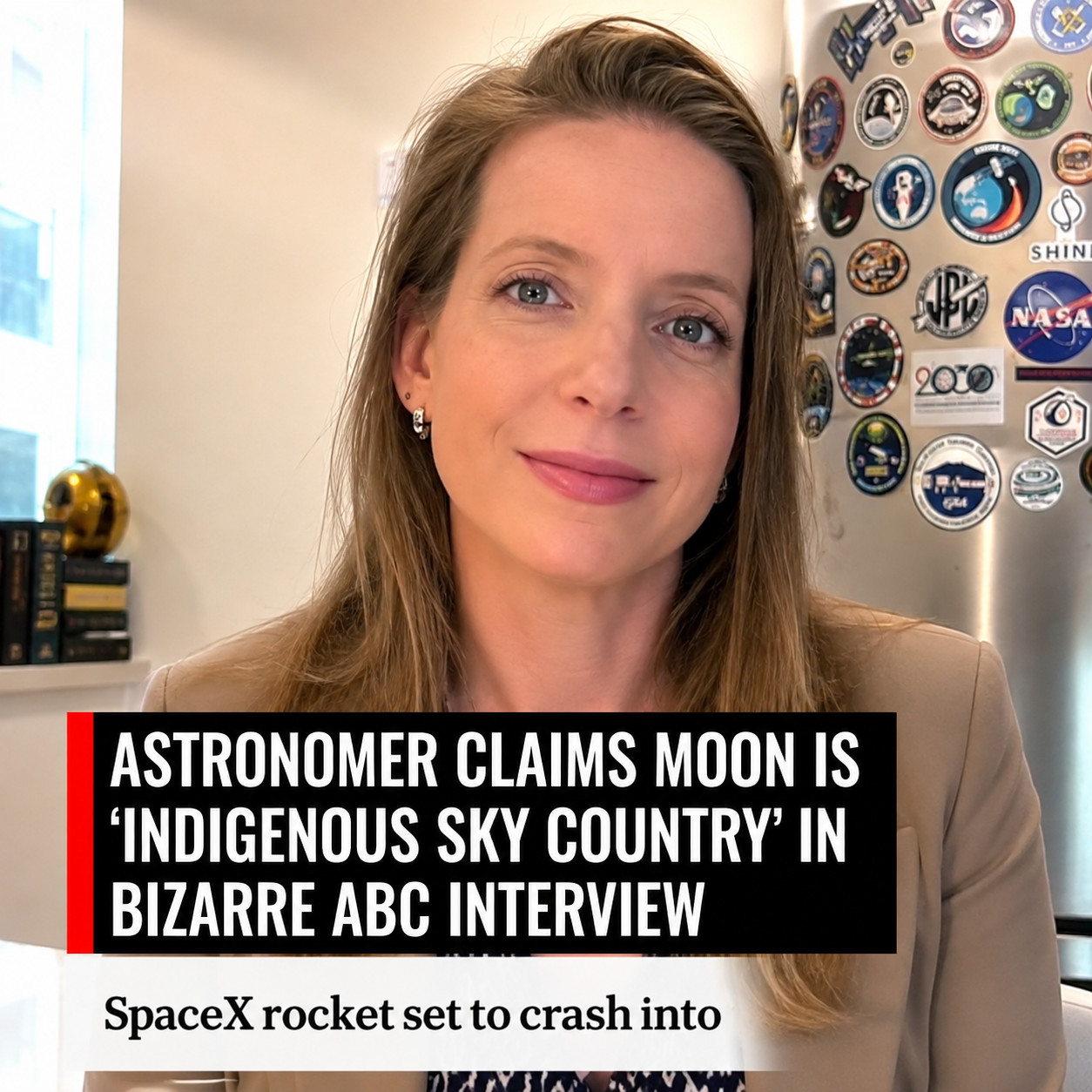
The comments were made by Dr Rebecca Allen, Co-Director of the Space Technology and Industry Institute at Swinburne University of Technology, during an ABC News segment examining a SpaceX rocket stage that is expected to strike the lunar surface at high speed, creating a sizeable impact crater.
During the interview, Dr Allen was asked whether Australians should be concerned about the predicted collision or whether the greater issue was the accumulation of space debris around Earth.
Rather than focusing solely on the technical aspects of the impact, she broadened the discussion to include cultural considerations.
“The moon is something that has fascinated us and is deeply rooted to Indigenous sky country and storytelling, and so we want to respect the fact that this is not just something for us to go and explore, as amazing as that is,” Dr Allen said during the interview.
She continued by arguing that responsible exploration of space should involve both scientific ambition and careful consideration of broader ethical and cultural questions.
“I think it’s actually a big focus for global space regulation as well as understanding Australia’s growing role in space exploration and how we continue to be responsible while pushing the boundaries and enabling new economic opportunities, innovation and inspiration,” she said.
“But we’ve got to be doing it in the right way, so this is a huge topic of conversation now for us globally.”
The interview quickly attracted attention online, with supporters arguing that Dr Allen was highlighting the importance of respecting Indigenous perspectives alongside scientific advancement, while critics questioned whether references to Indigenous cultural concepts were relevant to a discussion about a spacecraft striking the Moon.
The SpaceX object at the centre of the discussion is expected to impact the lunar surface after spending years in space following an earlier mission. Scientists have estimated the collision could occur at approximately 8,700 kilometres per hour, producing a crater roughly 27 metres wide and around five metres deep. Because the Moon has virtually no atmosphere, impacts of this nature leave long-lasting marks on its surface.
Although the impact itself is not expected to pose any danger to people on Earth, it has renewed discussion among scientists and policymakers about the growing amount of human-made material in space.
Space debris has become an increasingly significant issue as governments and private companies launch thousands of satellites and undertake more ambitious missions beyond Earth’s orbit. International agencies have repeatedly warned that uncontrolled debris can threaten spacecraft, satellites and future exploration missions if not managed responsibly.
Dr Allen’s comments linked that broader debate with Australia’s developing role in the global space sector.
Australia has invested heavily in expanding its space industry over recent years through research partnerships, commercial launches and increased cooperation with international agencies. Universities, private companies and the Australian Space Agency have all promoted the country’s growing capabilities in satellite technology, advanced manufacturing and deep-space missions.
Alongside those technological ambitions, Australian research institutions have also increasingly explored ways of incorporating Indigenous knowledge into environmental management, astronomy and space policy.
One example cited during the debate is an Australian Research Council grant awarded to the University of Newcastle to investigate how Aboriginal and Torres Strait Islander knowledge could contribute to Australian space policy.
The project received more than $528,000 in funding and aims to develop what the university describes as culturally respectful and environmentally responsible approaches to future space exploration.
According to the university, the research draws upon songlines, creation stories and long-standing cultural relationships between Indigenous Australians and the night sky in an effort to develop intercultural guidelines that may inform public education, industry practice and future policy development.
The project states that recognising long-held Indigenous knowledge systems could broaden Australia’s understanding of humanity’s relationship with space while contributing to more sustainable exploration beyond Earth.
The concept of “sky country” has become increasingly visible in academic and government discussions over recent years.
Within many Aboriginal and Torres Strait Islander cultures, celestial objects, constellations and the movement of the night sky form part of extensive cultural knowledge that has been passed between generations through oral traditions, navigation, seasonal calendars and creation stories.
Researchers involved in Indigenous astronomy argue that these knowledge systems represent sophisticated observations developed over thousands of years and deserve recognition alongside contemporary scientific understanding.
Critics, however, argue that cultural considerations should not influence scientific assessments or public policy relating to space exploration unless they have a direct operational or legal relevance.
The debate has surfaced previously in other areas of public administration.
Last year, criticism emerged after a senior official with the Office of the eSafety Commissioner began a podcast by acknowledging the traditional custodians of the “lands and airways” on which the broadcast was taking place, prompting discussion over how acknowledgement protocols should apply in different settings.
Supporters of expanded acknowledgements argued they reflected evolving cultural practices and demonstrated respect for Indigenous communities, while opponents questioned whether extending acknowledgements beyond land to concepts such as airways or outer space risked diminishing their intended meaning.
The latest ABC interview has therefore become part of a broader national conversation about the intersection of Indigenous knowledge, public institutions and scientific research.
It also highlights the growing complexity of modern space policy.
As more countries and private companies pursue lunar exploration, asteroid mining and commercial activities beyond Earth, governments are increasingly confronted with questions that extend beyond engineering and economics.
International discussions now encompass issues including environmental protection, sustainable exploration, ownership of extraterrestrial resources, heritage preservation and the ethical management of space activities.
Existing international law, including the 1967 Outer Space Treaty, establishes that outer space is the province of all humankind and prohibits national sovereignty over celestial bodies, while encouraging peaceful exploration and international cooperation. However, many practical questions surrounding commercial activity on the Moon remain the subject of ongoing international debate.
Australia has sought to position itself as an active participant in those conversations through its growing domestic space industry and its collaboration with international partners.
For Dr Allen, the discussion surrounding the SpaceX impact provided an opportunity to emphasise that future exploration should balance scientific progress, economic opportunity and responsible stewardship.
Whether references to Indigenous sky country belong in discussions about lunar exploration has become the principal point of public disagreement following the interview.
Supporters view the comments as an acknowledgement that space exploration can incorporate diverse cultural perspectives while remaining grounded in science.
Critics contend that questions about spacecraft impacts, orbital debris and lunar missions should primarily be addressed through scientific evidence and international regulatory frameworks rather than cultural considerations.
The ABC interview has consequently generated discussion extending well beyond the expected lunar impact itself, illustrating how Australia’s expanding role in space exploration is increasingly intersecting with wider debates about culture, policy, ethics and national identity.