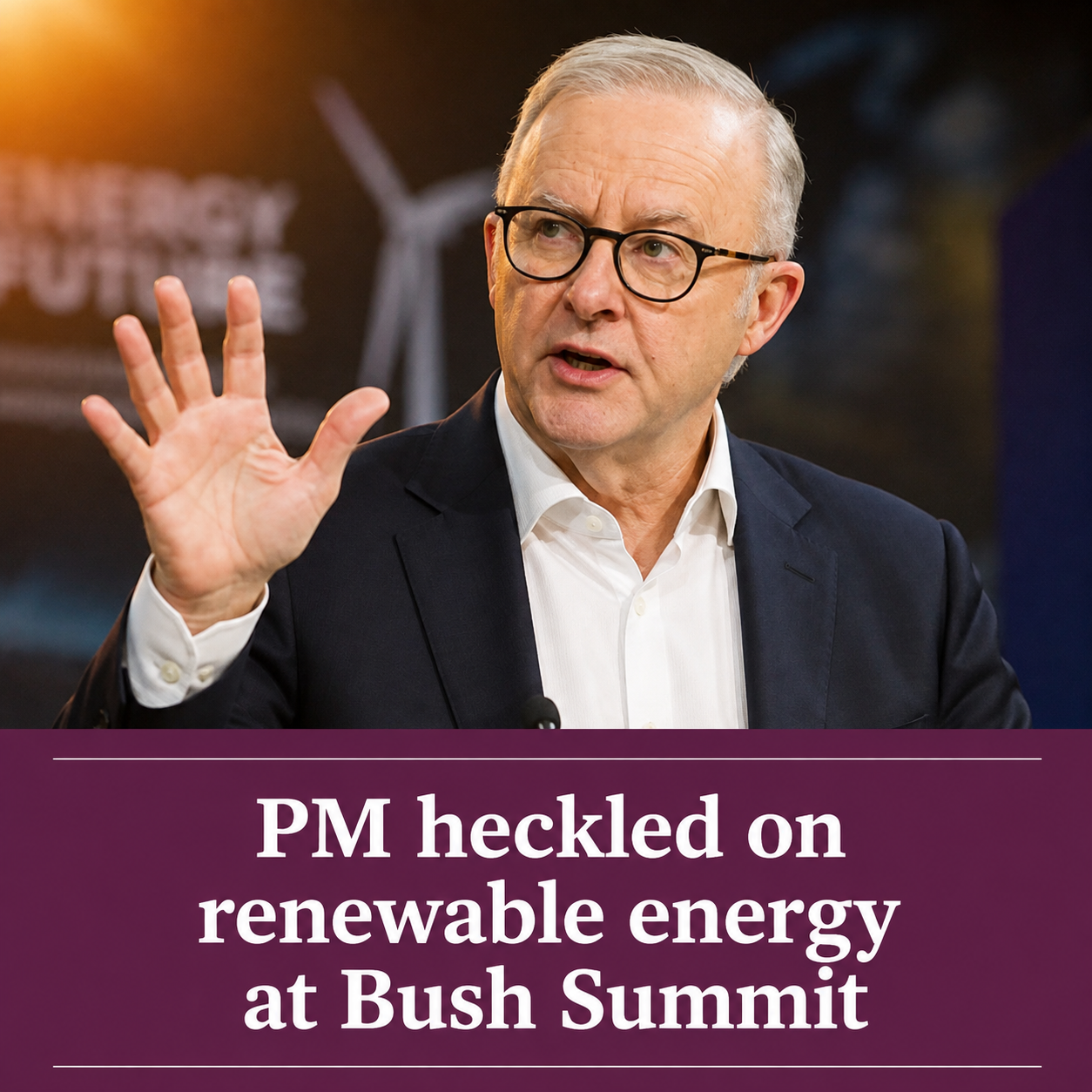
Prime Minister Anthony Albanese has faced laughter and heckling from a frustrated regional audience as renewable energy, migration and red tape erupted into political flashpoints at the 2026 National Bush Summit in Dubbo — while Pauline Hanson and Nationals leader Matt Canavan clashed over whether Australia’s conservative forces should work together against Labor.
The gathering brought some of Australia’s most senior political figures into the same room on Thursday as regional communities demanded answers over energy projects, agricultural land, migration, housing, business regulation and the mounting pressure on country infrastructure.
For Albanese, the reception demonstrated the political difficulty confronting Labor as it attempts to carry its renewable energy transition through communities where much of the new infrastructure must actually be built.
For Hanson, Canavan and Opposition Leader Angus Taylor, it provided an opportunity to argue that regional frustration is becoming a major threat to the government.
Albanese faces hostile reaction over renewables
Albanese was confronted over the impact of large renewable energy developments on regional communities, including concerns about consultation and the ability of local residents to influence projects being constructed around them.
Asked what his message was to people whose livelihoods were being disrupted by renewable developments, the Prime Minister acknowledged that governments and developers needed to improve their approach.
“We need to do better than that,” Albanese said, prompting laughter from parts of the audience.
He argued that major projects needed community acceptance rather than simply being imposed without adequate engagement.
“You need social licence in order to operate. There needs to be much better community consultation and engagement on all of those issues,” he said.
The response did not completely settle the room.
Reporting from the summit described Albanese as being heckled twice as he faced questions over renewable energy and efforts to reduce regulatory burdens on businesses operating in regional Australia.
The exchange highlighted one of the most difficult parts of the energy transition for the government: while renewable generation is central to Labor’s national energy policy, many of the transmission lines, solar developments and other infrastructure required to deliver it are concentrated in regional communities.
Dubbo business owner puts renewable rollout under spotlight
The questioning was given a local dimension through the experience of Dubbo business owner Robyn Hicks, whose rural property is expected to be surrounded on three sides by a major solar development.
Her circumstances became an example of the broader argument about whether regional Australians are carrying a disproportionate share of the physical consequences of the energy transition.
Albanese maintained that better consultation and genuine social licence were essential.
But the audience reaction illustrated the gap that remains between the government’s national energy objectives and sections of regional Australia that believe consultation has come too late or has not given communities sufficient influence over projects.
Hanson tells conservatives: Labor-Greens is the enemy
While Albanese faced pressure from the audience, another political fight was developing on stage between Pauline Hanson and Matt Canavan.
The One Nation leader used the summit to call for greater co-operation across the conservative side of Australian politics.
“Our enemy now, and I’m telling you, who’s ruining this country is the Labor-Greens,” Hanson said.
“That’s why we, as the conservative side, have to start working together.”
The comments come at an increasingly complicated moment for the Australian right.
One Nation has been seeking to translate its rising support into greater parliamentary representation, while the Coalition is attempting to rebuild its own electoral coalition under Taylor and Canavan.
The question confronting both camps is whether that produces co-operation against Labor or a competition for the same conservative voters.
‘Stop knocking me’: Hanson hits back at Canavan
The tension became personal when Hanson accused Canavan of treating her and One Nation as politically irrelevant.
“Stop knocking me,” she told him.
Hanson said she was frustrated by suggestions that she had little to contribute to the national political debate.
“It just annoys me, you know, to make me as if I’m irrelevant in this, as if I’ve got nothing to offer politics,” she said.
She pointed to One Nation’s longstanding opposition to net zero as evidence that her party had adopted positions before the Coalition was prepared to embrace them.
Canavan did not accept Hanson’s argument that the political priority should be managing the relationship between the Nationals and One Nation.
“I’m not worried about One Nation, I’m worried about Australia,” he said.
He instead argued that Australia needed to confront the extraordinary concentration of its population in a handful of metropolitan centres and develop more of the country outside the five biggest cities.
Barnaby Joyce departure adds another layer to conservative fight
The argument also reopened tensions surrounding Barnaby Joyce and his departure from the Nationals.
Canavan expressed disappointment about Joyce leaving his former party, while Hanson defended her One Nation colleague and rejected the suggestion that his decision could be reduced to a single disagreement.
Joyce had appeared at the Bush Summit a day earlier, answering questions about drought preparedness and regional policy.
His political move has complicated relations between the Nationals and One Nation because it gave Hanson’s party one of rural Australia’s most recognisable political figures while simultaneously weakening the Nationals’ claim to be the uncontested political voice of the bush.
That rivalry was plainly visible in Dubbo.
Migration becomes another battleground
Migration also emerged as one of the summit’s central disputes.
Albanese was asked whether Labor’s forthcoming changes to the migration system were being driven by One Nation’s rise.
The Prime Minister rejected that suggestion.
He acknowledged the current increase in support for One Nation but said the government had begun reducing migration numbers before that political surge.
“There is a current spike in the support for One Nation, quite clearly,” Albanese said.
“But we’ve responded. We started lowering the numbers well before that occurred because we recognise that we want to get that right to assist the Australian economy.”
The debate is particularly complicated in regional Australia because country businesses can simultaneously face pressure from rapid population growth and depend heavily on overseas workers.
Industries including agriculture, meat processing, tourism and aged care have warned that blunt reductions could leave regional employers unable to fill essential positions.
Hanson clarifies One Nation’s migration position
Hanson was also forced to revisit One Nation’s migration policy following confusion over the party’s proposed net overseas migration target.
She argued that programs such as the Pacific Australia Labour Mobility scheme should remain available because they provide essential workers for regional industries.
That distinction has become politically important after One Nation MP David Farley suggested the party’s headline migration figure did not include some categories of temporary workers.
Hanson maintained that One Nation still wants dramatically lower migration while preserving programs that provide labour to sectors with genuine shortages.
The exchange demonstrated why migration is likely to remain a difficult issue for every major political force: cutting headline numbers is considerably simpler than deciding which industries, visa categories and communities should bear those reductions.
Malinauskas says Australia has a housing crisis
South Australian Premier Peter Malinauskas pushed back against calls for sweeping migration reductions.
His argument was that Australia fundamentally has a housing supply problem rather than simply a migration problem.
Malinauskas warned that an ageing workforce means employers need younger workers and that migration remains essential to filling shortages in important sectors.
NSW Premier Chris Minns took a different position, arguing that migration at current levels was placing significant pressure on housing, infrastructure and services.
The disagreement demonstrated that migration is no longer dividing Australia only along traditional party lines.
Labor premiers themselves are confronting different economic and demographic pressures depending on their states.
Angus Taylor turns fire on Rushy Lagoon deal
Opposition Leader Angus Taylor used his appearance to intensify the Coalition’s campaign against using productive agricultural land for carbon projects.
At the centre of his attack was Rushy Lagoon, the enormous Tasmanian agricultural property whose sale has become a national political controversy.
The Clean Energy Finance Corporation committed $69 million to an investment vehicle involved in acquiring the property, with plans including extensive forestry plantings intended to generate timber and carbon credits.
Taylor described the conversion of productive agricultural country as a “disgrace”.
He promised the approach would not continue under a Coalition government.
“We need to use every bit of productive agricultural land we can in this country for growing food and fibre,” Taylor said.
Coalition moves to stop taxpayer-backed farm conversions
The Coalition is now moving beyond political criticism of Rushy Lagoon and towards legislation.
Taylor is backing a proposal to prevent the Clean Energy Finance Corporation from financing farm purchases for conversion into carbon farming and forestry projects.
The Rushy Lagoon transaction involved roughly 22,000 hectares of Tasmanian land traditionally used for livestock production.
The investment structure plans to plant millions of radiata pine trees, while supporters of the project argue forestry, carbon markets and agricultural production can coexist.
Critics counter that government-backed capital can distort rural land markets by allowing institutional investors to compete against farming families with access to taxpayer-supported finance.
The National Farmers’ Federation has also raised concerns about whether government financing arrangements could distort competition for agricultural property.
Taylor challenged over One Nation’s rise
Taylor was then confronted with the political problem sitting behind much of the day’s debate: One Nation’s increasing competition with the Coalition for regional and conservative voters.
Asked to identify policies the Coalition would deliver that One Nation either could not or would not, Taylor responded with four priorities.
He said a Coalition government would reverse Labor tax changes, reduce energy costs, tie permanent migration levels more closely to housing capacity and restrict some welfare programs, including the NDIS, to Australian citizens.
The answer amounted to an attempt to draw a dividing line between the Coalition and Hanson while simultaneously competing on many of the same issues driving One Nation’s support.
Regional Australia becomes the political battlefield
The broader message emerging from Dubbo was that regional Australia is becoming one of the most fiercely contested parts of the national political landscape.
Energy projects are colliding with land-use concerns. Migration policy is colliding with severe labour shortages. Carbon reduction policies are colliding with food-security arguments. Governments are promising infrastructure while regional communities continue to complain about roads, housing and essential services.
Those tensions help explain why Albanese faced such an unforgiving reception when the conversation turned to renewables and regulation.
They also explain the increasingly aggressive competition between One Nation and the Coalition.
Canavan wants the Nationals to rebuild their authority in the bush. Hanson believes One Nation deserves recognition as a major conservative political force. Taylor needs to demonstrate that the Coalition can turn regional dissatisfaction into a credible alternative government.
Labor, meanwhile, must convince voters that its energy and migration policies can work without forcing regional communities to absorb unacceptable costs.
Hanson’s unity call exposes a bigger problem for the right
Hanson’s appeal for conservatives to work together therefore contained an obvious contradiction exposed almost immediately by her argument with Canavan.
The parties may share opposition to Labor on net zero, energy costs, migration and aspects of agricultural policy, but they are also competing intensely for many of the same voters.
That competition is particularly acute in regional Australia, where One Nation is attempting to position itself as an alternative not only to Labor but to the traditional Liberal-National structure.
Canavan’s response — that he was worried about Australia rather than One Nation — made clear that the Nationals are not prepared simply to concede that territory.
Yet Hanson’s message was equally unmistakable: she does not intend to allow the Coalition to dismiss her party while simultaneously adopting positions One Nation says it championed first.
Dubbo delivers warning to every major political camp
The Bush Summit was designed to put regional Australia at the centre of the national conversation, and Thursday’s confrontations demonstrated just how politically volatile that conversation has become.
Albanese heard directly the frustration surrounding renewable infrastructure and regulation.
Hanson and Canavan exposed the unresolved struggle for leadership of conservative regional politics.
Taylor sought to transform anger over agricultural land and carbon farming into a broader attack on Labor’s economic and climate agenda.
And state leaders revealed deep disagreements over whether migration is itself the problem or whether Australia has simply failed to build enough housing and infrastructure to accommodate population growth.
If there was one common message from Dubbo, it was that regional voters are no longer prepared to be treated simply as spectators to decisions made in the capitals. With energy, migration, farmland and cost-of-living pressures converging, the political battle for the bush is intensifying — and Thursday’s hostile exchanges suggest neither Labor, the Coalition nor One Nation can take those voters for granted.






