Australia’s national broadcaster ABC has found itself at the centre of a fierce political and social media debate after publishing a report arguing that climate change is becoming an increasingly significant driver of child marriage across parts of Asia and the Pacific.
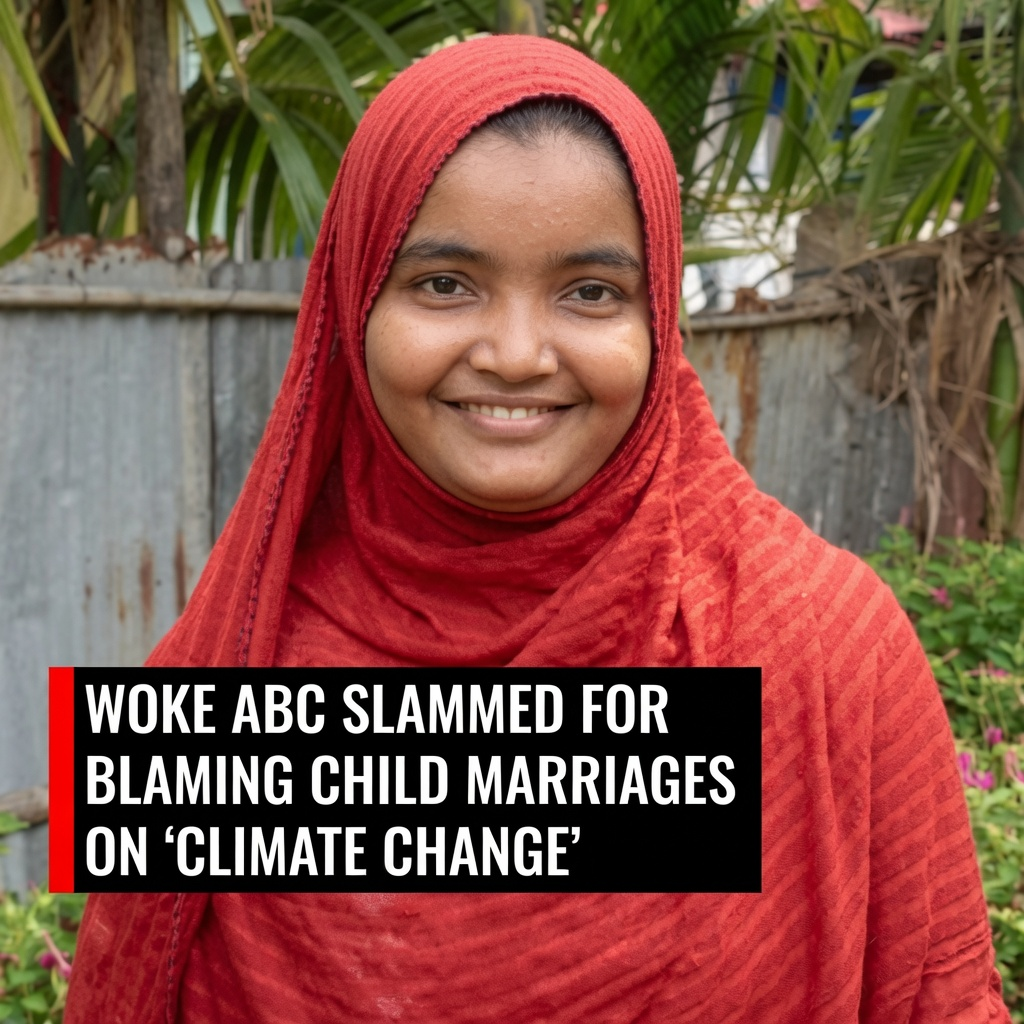
The article, published by ABC News, cited humanitarian organisations including Plan International and the International Rescue Committee, which argue that worsening natural disasters can increase financial hardship for vulnerable families and, in some cases, contribute to higher rates of child marriage.
However, the report immediately generated strong criticism from conservative commentators, former politicians and many Australians on social media, who accused the publicly funded broadcaster of downplaying longstanding cultural and societal causes of child marriage while placing excessive emphasis on climate change.
The ABC story was headlined “Climate change becoming a major driver of child marriage across Asia and the Pacific” and centred on examples from Bangladesh, where aid organisations say severe cyclones and flooding have pushed already impoverished families further into financial crisis.
According to the report, humanitarian groups argue that natural disasters can destroy homes, livestock and livelihoods, leaving some families believing they have little option but to marry off daughters at an early age in an attempt to reduce financial pressure.
The article also referenced figures from the International Rescue Committee suggesting child marriages may rise significantly following major natural disasters in Bangladesh, while noting that scientists expect climate change to increase the severity of some extreme weather events, including heavy rainfall and tropical cyclones.
Plan International representatives interviewed by the ABC also expressed concern that forecasts for a stronger El Niño pattern during 2026 could worsen humanitarian conditions across parts of the Asia-Pacific and increase risks facing vulnerable girls.
Those organisations have called for child protection measures to become a greater component of climate resilience and disaster recovery programs, arguing that humanitarian responses should address both immediate relief and longer-term social risks.
Despite those arguments, critics said the article framed climate change as the primary explanation for a practice that has existed for centuries in some regions.
Former Liberal MP Craig Kelly was among the most outspoken critics.
Posting on social media, Kelly argued the ABC had ignored what he described as the longstanding cultural and religious drivers behind child marriage in several countries.
He wrote that taxpayers should not be funding what he characterised as propaganda and argued the broadcaster should more directly address the historical prevalence of child marriage.
Former Liberal Democrats senator David Leyonhjelm also mocked the article, writing sarcastically that there “were no child marriages before they discovered carbon dioxide.”
Other social media users similarly accused the broadcaster of removing responsibility from individuals and communities by attributing harmful practices to broader environmental factors.
The criticism reflects an increasingly polarised debate in Australia over both climate reporting and the role of the ABC as the country’s publicly funded broadcaster.
Supporters of the ABC article, however, argue that many critics are attacking a position the report itself does not explicitly take.
The article does not claim climate change created child marriage or that it is the only cause. Rather, it reports the view of humanitarian organisations that worsening climate-related disasters can act as an additional risk factor in communities where child marriage already exists.
That distinction is important because researchers have long identified multiple drivers behind child marriage, including poverty, limited access to education, gender inequality, social norms, conflict, humanitarian crises and weak legal enforcement.
International organisations including UNICEF, UNFPA and Plan International have for years argued that economic shocks—including those caused by natural disasters—can increase the likelihood of vulnerable families resorting to child marriage as a coping mechanism.
Bangladesh is frequently cited in international research because it has one of the world’s highest rates of child marriage despite government efforts to reduce the practice.
The country is also highly vulnerable to cyclones, flooding and coastal erosion, with millions of people living in low-lying areas exposed to repeated natural disasters.
Researchers studying child marriage generally describe these disasters as factors that can intensify existing vulnerabilities rather than replace the deeper cultural, economic or legal reasons behind the practice.
Plan International has previously published research identifying a broad range of drivers for child, early and forced marriage across Asia-Pacific. These include poverty, entrenched gender inequality, limited educational opportunities, traditional social attitudes, inadequate legal enforcement and humanitarian crises. Climate-related disasters are discussed as one factor capable of worsening those existing conditions rather than a standalone cause.
The debate also illustrates how climate change has become increasingly intertwined with broader political arguments.
In Australia, climate reporting regularly attracts criticism from commentators who believe environmental issues receive disproportionate attention or are used to explain unrelated social problems.
Conversely, many humanitarian organisations argue climate change should be considered alongside economic development, public health, migration and human rights because environmental shocks can amplify existing vulnerabilities in poorer communities.
For journalists, the challenge is often how to communicate complex causal relationships without giving readers the impression that one factor alone explains longstanding social problems.
In this case, critics interpreted the ABC headline as implying climate change was responsible for child marriage itself, while supporters contend the story simply reported humanitarian evidence that worsening natural disasters can increase risks where child marriage is already present.
The controversy has also renewed discussion about editorial standards at the ABC.
As Australia’s national broadcaster, the ABC is funded by taxpayers but operates under statutory editorial independence. Nevertheless, its reporting is frequently scrutinised by politicians from across the political spectrum, particularly on issues involving climate policy, Indigenous affairs and social justice.
Whether the broadcaster’s wording fairly reflected the available evidence will likely remain contested.
What is less disputed is that child marriage remains a significant human rights issue across parts of South Asia and other developing regions. International agencies estimate that hundreds of millions of women worldwide were married before turning 18, with poverty, conflict, displacement, gender inequality and limited educational opportunities consistently identified among the principal underlying drivers.
The ABC article has therefore become about more than climate science alone. It has evolved into another flashpoint in Australia’s wider debate over media impartiality, public broadcasting and the language used to explain complex international social issues.






