It was supposed to be another ordinary morning at one of Sydney’s best-known beaches.
Families were gathering on the sand.
Swimmers were already in the water.
Surf lifesavers watched over the shoreline as they always do.
Then, in a matter of seconds, everything changed.
What began as a routine ocean swim became a desperate rescue that has since captured the attention of people across Australia.
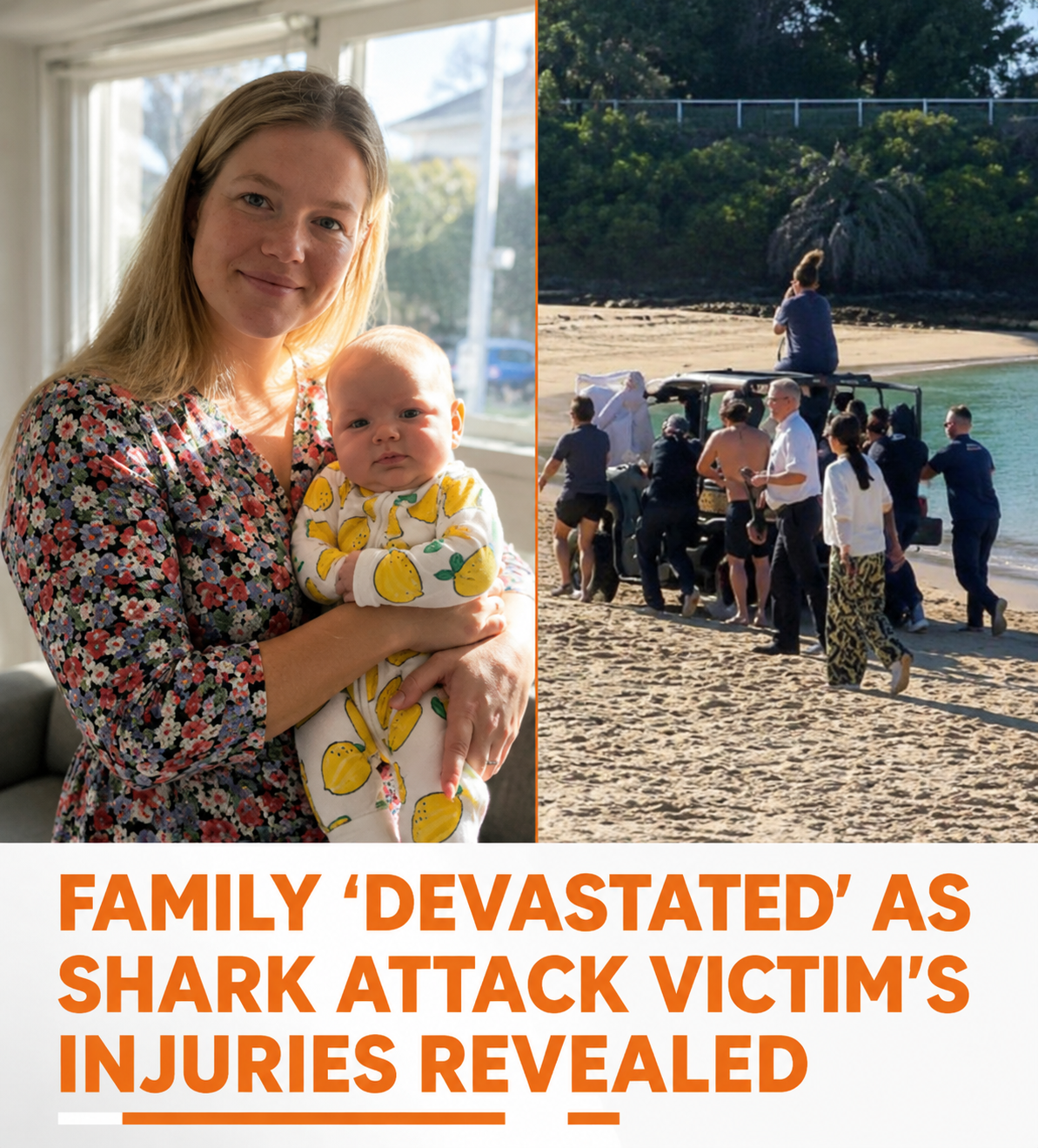
The woman at the centre of the incident has since been identified as 35-year-old Leah Stewart, a primary school teacher, experienced ocean swimmer and mother of an 18-month-old daughter.
According to authorities, Stewart was swimming about 30 metres offshore between the red-and-yellow flags at Coogee Beach shortly before 11am on Saturday when she was attacked by what experts believe was a great white shark.
Off-duty lifesaver Charlie Verco, who was training nearby on a rescue board, quickly reached Stewart after hearing cries for help.
He helped bring her back to shore, where surf lifesavers, paramedics and a critical care doctor immediately began emergency treatment to control catastrophic blood loss before she was transported to St Vincent’s Hospital.
Doctors later confirmed Stewart had suffered multiple life-threatening injuries.
Her left arm could not be saved, while serious injuries to her remaining arm and leg required several major operations.
Although her condition was initially critical, her family has since reported encouraging signs of progress as she begins what is expected to be a lengthy rehabilitation.
As news of the attack spread, Australians responded with an extraordinary outpouring of support.
A fundraising campaign established by family members quickly attracted hundreds of thousands of dollars, while messages of encouragement poured in from across the country.
Friends described Stewart as someone deeply involved in her local community, passionate about education and committed to charitable causes, including long-distance fundraising swims supporting breast cancer research.
The incident has also renewed discussion about beach safety in New South Wales.
Following the attack, authorities temporarily closed several eastern Sydney beaches while marine experts monitored shark activity.
The NSW Government also announced plans to expand shark surveillance, including greater use of drone technology after emergency exemptions allowed drones to operate over Coogee despite previous flight restrictions.
Marine scientists have stressed that shark attacks remain extremely rare despite the intense public attention they receive.
Researchers believe the animal involved was most likely a great white shark, a protected species that occasionally travels close to Australia’s coastline.
Experts also note that people are not natural prey for sharks and that most incidents are believed to result from mistaken identity or exploratory bites rather than deliberate hunting behaviour.
That scientific perspective, however, offers little comfort to families whose lives are changed forever by such encounters.
For Stewart’s relatives, the past two weeks have been defined by hospital visits, surgeries and the uncertainty that follows major trauma.
One of the most emotional moments came when she was reunited with her young daughter after beginning to recover in hospital, giving her family renewed hope for the long rehabilitation ahead.
The story has resonated far beyond Sydney because it reflects both the beauty and unpredictability of Australia’s coastline.
Millions of Australians swim, surf and enjoy the ocean every year with no incident.
Yet rare events like this remind communities of the importance of surf lifesavers, emergency responders and ongoing investment in shark detection technologies.
As Stewart continues her recovery, support from strangers has become one of the defining parts of the story.
While her injuries will have lifelong consequences, her family’s updates have increasingly focused on determination rather than despair.
For many Australians following the case, what began as a shocking shark attack has evolved into something else entirely.
It has become a story about resilience, community and the remarkable efforts of the people who refused to give up when every second mattered.






