Prime Minister Anthony Albanese has found himself at the centre of a fresh political storm after a series of prank signs accusing him of telling “50 lies” appeared throughout the affluent Sydney suburb where he owns a $4.3 million property.
The signs, which quickly spread across social media, have become the latest symbol of growing frustration among critics who accuse the Prime Minister of breaking key election promises.
Rather than appearing outside Parliament House or at a political rally, the campaign was directed at Albanese’s own neighbourhood, giving the protest an unusually personal edge.
For supporters of the stunt, that was precisely the point.
They wanted to ensure the Prime Minister could not ignore the message.
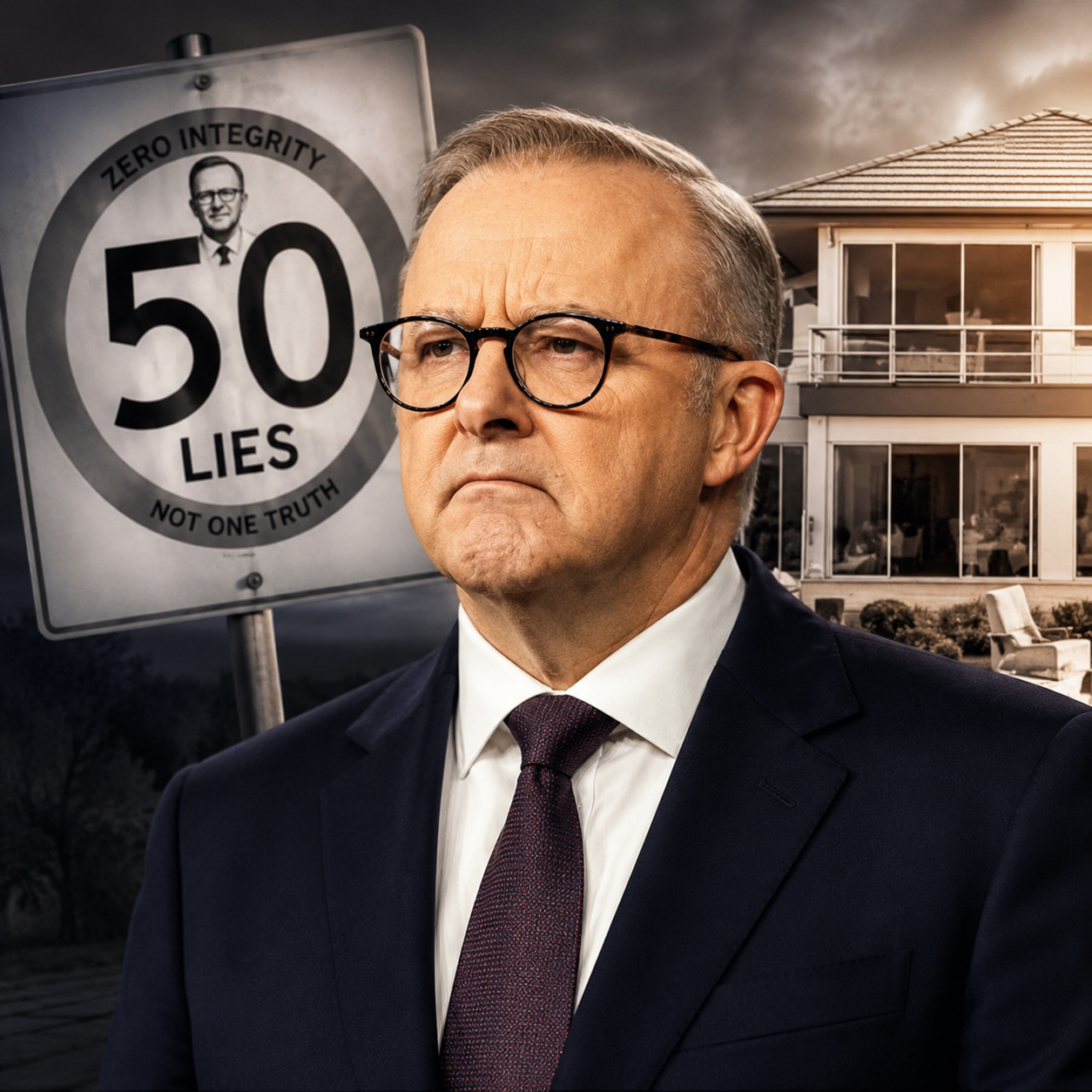
The signs appeared amid a fierce national debate over the Albanese Government’s tax reforms and broader economic agenda.
In recent weeks, critics have repeatedly accused Labor of abandoning commitments made before the election, particularly around negative gearing and capital gains tax policies.
Those accusations have become one of the most damaging political challenges facing the Prime Minister.
Opponents argue Australians were promised one thing before the election and delivered something very different afterwards.
The government rejects claims that voters were deliberately misled.
Albanese has argued that changing circumstances required policy adjustments and that the reforms are necessary to improve housing affordability and create what Labor describes as greater intergenerational fairness.
Nevertheless, the criticism has not disappeared.
If anything, it has intensified.
The appearance of the “50 Lies” signs reflects a broader political narrative that has been building since the federal budget.
Conservative commentators, opposition figures and some former Labor supporters have all questioned whether the government can maintain public trust after reversing positions on several high-profile issues.
What makes this campaign different is its location.
By targeting the suburb where Albanese owns his multimillion-dollar cliffside property, organisers shifted attention away from Canberra and directly into the Prime Minister’s local community.
That decision has generated significant online discussion.
Many social media users shared photographs of the signs, helping the story spread well beyond Sydney.
For critics, the imagery is politically powerful.
They argue it highlights what they see as a growing disconnect between ordinary Australians struggling with rising living costs and political leaders living in some of the country’s most expensive suburbs.
The issue of housing has become particularly sensitive.
Australia’s housing affordability crisis remains one of the biggest concerns for voters.
Mortgage costs, rents and property prices continue to dominate public debate.
Against that backdrop, any controversy involving politicians and expensive property holdings tends to attract attention.
Supporters of Albanese argue the criticism is unfair.
They point out that politicians are entitled to purchase homes like any other Australian and say personal property ownership should not be confused with government policy.
Others argue that the focus should remain on whether policies are working rather than where political leaders live.
Even so, the symbolism has proven difficult to ignore.
The signs appeared at a time when Labor is already facing questions about credibility.
Recent political commentary has focused heavily on accusations of broken promises and whether those issues could damage the government’s standing with voters.
Several commentators have suggested the government underestimated the backlash that would follow changes to previously stated positions.
That backlash has been amplified by social media, where short videos and photographs often spread far faster than detailed policy explanations.
The “50 Lies” campaign appears to have benefited from exactly that dynamic.
A simple message displayed on highly visible signs was enough to trigger national discussion.
Political opponents quickly seized on the story as evidence that public frustration is continuing to grow.
Some pointed to recent polling showing increasing support for minor parties and protest movements as a sign that traditional political loyalties are weakening.
Others argued that voters are becoming increasingly sceptical of promises made during election campaigns.
For Albanese, the challenge is not simply responding to a handful of signs.
The larger issue is whether accusations about trust and credibility continue gaining traction.
History shows that perceptions of broken promises can become politically damaging if they remain unresolved.
Australian politics is filled with examples of leaders who struggled to recover once voters concluded they had failed to keep their word.
That reality explains why the government has worked hard to defend its economic reforms and explain why policy positions have changed.
The Prime Minister insists the decisions were made in response to changing economic conditions and are aimed at helping future generations achieve home ownership.
Whether voters accept that explanation remains an open question.
What is clear is that the “50 Lies” signs have struck a nerve.
By combining concerns about broken promises, housing affordability and political trust into a single image, the campaign has managed to capture attention across the country.
For now, the signs themselves may eventually disappear.
But the debate they have reignited about trust, credibility and election promises appears far less likely to fade anytime soon.