A former Sydney childcare worker has been publicly identified as the man accused of committing hundreds of child abuse offences involving 136 children over 16 years, as federal police race to identify another 22 children allegedly depicted in material seized during one of Australia’s most confronting child exploitation investigations.
Hamish Alexander Edward Tait, 35, is facing 329 charges following an Australian Federal Police investigation that has involved the forensic examination of about 2.4 million electronic files, 12 search warrants and an extensive effort to identify children allegedly depicted in child abuse material.
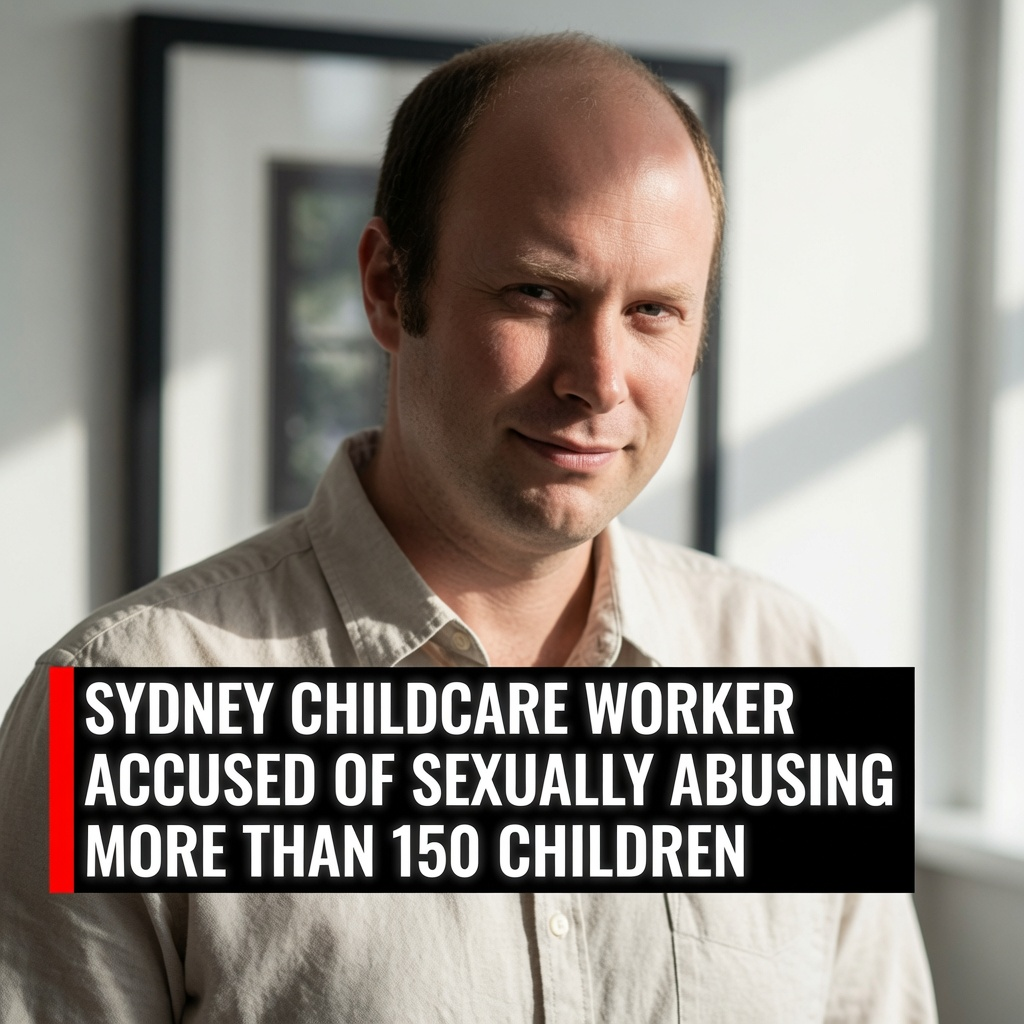
A court order that had prevented publication of Tait’s identity was lifted on Monday, allowing police to name him and publicly release his extensive history of working at or attending early childhood education facilities.
The AFP says it has positively identified 136 alleged victims and contacted 121 families in Australia and overseas.
Investigators are still trying to identify 22 other children.
The allegations have not been proven in court. Tait has been remanded in custody since July 2025 and has not applied for bail.
But the sheer scale of the police investigation is already forcing a deeply uncomfortable question for Australia’s childcare system.
How could one worker move through dozens of early learning environments over 16 years while allegedly accumulating material now linked by police to more than 100 children?
That question cannot be answered simply by publishing a list of childcare centres.
The AFP has stressed that Tait worked at or attended 62 early childhood education facilities, predominantly in Sydney’s north-west. Police do not allege offending occurred at every one of those locations.
Five locations have been specifically identified by police as places where alleged offending occurred: Fit Kidz Learning Centre Box Hill, Fit Kidz Learning Centre Putney, Fit Kidz Learning Centre Rouse Hill, Fit Kidz Learning Centre Warrawee and Wild Earthlings Glenorie.
The distinction is critical.
Inclusion on the AFP’s broader work history list does not mean a childcare centre, its management or other staff are accused of wrongdoing. The list has been released because investigators need families to consider whether their children may have had contact with Tait and whether they recognise information that could assist Operation Moonbi.
The investigation began with a single report about an online file.
In June 2025, the AFP received information from the US-based National Center for Missing and Exploited Children about an online user allegedly uploading a file depicting child abuse.
Federal investigators linked Tait to the alleged online activity.
On June 20, 2025, police executed a search warrant at his home in Glossodia, in Sydney’s north-west.
Electronic devices were seized and subjected to forensic analysis.
According to the AFP, investigators identified a large volume of child abuse material on the devices.
The examination eventually expanded to approximately 2.4 million electronic files.
Tait was initially charged in July 2025 with eight alleged online child abuse material offences. As investigators continued analysing the devices and identifying children, further charges followed in April, June and July this year.
He now faces 329 charges.
They include 162 counts of producing child abuse material and 81 counts of filming a person engaged in a private act without consent.
He is also charged with 24 counts of using a child under 14 for the production of child abuse material.
Other allegations include sexual touching of children under 10, filming private parts without consent and using a carriage service to make child abuse material available.
Police allege the offending occurred between 2009 and 2025.
AFP Acting Commander Luke Needham described the alleged scale as confronting and horrific.
“The AFP has been in contact with 121 families, based around Australia and internationally, who we have positively identified their child as being depicted in child abuse material,” he said.
“As a result of our comprehensive investigation and extensive victim identification process, we allege this matter currently involves 136 victims.”
Needham said any form of child sexual abuse was horrific, particularly where the alleged perpetrator was somebody trusted with caring for children.
“Operation Moonbi has spanned 12 months and involved the analysis of 2.4 million electronic files, 12 search warrants and countless hours trying to uncover the scale of the man’s alleged offending,” he said.
The decision to name Tait was itself the subject of a court fight.
His identity had initially been protected under a non-publication order.
The AFP originally sought suppression to protect the integrity of its investigation and allow officers to contact the families of children already identified before the accused became publicly known.
As Operation Moonbi progressed, the position changed.
Police wanted Tait’s identity and his work history made public because investigators had reached a point where community assistance could help identify the remaining children.
Tait’s legal team sought to extend the order.
Arguments were raised about potential prejudice to future criminal proceedings and the consequences of public identification for Tait and his family.
The AFP, prosecutors and media organisations opposed continuing the suppression.
On Monday, the court rejected the attempt to keep Tait’s name secret.
The judge was not persuaded that publication of his identity and workplaces would create incurable prejudice to a future jury. The court instead accepted the AFP’s argument that continued suppression risked frustrating efforts to identify potential victims.
The ruling transformed what had been a largely concealed investigation into a national public appeal.
For thousands of parents, the immediate response was to scan the list of 62 locations.
Some of the children who had contact with Tait during the earliest years covered by the investigation may now be adults.
Others are still young.
Some families are no longer in Australia.
The AFP has established a dedicated contact point and published information about Tait’s work history as investigators attempt to complete the identification process.
Among the most disturbing aspects of the case is the breadth of Tait’s access to children.
Police say he worked at or attended 62 early childhood education facilities between 2009 and 2025.
They include long day care centres, preschools, outside-school-hours services and other early childhood settings.
Tait was also connected to Wild Earthlings, a private outdoor education business.
Promotional material described Wild Earthlings as a “bush kindy service” designed to reconnect children with the natural world.
Images associated with the business showed Tait participating in outdoor activities with children, including playing the didgeridoo in bush settings.
The public image was built around nature, exploration and child development.
Police now allege offending occurred at the Wild Earthlings Glenorie location.
Four Fit Kidz centres have also been specifically marked by the AFP as alleged offending locations.
Fit Kidz has publicly apologised, saying alleged offences occurred “on our watch” and describing the situation as devastating for children, families, educators and the wider community.
The provider has also rejected claims circulating online that it participated in a cover-up, saying it had no role in the court orders that prevented publication of Tait’s identity.
Fit Kidz has introduced additional precautionary measures, including restrictions on male educators performing bathroom and toileting duties unless written parental consent has been provided.
The company has acknowledged the measure does not sit comfortably with its broader philosophy but said male staff had been stood down from those duties as a precaution.
There is no allegation that other male educators at the centres engaged in wrongdoing.
Phones previously kept at centres for taking photographs have also been removed.
The case lands at a moment when Australia’s early childhood sector is already undergoing major child safety reform.
Governments began accelerating changes in 2025 after a series of allegations and investigations exposed weaknesses in the way the early childhood education and care workforce was tracked and regulated.
From February 27 this year, a National Early Childhood Worker Register became active.
Approved providers are now required to record and maintain information about people working or volunteering in their services.
The register is intended to give regulators a clearer picture of who is working in early childhood education and care and where they are working.
That is a fundamental change in a sector where workers can move between providers, services and jurisdictions.
Mandatory national child safety training has also been introduced for people working or volunteering in services regulated under the National Quality Framework.
Foundation training is available now, with advanced modules due from the end of July.
By late June, more than 290,000 staff had completed the foundation training, according to the federal Department of Education.
The training is designed to strengthen understanding of legal child safety obligations, safeguarding practices and the detection, escalation and reporting of abuse.
The Commonwealth has described the reforms as part of a $226 million child safety package.
Other measures include a national CCTV trial, increased compliance activity and restrictions on personal devices in childcare environments.
NSW has separately pursued stronger regulatory powers, higher penalties, changes to Working With Children Check arrangements and a CCTV trial focused on safety concerns and investigations.
These reforms matter because traditional child safety screening has limits.
A Working With Children Check is an important safeguard, but it cannot function as a guarantee that a person will never harm a child.
Screening systems depend on available information. They are strongest when prior criminal, disciplinary or relevant intelligence exists and can be lawfully connected to an applicant.
They cannot replace supervision, workplace culture, reporting systems, environmental design and active regulation.
The alleged offending in Operation Moonbi highlights why safeguarding must be built around opportunity as well as identity.
Child safety systems often begin with the question: is this person suitable to work with children?
The more difficult question is: what opportunities does the organisation give any adult to be alone with a child, photograph a child, use a device near a child or move between locations without patterns of behaviour becoming visible?
Those are systems questions.
They involve who can access bathrooms and change areas.
They involve rules governing personal phones and service-owned devices.
They involve the storage and auditing of photographs.
They involve supervision arrangements and whether unusual behaviour is documented across multiple workplaces.
They involve whether regulators can see that one person has worked or volunteered at a large number of services.
They also involve whether staff feel empowered to report a concern that appears minor, ambiguous or socially uncomfortable.
A sophisticated child safety system does not rely on colleagues correctly identifying a “dangerous person” by instinct.
It assumes adults cannot reliably detect risk by personality alone and instead reduces opportunities for abuse, creates observable working practices and makes concerns easier to escalate.
That is one reason the new national worker register is significant.
It gives regulators a mechanism to identify who is working across the sector and where.
But a register is only as useful as the information recorded, the quality of regulatory analysis and the speed at which agencies act when warning signs emerge.
The same is true of CCTV.
Cameras may assist investigations and deter some conduct, but they create their own privacy, storage and monitoring questions. They are not a substitute for adequate staffing or a safeguarding culture.
Mandatory training can improve awareness, but completing an online module does not automatically create an organisation where a junior educator feels safe challenging a senior colleague.
Personal device bans can close one avenue for creating or storing material, but services must also control shared devices and understand how images of children are accessed, retained and transferred.
Operation Moonbi will now continue on two tracks.
The criminal case against Tait will proceed through the courts.
He is accused of serious offences but is entitled to the presumption of innocence. The 329 charges are allegations and will need to be tested according to law.
At the same time, AFP investigators will continue trying to identify every child allegedly depicted in the material they have examined.
For families connected to any of the 62 locations, police have urged people to use the official information released through Operation Moonbi and the AFP’s dedicated contact arrangements.
The AFP has already contacted families where a child has been positively identified.
That detail is important for parents confronting the list for the first time.
A centre appearing in Tait’s work history does not mean every child at that centre was an alleged victim. Nor does it mean police allege offending occurred at that location.
The public release is part of an identification process focused on 22 children whose identities remain unknown to investigators.
For those children and their families, identifying them may be the beginning of a profoundly difficult process.
Police say tailored support has been offered to families already contacted.
The broader early childhood sector now faces a different challenge.
Australia has already begun building a stronger safety framework. A national worker register is active. Child safety training is mandatory. CCTV trials and compliance reforms are under way.
The allegations against Tait will test whether those changes are ambitious enough and whether governments have learned the right lessons from cases involving alleged long-term access to children.
Because the scale of Operation Moonbi cannot be reduced to one accused man and one enormous criminal brief.
If police prove their allegations, the case will also represent 16 years in which an individual allegedly moved through a profession built on extraordinary trust.
Parents hand over babies, toddlers and young children to educators because modern Australia depends on the assumption that childcare environments are safe.
That trust is not optional. It is the foundation of the entire system.
The 329 charges before the courts will determine Tait’s criminal responsibility. The 2.4 million files examined by police should also force Australia to examine how child safety systems recognise risk before an investigation reaches this scale.
For Operation Moonbi, the most urgent work is not finished.
Twenty-two children are still waiting to be identified.