A confrontation at a GoodLife Fitness club in Windsor, Ontario, has ignited a wider debate about the balance between religious freedom and public safety after a Sikh personal trainer accused the gym of racial and religious discrimination for asking him to leave while wearing a ceremonial kirpan.
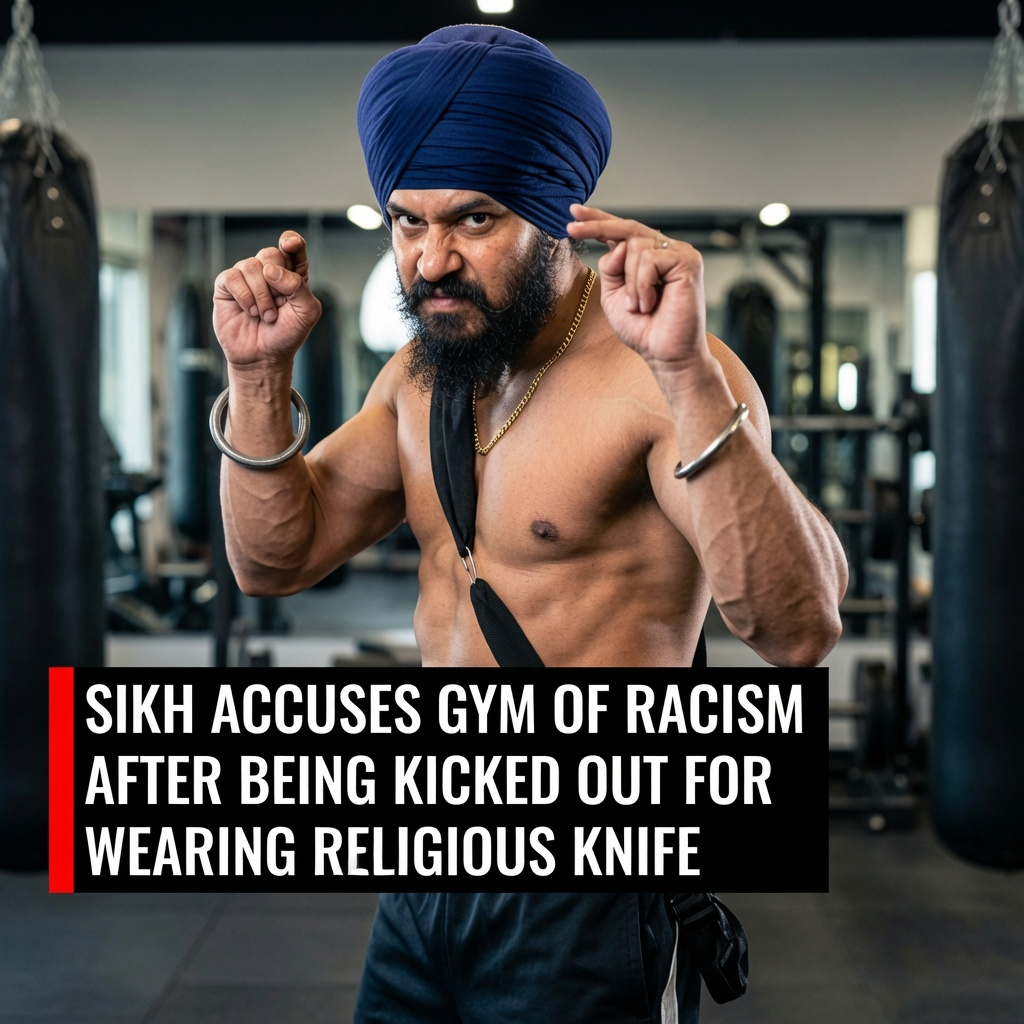
Gurpartap Singh Khalsa, a personal trainer and TikTok content creator, shared videos online after the July 15 incident at the GoodLife Fitness location on Dougall Avenue in Windsor, claiming he had been “racially singled out” because he was wearing the kirpan, a ceremonial dagger carried by many initiated Sikhs as one of the faith’s Five Ks.
The videos quickly attracted widespread attention across social media, with supporters arguing that Khalsa had been subjected to religious discrimination while others defended the gym’s decision as a reasonable response to safety concerns inside a private fitness facility.
In footage recorded during the encounter, Khalsa questioned why staff believed he represented a danger.
“You’re kicking me out of the gym right now because you are scared that I’m going to take my religious symbol and kill somebody?” he asked a female employee.
The employee responded that another member had alerted staff after noticing the blade.
“What I’m saying is you have a weapon on your person,” she replied. “A member has brought it to my attention, and for the safety of me and everybody else in the gym, I’m asking you to leave.”
When Khalsa challenged the decision, the employee added that the business was privately owned and could refuse entry.
According to Khalsa, the situation was particularly upsetting because he had already purchased a day pass and been admitted without objection.
In a follow-up TikTok video recorded outside the gym, he said he felt “heartbroken” by what had happened.
He explained that staff had initially allowed him into the facility while he was wearing both his turban and kirpan before later approaching him during his workout after another customer raised concerns.
Khalsa said he attempted to explain that Canadian law recognises the religious significance of the kirpan and provides legal protection for Sikhs who wear it as an article of faith.
According to his account, the employee questioned why others could not similarly carry firearms if religious daggers were permitted. Khalsa argued that the comparison was inappropriate because firearms are heavily regulated while the kirpan has long received legal accommodation in Canada under freedom of religion protections.
He also claimed staff threatened to call police if he refused to leave.
Khalsa said he remained at the gym waiting for officers to arrive, but ultimately left after police did not attend.
Following publication of the videos, online opinion quickly split.
Some commenters argued that gym operators have a responsibility to maintain an environment in which members feel safe, particularly when exercise equipment, crowded spaces and heavy weights are involved.
Others maintained that the kirpan is fundamentally misunderstood outside the Sikh community and should not automatically be viewed as a weapon simply because it contains a blade.
The incident has become another example of the difficult questions businesses sometimes face when religious practices intersect with workplace or customer safety policies.
GoodLife Fitness promotes diversity and inclusion as a core corporate value.
Its publicly available diversity, equity and inclusion statement says the company is committed to creating a community where “everybody – and every BODY – feels welcome,” describing diversity, equity and inclusion as “non-negotiable.”
As of the latest reporting, the company had not publicly released a detailed statement addressing Khalsa’s allegations specifically.
The kirpan occupies a unique place within Sikhism.
It is one of the Five Ks—five articles of faith traditionally worn by initiated Sikhs. Alongside uncut hair, a wooden comb, a steel bracelet and special undergarments, the kirpan symbolises the duty to defend justice, protect vulnerable people and stand against oppression.
For practising Sikhs, the kirpan is regarded as a sacred religious symbol rather than an offensive weapon.
Most are worn in a sheath and secured close to the body.
However, because they are bladed objects, kirpans have periodically generated legal disputes in countries attempting to balance religious accommodation with public safety.
Canada has long recognised significant legal protection for the kirpan.
One of the country’s landmark rulings came in 2006 when the Supreme Court of Canada decided Multani v Commission scolaire Marguerite-Bourgeoys.
The case involved a Sikh student prohibited from wearing his kirpan to school.
The Supreme Court ruled that an outright prohibition unjustifiably infringed religious freedom protected under the Canadian Charter of Rights and Freedoms.
Instead, the court concluded that reasonable safety measures—such as ensuring the kirpan remained secured and concealed—could address legitimate concerns without imposing a complete ban on religious practice. That decision has since become one of Canada’s leading precedents on balancing constitutional rights with safety considerations.
Even so, legal protection does not necessarily require every private organisation to permit kirpans in every circumstance.
Questions often depend upon the particular environment, applicable provincial human rights legislation, workplace health and safety obligations, and whether restrictions can be justified as reasonable and proportionate.
Those issues have periodically arisen in schools, court buildings, airports, sporting venues and private workplaces.
The Windsor dispute also arrives during heightened international discussion surrounding ceremonial blades following the widely reported murder of British teenager Henry Nowak.
That case prompted renewed political debate in the United Kingdom after offender Vickrum Digwa claimed connections between larger ceremonial-style blades and Sikh tradition.
Numerous Sikh organisations and legal commentators strongly rejected attempts to link the crime to mainstream Sikh religious practice, emphasising that the fatal weapon was distinct from the small ceremonial kirpan typically worn as an article of faith.
They argued that criminal misuse of a blade should not be conflated with lawful religious observance practised by millions of Sikhs worldwide.
That broader context has inevitably shaped public reaction to the Windsor incident.
For some observers, any visible blade naturally raises concerns about safety regardless of religious significance.
For others, assuming danger based solely on the presence of a kirpan risks reinforcing stereotypes and undermining long-established protections for religious minorities.
Legal experts frequently note that liberal democracies face recurring challenges when constitutional freedoms intersect with practical security considerations.
The answer rarely lies in treating either value as absolute.
Instead, disputes often revolve around whether a particular restriction is genuinely necessary, proportionate and based on objective evidence rather than fear or misunderstanding.
Khalsa has maintained that he was treated differently because of his appearance and faith, arguing that the incident left him feeling humiliated despite complying with Canadian law.
Supporters have described the encounter as an example of inadequate understanding of Sikh religious practices.
Others, however, believe the employee acted appropriately after responding to concerns raised by another customer, noting that businesses routinely intervene whenever members report behaviour or objects they perceive as potentially dangerous.
The debate illustrates how a single encounter inside a local gym has evolved into a much broader conversation about multiculturalism, religious accommodation and public confidence.
Canada is home to one of the world’s largest Sikh populations outside India, and legal protections for Sikh religious practices are generally well established.
At the same time, businesses continue to navigate practical questions about customer expectations, risk management and workplace safety in increasingly diverse communities.
Whether the Windsor incident ultimately leads to formal legal action remains unclear.
For now, it has become another prominent example of the ongoing challenge faced by institutions across many democratic societies: respecting deeply held religious beliefs while ensuring that policies designed to protect public safety are applied fairly, consistently and without discrimination.