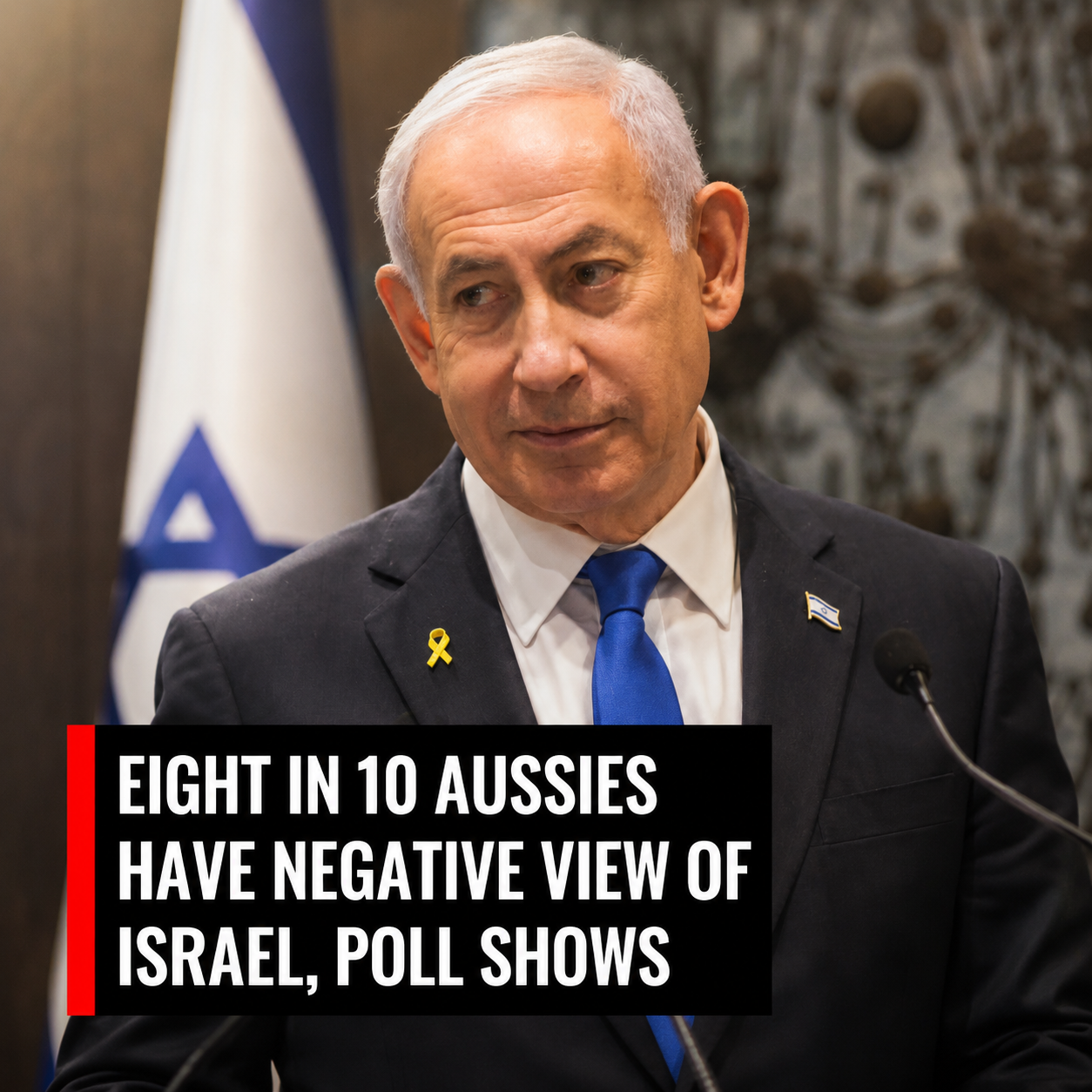
A major new poll has found that most Australians now hold a negative view of Israel, highlighting a dramatic shift in public sentiment that is increasingly shaping political debate across the country.
The findings suggest that attitudes towards Israel have deteriorated significantly, with roughly eight in ten Australians expressing an unfavourable opinion according to polling data cited in recent reports.
The results are particularly striking because negative views are no longer confined to one side of politics.
Large numbers of Australians across different age groups and political backgrounds now report unfavourable attitudes towards Israel.
The survey found especially strong negativity among younger Australians, while even many voters who identify as politically conservative expressed negative views.
The findings mirror broader international trends identified in recent global polling.
According to international research released this month, unfavourable views of Israel have risen across many Western countries, including Australia, with sentiment becoming increasingly negative compared with previous years.
The shift comes after years of intense public attention on conflicts involving Israel and Gaza.
Images, videos and reporting from the region have dominated social media feeds, television coverage and public debate.
As a result, attitudes that were once relatively stable appear to have changed significantly.
For many Australians, the issue has become impossible to ignore.
Public demonstrations have been held in major cities.
University campuses have seen heated debates.
Political leaders have faced pressure from both supporters and critics of Israel’s actions.
The new polling suggests these debates are having a measurable impact on public opinion.
One of the most notable findings involves younger Australians.
Polling consistently shows younger age groups are more likely to hold negative views of Israel than older generations.
Political analysts say this generational divide could have long-term consequences because younger voters are likely to shape Australia’s future political landscape.
If these attitudes remain unchanged, governments may face increasing pressure to adjust foreign policy positions over time.
The poll also challenges some traditional political assumptions.
Historically, criticism of Israel has often been associated with progressive or left-leaning voters.
However, the latest findings suggest negative sentiment now extends well beyond those groups.
Even among Australians who identify as right-wing, substantial numbers reported unfavourable views.
That suggests dissatisfaction is becoming broader and more politically diverse than in the past.
The reasons behind the shift are heavily debated.
Supporters of Israel argue public opinion has been influenced by selective reporting, social media campaigns and misinformation.
Critics argue growing opposition reflects genuine concern about military actions, civilian casualties and humanitarian conditions in conflict zones.
Regardless of the explanation, the polling indicates public attitudes have changed.
Recent Australian surveys on related Middle East issues have pointed in a similar direction.
Other polling has found significant public support for sanctions against Israel, while separate surveys showed many Australians disapproved of military actions involving Israel in the region.
Together, those findings suggest a broader trend rather than an isolated result.
The political implications are becoming harder to ignore.
Foreign policy is rarely a decisive issue in Australian elections.
However, public opinion can influence how governments respond to international events, diplomatic disputes and humanitarian crises.
Political parties are increasingly aware that Middle East issues now attract strong engagement from voters, particularly younger Australians.
That reality has already influenced parliamentary debates and public statements from politicians across the political spectrum.
Community leaders are also paying close attention.
Jewish organisations have expressed concern about rising hostility and increasing levels of antisemitism within parts of Australian society.
Recent inquiries and public hearings have highlighted fears among some Jewish Australians who believe anti-Israel sentiment is increasingly spilling over into hostility towards Jewish communities.
Others argue it is important to distinguish between criticism of a foreign government and prejudice against individuals based on religion or ethnicity.
That distinction has become one of the most contested aspects of the broader debate.
The new polling arrives at a time when Australian public opinion appears to be shifting on a range of international issues.
Voters are increasingly engaged with global events and often form views through social media, independent media and online communities rather than traditional news sources alone.
As information flows become faster and more fragmented, public attitudes can change more rapidly than in previous decades.
The result is a political environment where international conflicts can generate strong domestic reactions.
The latest poll suggests Israel has become one of the clearest examples of that phenomenon.
Whether those attitudes continue to harden or eventually stabilise remains uncertain.
What is clear is that public sentiment appears very different from where it stood only a few years ago.
For policymakers, community leaders and political parties alike, the findings represent another sign that Australian attitudes towards Israel are undergoing a significant transformation.
And with younger generations expressing some of the strongest views, the debate is unlikely to disappear anytime soon.






